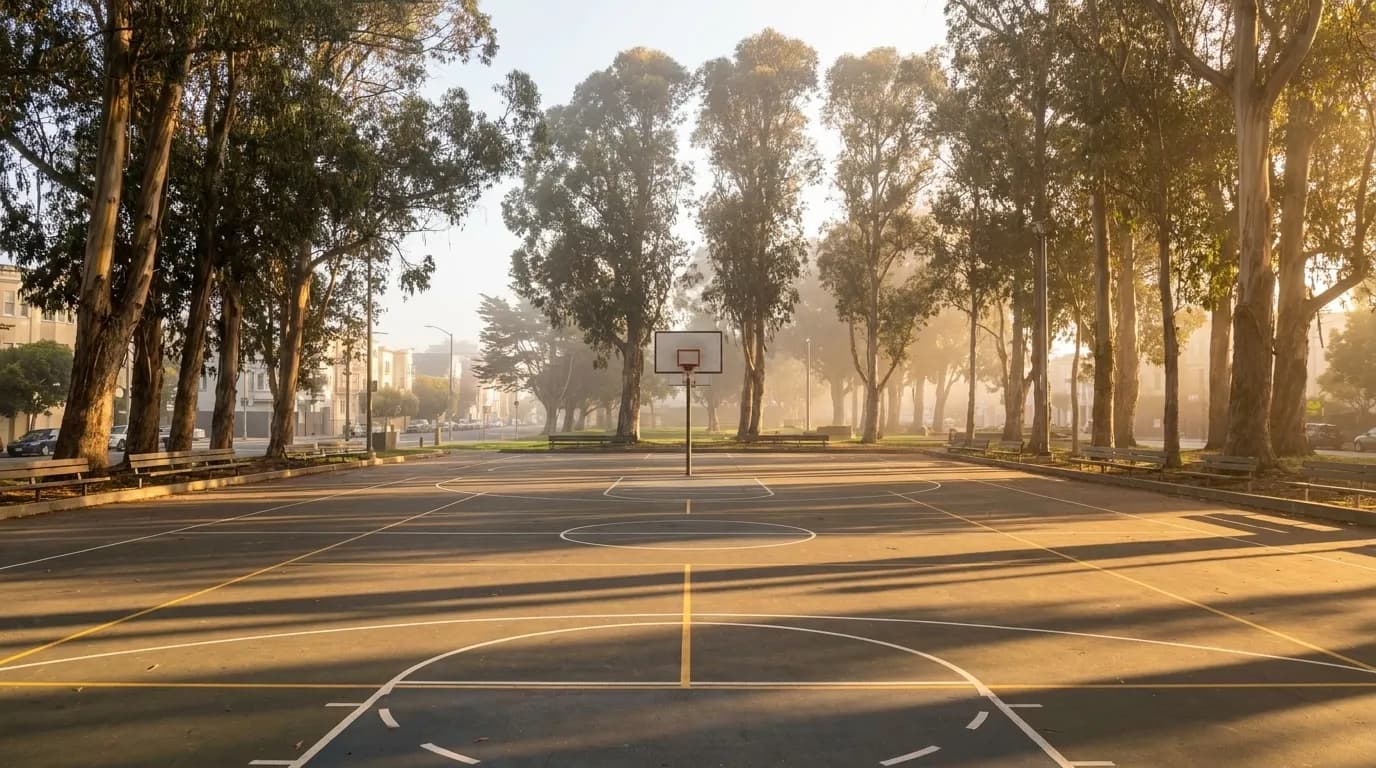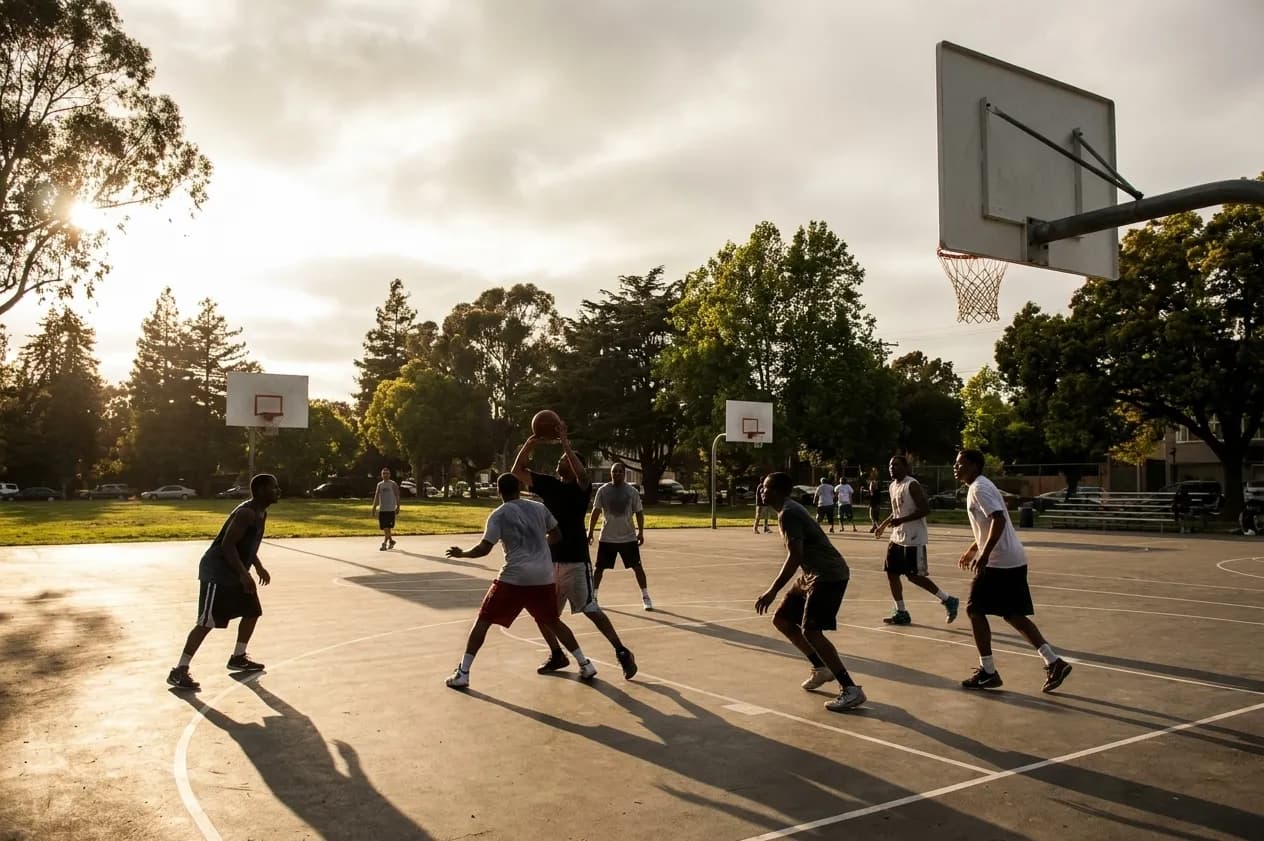
The concrete at Mosswood Park has absorbed decades of crossovers, trash talk, and the kind of competitive fire that turns neighborhood pickup games into proving grounds. On any given evening, the outdoor courts at 3612 Webster Street in North Oakland host runs where players battle with an intensity that rivals anything you'd see when the Fever face the Sky in a playoff atmosphere. This isn't recreational basketball—it's where Hall of Famer Gary Payton learned toughness as a kid, where Jason Kidd developed his court vision, and where serious hoopers still come to test themselves against whoever shows up ready to play.
Karpo knows the best times to catch competitive runs at East Bay courts and can guide you to lesser-known spots when Mosswood is packed.
Where NBA legends learned to battle
Gary Payton and Jason Kidd didn't become NBA All-Stars by accident. Both future Hall of Famers spent countless hours at Mosswood Park's outdoor courts, developing the toughness and court vision that would define their careers. The park sits at 3612 Webster Street in North Oakland, a four-acre green space where the asphalt runs hot and the competition never stops asking questions.
John Hill, who directs the Mosswood Recreation Center, remembers the 1970s and 80s when losing a game meant waiting until the next day to play again. Lines of players stretched across the park, everyone waiting for next. Hill and his crew would tour Bay Area courts after a loss here—Bushrod, Grove Street in South Berkeley, San Pablo Park, then up to Harmon where Cal played, over to Live Oak, then finally home. That circuit defined serious basketball in the East Bay.
The courts underwent a major refresh in 2024, courtesy of the Golden State Warriors Community Foundation and Kaiser Permanente. Festus Ezeli, who won a championship with the Warriors, cut the ribbon alongside Payton. The renovated surfaces feature crisp white square backboards and smooth concrete that rewards precise footwork. This marked the second time the Warriors invested in Mosswood, following their initial 2011 renovation when the team still played across the bridge.
The game that never ends
Walk onto Mosswood's courts on a weekday evening and you'll find variations of 21—a ruthless free-for-all where each player scores single-handedly against all others before adding free throws to their total. First to 21 wins, but the real competition is about proving you belong. The intensity mirrors what you'd see in a Fever vs Sky fourth quarter, except there's no shot clock and no one's getting paid.
The level of play fluctuates throughout the day. Serious runs tend to happen late afternoon through early evening on weekdays, when players coming off work bring their A-game. Weekends draw larger crowds but more variable skill levels. According to regulars, the best competition now happens sporadically rather than the all-day marathons of decades past. Hill notes that many current players focus on highlight-reel crossovers they've seen on social media rather than the fundamental toughness that defined earlier eras.
Mosswood earned its reputation as a basketball Mecca through generations of players who treated these courts like sacred ground. The park even appeared in EA Sports' NBA Street Vol. 2 video game in 2003, cementing its place in hoops culture beyond the Bay Area. Street-ball legend Demetrius 'Hook' Mitchell allegedly jumped over a Cadillac here during a dunk contest, the kind of mythology that separates legendary courts from ordinary playgrounds.
More than basketball
The Victorian mansion at the park's center tells Mosswood's deeper history. Built in 1864 in Carpenter Gothic style, the house belonged to J. Mora Moss and Julia Wood, whose combined names gave the park its identity when the site became public between 1909 and 1911. The estate-turned-park has hosted cultural events, pre-NBA basketball, and everyday Oakland life for over a century.
Beyond the four basketball courts, Mosswood offers baseball fields, tennis courts, a dog play area, community garden, amphitheater stage, and separate playgrounds for ages 2-5 and 5-12. Barbecue areas and picnic tables make it a genuine neighborhood hub. The recreation center, which began construction on a new facility in 2024 with completion expected by spring 2025, coordinates after-school programs and outdoor rentals.
The park's location at the edge of downtown Oakland, bounded by the Grove Shafter Freeway to the west and MacArthur Boulevard running through its center, makes it accessible but gritty. This isn't a sanitized suburban rec center. Gary Payton told kids at the 2024 court unveiling that in his day, coming to play here meant having gut and toughness because people would test you. That edge remains part of Mosswood's character.
The evolution of pickup culture
Payton, who now coaches at College of Alameda, sees the courts as essential for getting kids away from screens and back into physical competition. His message at the 2024 ribbon-cutting was direct: get off phones and PlayStations, get out of the house, grow up on the playground. The sentiment echoes what Festus Ezeli experienced after moving from Nigeria as a teenager—the park became where he made friends, learned basketball, and absorbed discipline.
Hill's observation about modern players imitating television moves rather than developing fundamental toughness reflects a broader shift in basketball culture. The game has changed everywhere, not just at Mosswood. But the bones remain—outdoor courts, open access, and the democratic principle that anyone can show up and prove themselves through play. No membership fees, no reservations, just ball.
The Warriors' continued investment in Mosswood demonstrates how professional sports organizations can maintain roots in the communities that shaped their players. While the team moved to San Francisco, their foundation keeps renovating Oakland courts where future generations might develop the same skills that made Payton and Kidd legends. The cycle continues, even if the intensity doesn't match the 1980s peak when losing meant a day-long wait for another run.
Practical notes
Mosswood Park is located at 3612 Webster Street in North Oakland, open daily for outdoor basketball and other activities. The courts are free and available first-come, first-served. MacArthur BART station sits about a mile southeast; the walk is manageable but includes a slight uphill grade. Street parking along Webster and nearby residential blocks is typically available. Bring your own ball—while pickup games often have players with equipment, counting on it is risky. The recreation center can be reached at 510-547-5032 for information about programs and facility rentals. Court lighting exists but verify functionality before planning night sessions, as outdoor court lights can be unreliable. The neighborhood requires standard urban awareness; go with a group if possible and keep valuables secured.
Tags: #MosswoodPark #OaklandBasketball #PickupHoops #StreetballLegends #EastBayBasketball #GaryPayton #JasonKidd #OutdoorCourts #BayAreaHoops #OaklandParks #FreeBasketball #WarriorsCommunity #NorthOakland #UrbanBasketball #HoopCulture
All trademarks are the property of their respective owners.
Ask Karpo first
Ask Karpo which East Bay courts are running right now, how to get from BART to Mosswood without the uphill walk, or where Gary Payton's current team practices at College of Alameda. Karpo tracks real-time park conditions and knows the pickup culture at every outdoor court from Berkeley to San Leandro.