 Dog Costume Parade Near Me in East Village: Boris and Horton
Free Things to Do
Morningside Park Waterfall and Cliff-Base Trail Loop: A Fresh Field Note
A narrow park clinging to Manhattan's schist escarpment, where a thirty-foot waterfall tumbles into a grotto and a shaded trail loops beneath Columbia's retaining wall—quietest on weekday mornings, greenest in spring.
Morningside Park doesn't sprawl. It clings. Wedged between Morningside Heights and Harlem, this narrow ribbon of green follows the natural drama of the Manhattan schist escarpment—a rocky spine that drops thirty feet in places and creates one of the city's few genuine elevation experiences you can walk in ten minutes. The centerpiece is a stone waterfall that tumbles into a shallow pond, misting the rocks below and turning the grotto cool even on humid afternoons. The loop trail that rings the lower park is shaded by London planes and sweetgums, used by local runners on weekday mornings when the place feels less like a destination than a neighborhood secret.
The Escarpment and Its Bedrock
The cliff face that defines Morningside Park is Manhattan schist—the same metamorphic bedrock, striped with mica and quartz, that supports the city's skyscrapers. You can see it best along the western edge of the park, where the rock breaks through in jagged outcrops and the retaining wall holding up Morningside Drive becomes less wall than geological exhibit. Geology students from Columbia use the park for field study, notebooks in hand, tracing the foliation patterns that ripple through the stone like frozen waves.
The escarpment runs roughly north-south, which means the lower trail spends most of the day in shadow—a feature that makes the loop one of the cooler walks in upper Manhattan come July. In spring the effect is different: dappled light, the cliff face still holding overnight chill, ferns unfurling in the crevices where moisture collects. April and May are the greenest months here, when the water volume peaks and the waterfall earns its name.
The Waterfall and Its Mechanics
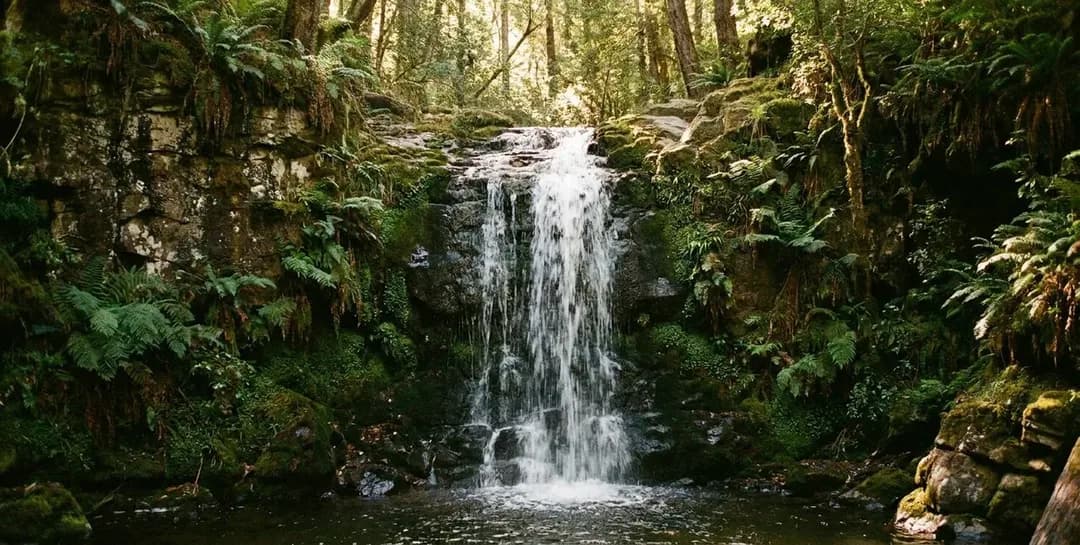
The waterfall is fed by city water on a timer—it runs on a seasonal schedule; verify current hours with NYC Parks before stating exact daily timer This is useful information if you're planning a visit: show up at seven-thirty on a weekday in November and you'll find a dry rockface and a quiet pond. Show up at nine on a Saturday in May and the cascade is in full voice, white threads braiding down the stone into a pool that reflects the canopy above.
The grotto at the base is the park's acoustic center. Water hitting rock creates a low, steady hiss that drowns out traffic noise from both Morningside Drive and Manhattan Avenue. Spray mists the boulders closest to the fall, keeping them slick and dark even in dry weather. In late spring, when the timer runs longer and the flow is strongest, you can feel the cool draft ten feet away. It's one of the few places in the city where water does the work of air conditioning.
The Pond and Its Amphibious Residents
The pond at the waterfall's base is shallow—eighteen inches at its deepest—and bordered by smooth stones that double as informal seating. In early spring it hosts wood frogs, small amphibians whose calls sound less like ribbits than quacking ducks. The chorus is loudest in March, audible from the lower trail before you even see the water. By April the frogs have moved on, but the pond remains a hub: sparrows bathing at the edges, joggers pausing to stretch, the occasional heron threading between the rocks at dawn.
The water is recirculated, which keeps it clearer than you'd expect for a city pond, though algae blooms by midsummer and the surface takes on a greenish cast. The frogs don't seem to mind. Neither do the red-eared sliders that bask on the larger stones when the sun breaks through the canopy, their shells dry and geometric against the wet rock.
The Lower Trail and Its Rhythms
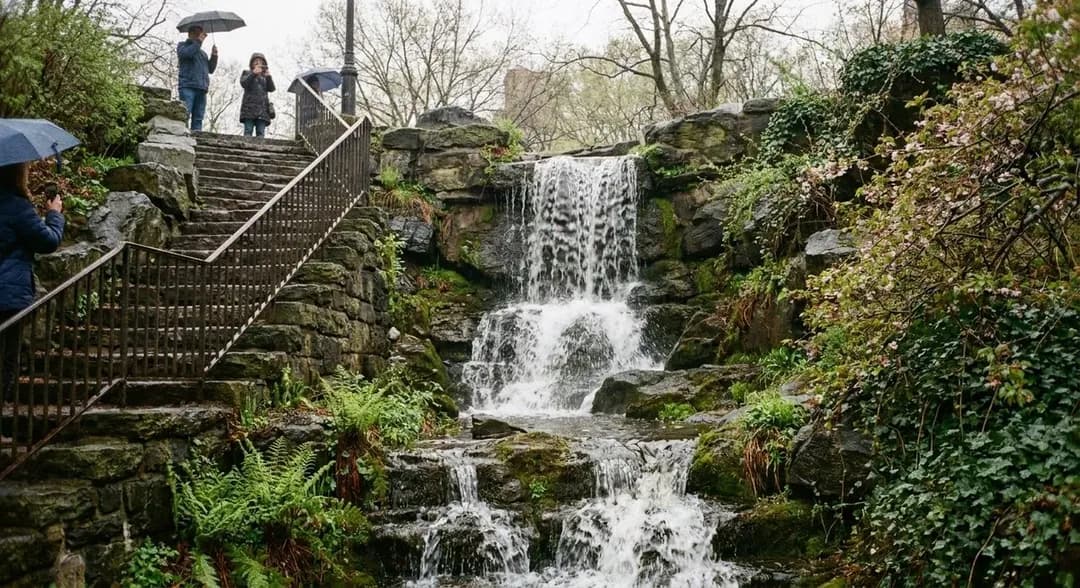
The loop trail begins near the 116th Street entrance on Manhattan Avenue, descending via stone steps into the park's lower basin. The path is asphalt, wide enough for two runners to pass, narrow enough to feel intimate. It curves north beneath the escarpment, passing the waterfall and pond, then swings south through a grove of oaks before climbing back to street level near 110th. The full circuit is just under a mile.
Weekday mornings are the quietest window—seven to nine, before the park fills with students and dog walkers. Local runners know this, and you'll see the same faces looping the trail, earbuds in, breath visible on cool mornings. By afternoon the tenor shifts: kids on the playgrounds near 116th, pickup basketball games echoing from the courts, the benches along the upper path occupied by regulars who've claimed their spots for years. It's a working park, used hard, which gives it texture that purely ornamental greens lack.
The Upper Overlook and the View East
Morningside Drive traces the top of the escarpment, and the overlook near 116th offers a view east across the park and into Harlem. The perspective is unusual: you're looking down at treetops, rooftops, the waterfall's plume rising from the green below. On clear days the sightline extends to the towers of the East Side, hazy and distant. On overcast mornings the view compresses, and the park feels like its own microclimate—cooler, quieter, a pocket of weather distinct from the blocks around it.
The overlook benches are prime real estate at sunset, when the light rakes across the stone and turns the schist gold. Bring a book, bring coffee, bring nothing—it's among the free things to do in the city that require only your presence. Spring evenings, when the waterfall is running and the ferns are bright along the cliff, the place earns its reputation as one of upper Manhattan's underrated landscapes. Summer evenings it's cooler here than anywhere else within ten blocks. That's reason enough.
Practical Notes
Morningside Park runs from 110th to 123rd Street between Morningside Drive and Morningside Avenue Nearest subway: 1 to 116th Street–Columbia University Street parking is metered; the lot at 116th and Broadway is a ten-minute walk. The park is open dawn to dusk year-round; the waterfall timer runs 8 a.m. to 8 p.m. April through October, weekends only in winter. The lower trail is paved but steep in sections; the upper path along Morningside Drive is level and accessible. Bring water in warm months; the grotto stays cool but the climb back up does not. Verify seasonal schedules with NYC Parks before planning around the waterfall.
Tags: #MorningsidePark #WestHarlem #MorningsideHeights #NYCParks #ManhattanSchist #HiddenNYC #FreeAndFine #UrbanNature #SpringInNYC #NYCTrails #ColumbiaUniversity #HarlemWalks #UpperManhattan #NYCWaterfalls #CityHiking
All trademarks are the property of their respective owners.
Ask Karpo for more information.
Keep reading
- Dog Costume Parade Near Me in East Village: Boris and Horton
 Dog Costume Parade Near Me in Astoria: Château le Woof
 Dog Costume Parade Near Me on Upper West Side: Black Lab Cafe