A Museum the Size of a Closet
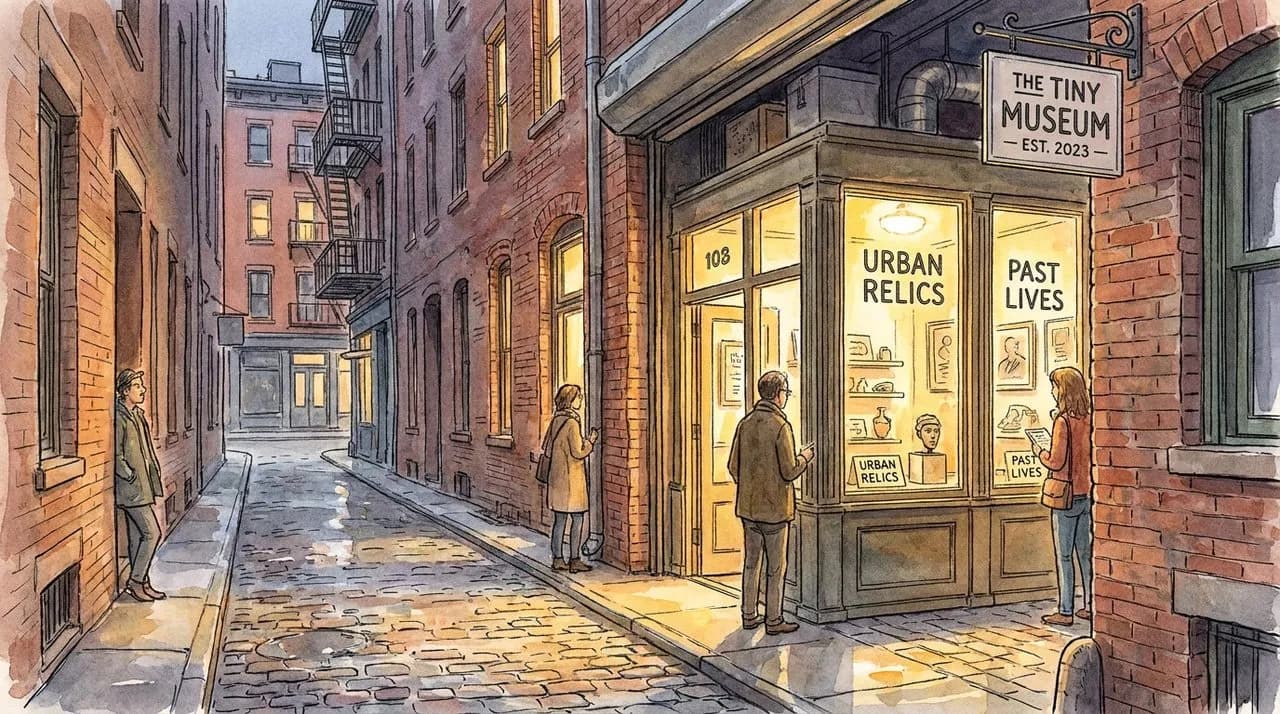
On a narrow Tribeca side street called Cortlandt Alley, between Franklin and White, there is a steel-shuttered storefront that opens to reveal a six-by-six-foot room. The room is a museum. It is called Mmuseumm. The double-M is intentional.
The space was a working freight elevator before its current life. It is now one of the smallest museums in the world that issues press releases. Inside: glass shelves, internally lit, holding what the founders call "the modern artifacts of contemporary civilization." Outside: three small windows so the institution is, in effect, always open. Free.
Mmuseumm was founded in 2012 by the filmmaker Alex Kalman with the brothers Josh and Benny Safdie. It runs in seasons, like a theater. Each season a new set of curated micro-collections goes in.
What's in the Vitrines
The objects are everyday and exact. A collection of toothpaste tubes from countries that have banned each other. A grid of the disposable cutlery that an airline used over forty years. A vitrine of the personal effects an asylum-seeker carried across a border, on loan from the family. A grid of fake vomit, the kind sold at novelty stores, sourced from twelve countries.
Each object has a typed label, mounted at eye level, written in the museum's house style — clinical, brief, with no decorative adjectives. The labels do the work. The objects, having been chosen by Kalman and his guest curators with extraordinary care, do the rest.
The animating idea is that the smallest, most disposable things made by humans are the things that say the most about what humans are doing. Mmuseumm is, in effect, a serious institutional response to that idea.
How to See It
There are two ways. The first is to walk by. The shutter is up most days, the lights are on, the windows are at street height, and you can read the labels from the sidewalk. The whole experience takes ten minutes. It is free, twenty-four hours a day, and it is the easiest art encounter in lower Manhattan.
The second is to step inside. Mmuseumm opens its door on weekend afternoons in season — typically April through November, Friday through Sunday, hours posted on the door. Two visitors at a time. A docent, often a graduate student or working artist, walks you through. A printed gallery guide costs a dollar.
The door is unmarked. Cortlandt Alley itself is unmarked. You find it by walking south from Canal Street on Lafayette and turning west onto the alley, or by walking east on Franklin and turning into the cut. The address is 4 Cortlandt Alley.
The Sister Space
Two doors down, at 7 Cortlandt Alley, the same team operates a slightly larger annex called Mmuseumm 2. It is a one-room reconstruction of the kitchen and living room of Lana Turner — the founder's mother, the late designer and artist. The room is shown as it was lived in. The radio still works. The books are arranged the way she arranged them.
Mmuseumm 2 is also visible from the street through a single window, and it can be entered on the same weekend schedule. It is one of the most affecting small rooms in the city, and a quiet argument that a person's actual interior is a more honest museum than most.
Why Mmuseumm Works
The micromuseum format is not new — Wunderkammers go back four centuries — but Mmuseumm's specific success is its tone. It takes its subject seriously without taking itself seriously. The labels are dry. The curation is rigorous. The acquisition program is real — Mmuseumm has a board, a budget, a permanent collection in a climate-controlled storage facility uptown, and a registrar.
What it does not have is an admission charge, a gift shop with branded tote bags, or a wing named after a donor. The smallness is the discipline.
This is the through-line that connects Mmuseumm to the broader Tribeca art ecology of the 1990s — Walter De Maria's Earth Room, the Broken Kilometer, the Drawing Center, the small artist-run lofts that have largely vanished. Mmuseumm is what happens when that ethic survives into a much more expensive neighborhood: smaller, harder, still open.
When to Go
The season runs roughly April through November. In the winter, the shutter is sometimes down, but the windows are usually still lit. The best time is a weekend afternoon when the door is open and you can step inside — call it the difference between reading about something and standing in the room.
A visit pairs naturally with a walk through Tribeca: lunch at Bubby's on Hudson, a stop at the Drawing Center on Wooster, a slow loop back through the cast-iron streets of SoHo. The whole afternoon is a Lower Manhattan that is mostly intact.
The Quiet Argument
The largest American art museums are getting larger. The Met has annexed a wing. MoMA expanded sideways. Even the Whitney, by relative standards small, occupies a building larger than most European national museums. Bigger collections, bigger crowds, bigger ticket lines, bigger gift shops.
Mmuseumm is the counter-argument. It says: a museum is not a building. A museum is a way of paying attention to objects. If you do it well enough, you can fit one inside a freight elevator.
People have been doing it well enough on Cortlandt Alley for over a decade.
Practical notes
- Address: 4 Cortlandt Alley, Tribeca, New York, NY 10013. Mmuseumm 2 is at 7 Cortlandt Alley.
- Getting there: Subway to Canal Street (J/N/Q/R/W/6). Walk one block south on Lafayette, turn west into the alley.
- Hours: Outside windows: 24/7 when shutter is up. Inside: Friday–Sunday afternoons, in-season (roughly April–November). Check the door.
- Admission: Free. A printed guide is $1.
- Don't miss: The toothpaste collection, the asylum-seekers' belongings, the Lana Turner room at Mmuseumm 2.
- Pairs well with: A walk through Tribeca and SoHo, the Drawing Center on Wooster, the Earth Room on Wooster.
#mmuseumm #tribecanyc #nycoddities #smallmuseums #nycart #cortlandtalley #lowermanhattan #manhattanmuseums #microculture #oddedit #karpofinds #hiddennyc #nyclocalknowledge #weekendnyc #freenyc
Sources consulted: Mmuseumm · The New York Times · Atlas Obscura · Mmuseumm 2 · The Cut
All trademarks are the property of their respective owners.