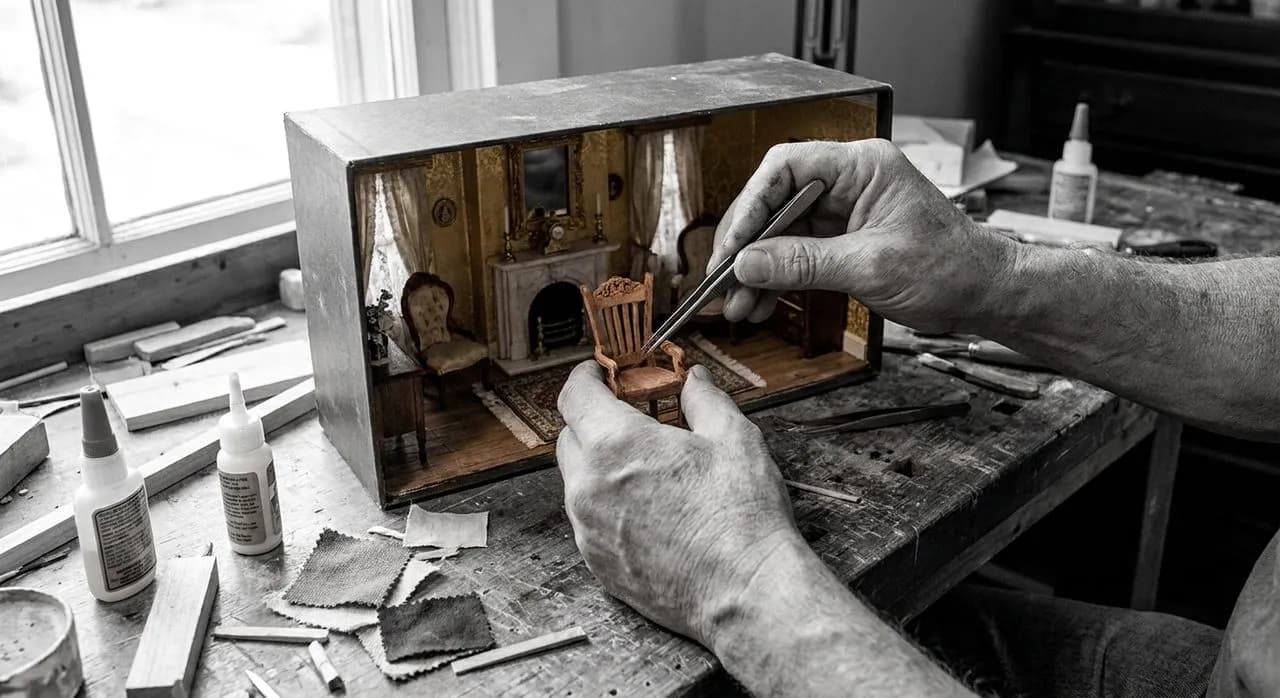
The magnifying lamp casts a pool of white light across a worktable scattered with basswood shavings, tweezers, and pots of paint no larger than thimbles. Beneath the lens, a miniature Windsor chair takes shape, its spindles thin as toothpicks, its seat barely wide enough for a dime. This is the kind of precision work that unfolds in a Bay Ridge row house basement, where an artist spends her days building entire rooms—parlors, kitchens, bedrooms—that fit inside frames you could hang with two hands. It's meticulous, slightly obsessive, and oddly moving: proof that scale has nothing to do with emotional weight.
A workshop built for small wonders
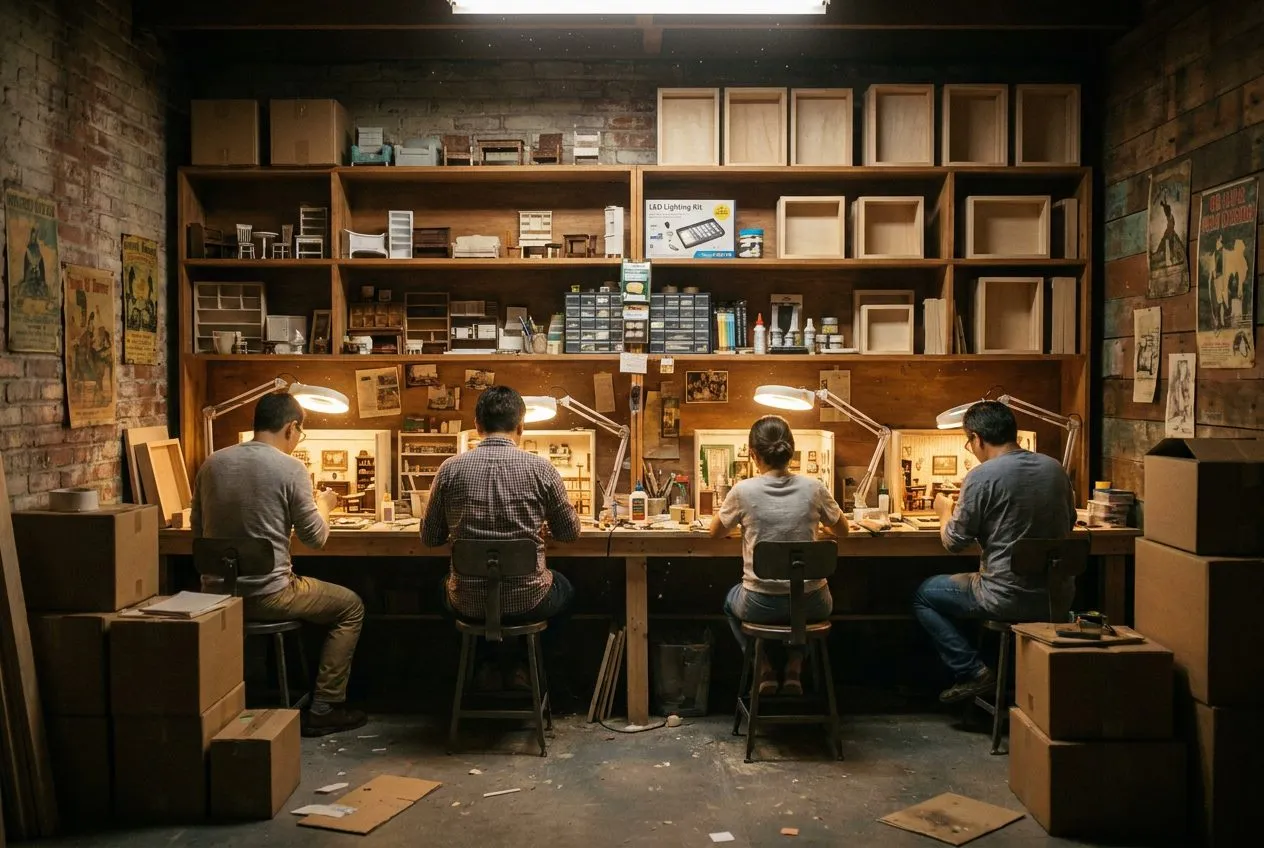
The studio occupies a finished basement with drop ceilings, fluorescent tubes, and metal shelving stacked with boxes of miniature trim, fabric scraps, and LED components. It smells faintly of wood glue and sawdust. The artist—a former set designer who pivoted to miniatures after years building full-scale theatrical backdrops—works at a counter lined with X-Acto blades, calipers, and jars of pigment. Her tools are jeweler-grade, her patience monastic.
The dioramas and shadow boxes she creates range from nostalgic recreations of childhood bedrooms to surreal, dreamlike vignettes: a library where books spill into clouds, a greenhouse with vines that curl around invisible walls. Some commissions arrive with photographs and floor plans; others begin with a mood, a color, a fragment of memory. She translates them all into three-dimensional miniatures, complete with forced-perspective backdrops that make a twelve-inch frame feel like a portal.
The economics of tiny furniture
Custom shadow boxes start at three hundred eighty dollars for a twelve-by-twelve-inch frame—a baseline that includes a simple interior scene with painted walls and basic furnishings. LED lighting adds forty-five dollars, a worthwhile investment for pieces meant to glow softly on a dim shelf or mantel. Hand-carved miniature furniture—chairs, tables, bookcases—adds thirty to sixty dollars per piece depending on detail. A four-poster bed with turned posts and a quilted coverlet will cost more than a simple stool. It's bespoke work priced accordingly, though still within reach for anyone willing to commission a keepsake rather than buy mass-market decor.
The pricing reflects hours, not materials. A single chair might take an afternoon. A full room—wallpapered, furnished, lit—can stretch across weeks. Clients tend to understand this. They're not buying tchotchkes; they're buying time made visible, memory made tangible.
A grandmother's kitchen, grain-of-rice bulb included
On the top shelf of the studio, nestled between reference books and a roll of copper wire, sits the artist's personal diorama: a recreation of her grandmother's Bensonhurst kitchen circa nineteen fifty. The miniature appliances—a white enamel stove, a rounded refrigerator—are painstakingly accurate, down to the chrome handles and the checked linoleum floor. A working light bulb the size of a grain of rice hangs from the ceiling, powered by a hidden battery pack. It glows with the faint warmth of an incandescent filament, a technical feat that took weeks to engineer.
She built it as a test piece, a proof of concept, but it's become something more: a talisman, a tiny monument to a place that no longer exists. Visitors to the studio always ask about it. She always lights it up for them.
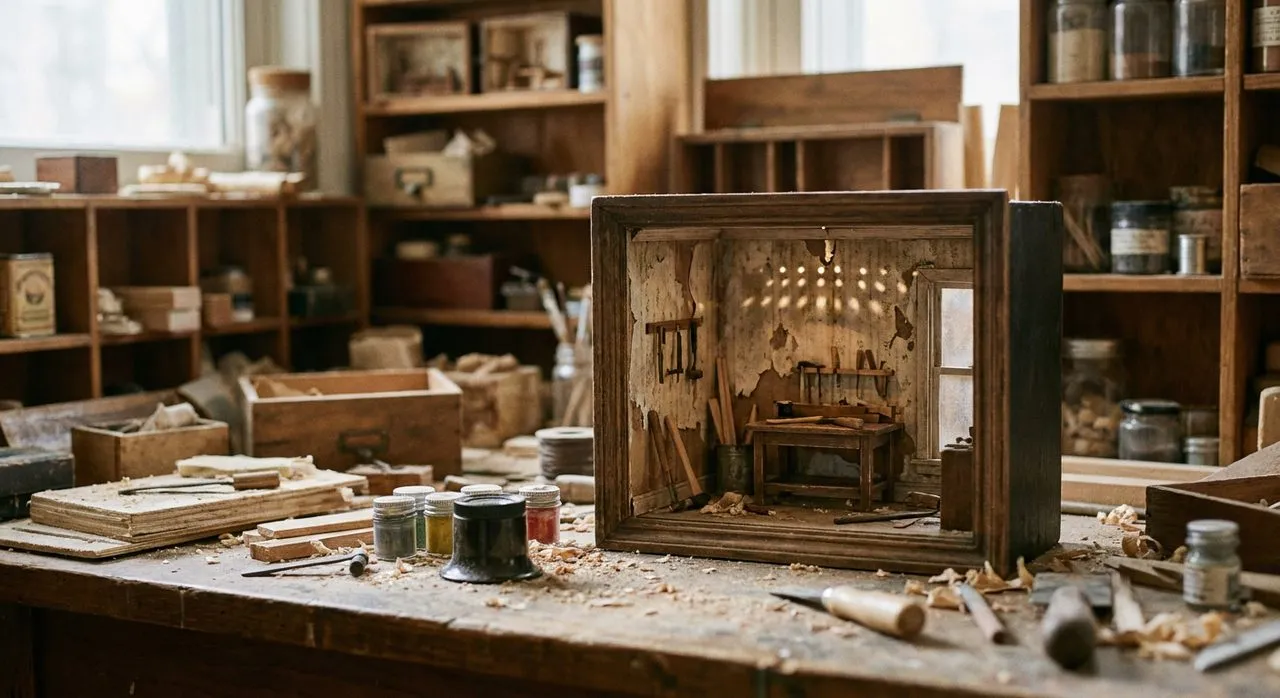
Open studio: tea, carving demos, and quiet conversation
The open studio runs on the first Sunday of each month from one to four in the afternoon, a standing invitation for the curious and the nostalgic. The artist demonstrates carving techniques at her worktable—how to score a plank, how to sand a curve without splintering the grain—and discusses commission concepts with visitors over tea. It's low-key, unhurried, the kind of afternoon that feels like a city guide secret even though it's technically public. Ring the side door bell; she'll buzz you down.
Most visitors arrive with questions: Can you recreate my childhood bedroom? Can you build a scene from a photograph? Can you make it look old, distressed, like it's been sitting in an attic for decades? The answer is almost always yes. She's developed techniques for aging paint, distressing wood, even building hidden compartments into frames—tiny drawers that slide out to reveal love letters, pressed flowers, whatever the client wants tucked away.
The appeal of forced perspective
Forced perspective is the trick that makes these shadow boxes sing. The artist paints backdrops on thin panels set inches behind the main scene, using subtle gradations of scale and color to suggest depth. A hallway recedes into darkness. A window opens onto a painted garden that seems to stretch for yards. It's the same technique used in theater and film, scaled down to fit a frame you could carry under one arm.
The effect is quietly magical. Stand too close and the illusion fractures; step back and the room coheres, becomes believable. It's a reminder that art doesn't need to be large to be immersive, that intimacy and grandeur aren't opposites. Some of her best work measures less than a foot in any direction.
Commissions, nostalgia, and the business of memory
Most commissions arrive trailing stories. A client wants the apartment where she lived during her first year in New York, before the landlord gutted it and doubled the rent. Another wants his grandmother's sewing room, complete with a miniature Singer and spools of thread. A third asks for something stranger: a Lynchian bedroom where the proportions don't quite add up, where the door is too small and the bed too large. The artist accommodates all of it, adjusting her style to match the client's vision.
She's learned that people don't just want accurate recreations; they want emotional accuracy, the feeling of a place more than its literal dimensions. A childhood bedroom should feel vast, even if it was only ten by twelve. A grandmother's kitchen should smell—metaphorically—of bread and coffee. She builds that into the work: the tilt of a chair, the warmth of the paint, the way light falls across a miniature floor.
Practical notes
The studio is located in a Bay Ridge row house; exact address provided upon inquiry for open studio dates. Nearest subway is the R train to Bay Ridge Avenue, about a ten-minute walk; street parking is generally available on weekends. Open studio runs the first Sunday of each month from 1–4 p.m.; ring the side door bell. The basement is accessible via a short flight of stairs—not wheelchair-accessible, unfortunately. Commissions can be discussed in person or via email. Bring photos or sketches if you have a specific vision; otherwise, come with questions and curiosity. No fee to visit during open studio hours.
Tags: #MiniaturesNYC #ShadowBoxArt #BayRidgeFinds #NYCArtStudio #HandmadeMiniatures #DioramaArt #BrooklynArtists #TheOddEdit #TinyWorlds #CustomShadowBox #ArtisanCrafts #HiddenNYC #CityGuide #BespokeArt #Winter2026
Sources consulted: Diorama · Bay Ridge, Brooklyn · Miniature Art · Brooklyn Parks · Time Out New York Arts
All trademarks are the property of their respective owners.