 MiMo District Free Indoor Weekend Plan Finder for Retro Fans
Free Things to Do

Sculpture Garden Near Me in Coral Gables: The Lowe's Free Campus Sculpture Walk
The Lowe Art Museum at 1301 Stanford Drive in Coral Gables is free, opens Wednesday to Saturday from 10 am to 4 pm, and looks after more than 30 outdoor sculptures spread across the University of Miami campus. Here is a walking order, where to park for $2.75 an hour, and what is on view inside this fall.
The Lowe Art Museum at 1301 Stanford Drive in Coral Gables charges nothing at the door, opens Wednesday through Saturday from 10 am to 4 pm, and is the keeper of more than 30 outdoor sculptures scattered across the University of Miami campus. If you searched for a sculpture garden near me in South Miami-Dade, this is a free one with a twist: instead of a single walled yard, the garden is the whole campus, and the Lowe's own front lawn is the first room.
Miami-Dade's First Collecting Art Museum
The museum started on February 22, 1950, when the University of Miami opened a "University Art Gallery" inside the Merrick Classroom Building, the first professional art exhibition space in Miami. Philanthropists Joe and Emily Lowe then paid for a separate building, and the Lowe Art Gallery was dedicated on February 4, 1952. It became the Lowe Art Museum in 1968, and in 1972 it was the first museum in Miami-Dade to win accreditation from the American Alliance of Museums.
The collection now runs to nearly 19,500 objects covering more than 5,000 years. Outside, the university formalized its Public Sculpture Collection in 2001 to push art beyond the museum grounds, and the Lowe still oversees it under Coral Gables' Art in Public Places rules. The museum even calls the campus a "fine developing sculpture garden," which is a fair description.
Start on the Lowe's Own Lawn
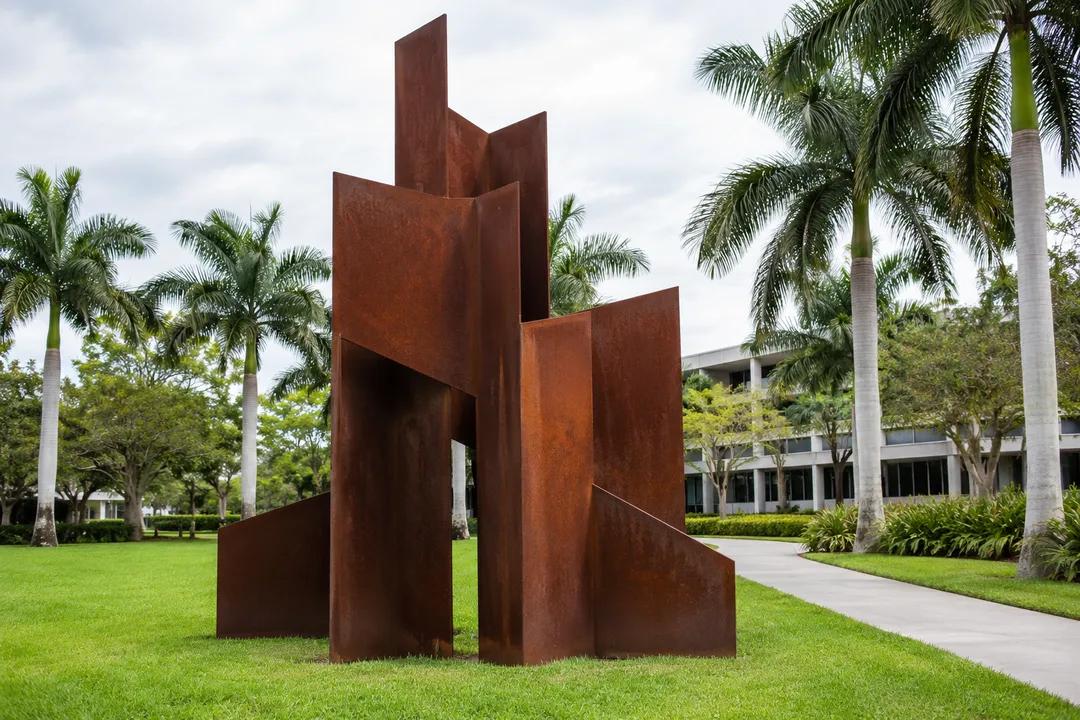
Begin right outside the museum, where several pieces cluster. John Henry's Snapper Creek from 1982 is made of painted aluminum. Del Geist's Quadriplate V from 1980 is a set of Cor-ten steel plates that has weathered to a deep rust, and Hans Van de Bovenkamp's Circles and Waves XX from 1987 mixes Cor-ten with paint.
The museum's own grounds also hold something older in spirit: a pair of Chinese marble lion dogs, male and female, carved around 1980, and schist reliefs of the Buddha with attendant bodhisattvas. They make a striking contrast with the American steel sharing the same grounds.
A Walking Order Across Campus
From the Lowe, head to the Campus Green, which holds the strongest group. Beverly Pepper's painted-steel Ascension/Descension dates to 1974 and 1975, Joel Perlman's Big Diamond to 1982, and Ralph Provisero's Pietra Veloce, in steel and slate, to 2003. Tony Rosenthal is here too with an aluminum Barbell, painted and undated.
Then loop past the Business School for Chryssa's Large Metal B, made around 1958, and Elisa Arimany's painted-steel Hem Fet El Cim from 1990. The Whitten University Center has Rotraut Klein-Moquay's playful aluminum Tête-à-Tête from 2001, and the Ashe Building holds Fletcher Benton's Donut with Balls Number 28. The Lowe's printed Guide to Public Sculpture on Campus, published in November 2019, has the full map.
The Newest Arrival Behind Merrick
In early 2026 a seven-meter steel sculpture by American artist Jedd Novatt, titled Chaos Herrirako Atea, appeared behind the Merrick Building, as the student paper The Miami Hurricane reported in March. Because it is not on the 2019 map, it is easy to miss, so make it the last stop of the walk. Nearby, the Merrick Building also holds Herzl Emanuel's 1981 bronze Homage to Dr. Janusz Korczak.
Other quieter stops include Efraín Recinos' bronze Siren in the Clouds at the Memorial Classroom Building, Agustín Cárdenas' marble La familia from 1989 at the School of Nursing, on loan from the Ella Fontanals-Cisneros Collection, and Ralph Hurst's cement Don Quixote de la Mancha from 1978 at the music school. Science fans can detour to the Physics Quadrangle for Olivier Seguin's stone Brote, or Sprout, from around 1960, then to Pentland Tower for Jean Claude Rigaud's painted-steel Composition in Circumference and to the McArthur Building for Joel Perlman's 1990 Island Star, his second piece on campus.
Inside the Museum This Fall
General admission is free thanks to Beaux Arts, the museum's support group, and the ticket covers every gallery and special exhibition. Advance timed tickets are strongly recommended, because walk-ins can be turned away at capacity, and groups of 10 or more must register ahead. This autumn, Helen Frankenthaler and her circle fill Let the Picture Lead through February 6, 2027.
Also on view are Dustin Yellin: Psychogeographies, through August 7, 2027, and Morel Doucet: The Things We Carry, through March 27, 2027. On October 23, 2026, Young, Gifted, and Black opens with more than 50 works from the Lumpkin-Boccuzzi Family Collection. Indoors, the Palley Pavilion holds a glass collection with work by Dale Chihuly.
Rules and Timing
Inside, non-flash photos for personal use are fine, but video, tripods, monopods and selfie sticks are not. Sketching is allowed with pencils and a moderate-sized notepad only. Backpacks, umbrellas, laptops and any bag bigger than 11 by 14 inches go to storage. There is no café and no gift shop, so bring water for the campus walk, and remember the whole campus is smoke-free.
Galleries close about 15 minutes before 4 pm, so arrive by 2:30 pm to see the inside and still have daylight for the outdoor loop. The museum is closed Sunday through Tuesday and on university holidays, including Veterans Day and Thanksgiving. On a Sunday the sculptures are still outdoors, but you lose the museum, so a Saturday morning is the best plan.
Parking and Metrorail
Visitor parking is easiest at the Pavia Garage, 5615 Pavia Street, which the Lowe calls the most guaranteed option: take Stanford Drive past the university gatehouse and make the second left. University metered parking costs $2.75 an hour or $14 a day, paid by PayByPhone or at a pay station, and on weekdays from 8 am to 4 pm visitors must use the marked visitor section.
Without a car, ride Metrorail to University station, then take the free University of Miami shuttle to the museum or walk about eight minutes. The Lowe describes the train as the best public transit option.
Practical Notes
Address: Lowe Art Museum, 1301 Stanford Drive, Coral Gables, FL 33146. Hours are Wednesday to Saturday, 10 am to 4 pm. Admission is free with an advance timed ticket recommended. The outdoor sculptures are spread across the campus and can be seen free. Parking at the Pavia Garage is $2.75 an hour.
Ask Karpo for more information.
Keep reading
- MiMo District Free Indoor Weekend Plan Finder for Retro Fans
 Coral Gables Free Indoor Weekend Plan Finder for Book Lovers
 South Beach Free Indoor Weekend Plan Finder for Rainy Days