 MiMo District Free Indoor Weekend Plan Finder for Retro Fans
Free Things to Do

Sculpture Garden Near Me in Miami Beach: The Holocaust Memorial on Meridian Avenue
The Holocaust Memorial Miami Beach, at 1933-1945 Meridian Avenue, is a free outdoor memorial garden built around Kenneth Treister's bronze Sculpture of Love and Anguish. It is open every day from 10 am until sunset, takes about 90 minutes to walk, and is recommended for ages 10 and up.
The Holocaust Memorial Miami Beach is free, outdoors and open every day of the year from 10 am until sunset at 1933-1945 Meridian Avenue. It is not a sculpture garden near me in the leisurely sense: it is a memorial to the six million Jews killed in the Holocaust, built by the architect and sculptor Kenneth Treister as a sequence of outdoor spaces around a four-story bronze arm. Allow about 90 minutes, and the memorial recommends it for visitors aged 10 and older.
How Survivors Built It
In 1984 a small group of Holocaust survivors began planning a permanent memorial in Miami. South Florida then had one of the largest survivor populations in the United States, estimated at 20,000 to 25,000 people, many living in Miami Beach itself. A Holocaust Memorial Committee formed as a nonprofit in 1985.
The site's street numbers, 1933 to 1945, match the years of the Nazi regime exactly, and the memorial's history page says many supporters took the coincidence as bashert, or fate. Not everyone agreed. Some residents argued that a vacation city should stay about sun and fun, and a Garden Club member said, "Gloom is doom!" On November 27, 1984, about 500 people packed the Miami Beach Planning Board meeting, survivors among them. The board approved the plan unanimously, and the City Commission followed eight days later.
Treister's Sculpture of Love and Anguish
Treister was commissioned in 1985 to create a memorial garden that would give survivors "a place to visit in lieu of the cemetery they do not have." His centerpiece is an outstretched arm rising from the earth, tattooed with a number from Auschwitz, with hundreds of small human figures clinging to it and to each other. Critics called it grotesque. Survivor and committee member David Schaecter answered, "Would he find it acceptable for me to stand on a street corner and weep?"
The bronze was cast at the Fundición Artística foundry in Mexico City between 1987 and 1989. The arm was made in five interlocking slices and trucked to Miami Beach, and Treister gave each figure its own patina in blues, greens, browns, golds and oranges, so no two faces match.
Walking the Memorial
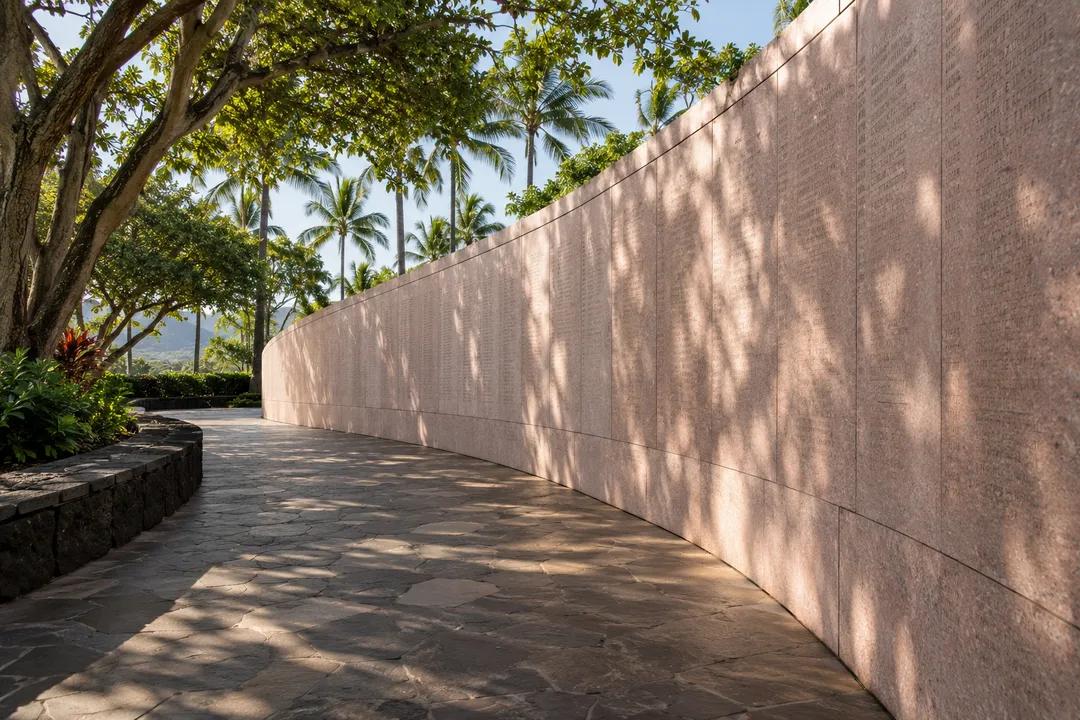
The visit is designed as a procession of visual, historical and emotional experiences, in Treister's words, rather than a single object to photograph. Pink-hued Jerusalem stone, shipped from Israel, forms the foundation. Photographs and inscriptions tell the history of the Holocaust along the way before you reach the central pool and the arm.
The Memorial Wall lists thousands of names, and families and survivors continue to add more. A searchable directory on the memorial's website shows which panel holds a given name, so look it up before you go if you are visiting for a relative.
Details Most Visitors Miss
Treister's early sketches already showed emaciated people reaching out for help, a naked woman holding her baby, and a small child huddled and crying under a blanket, In the finished work hundreds of small figures cling to the arm and to each other, so walk the circle slowly enough to see the faces one by one.
The building of the memorial has its own small stories. Treister described the Mexico City foundry as a dark, cavernous space with wax body parts floating in water and smoke from brick furnaces, and he called the project the greatest challenge of his career. While the Jerusalem stone waited to be set, a founding member named Resnick guarded it overnight, his family later said, afraid that thieves would take the costly blocks.
Dedication in 1990
The memorial took more than four years to build. It was dedicated on Sunday, February 4, 1990, with Elie Wiesel, the Nobel laureate, as guest speaker. "I hope that visitors will bring their children," he said. "Look at all the faces."
That line still describes the crowd. On weekdays you will see school field-trip groups led by volunteer docents, and older visitors searching the wall for a family name. The memorial also runs 3GMiami, a program that trains grandchildren of survivors to speak to students, so some groups hear a family story told in person.
Rules and Etiquette
Tickets are not required. Bicycles and pets are not permitted, though service dogs are welcome after an email to the memorial. The memorial asks that you not bring food onto the property. Groups of 10 or more need a reservation.
Be honest with yourself about children. The photographs and sculptures are graphic, and the recommended age of 10 exists for a reason. Keep your voice low, skip posed selfies at the arm, and save phone calls for the sidewalk outside.
The Education Center
In 2026 the memorial opened a new Education Center with survivor testimony, digital storytelling and immersive learning spaces. Its grand opening was on March 22, and tours are booked through the memorial's website. Pair the outdoor memorial with a reserved Education Center slot if you want the context indoors, or download the free audio tour on your iPhone before arriving. The memorial also publishes a Holocaust Survivor Journey app and a digital library of testimonies and memoirs for preparing at home.
Parking and the Walk Nearby
Limited metered parking runs along Elie Wiesel Way, also called 19th Street, and the city's 17th Street Garage at 640 17th Street has more spaces. From the south, take the MacArthur Causeway, turn right on 17th Street and left on Meridian.
Afterward, the Miami Beach Botanical Garden is next door at 2000 Convention Center Drive, a free and calmer place to sit, and Collins Park with the Bass Museum is a 15-minute walk east toward the ocean.
Practical Notes
Address: Holocaust Memorial Miami Beach, 1933-1945 Meridian Avenue, Miami Beach, FL 33139. Email: info@holocaustmemorialmiamibeach.org. Free, open 365 days a year, 10 am until sunset. Allow about 90 minutes, recommended for ages 10 and up. No bikes, no pets, no food. Groups of 10 or more reserve ahead. Parking: Elie Wiesel Way meters or the 17th Street Garage at 640 17th St.
Ask Karpo for more information.
Keep reading
- MiMo District Free Indoor Weekend Plan Finder for Retro Fans
 Coral Gables Free Indoor Weekend Plan Finder for Book Lovers
 South Beach Free Indoor Weekend Plan Finder for Rainy Days