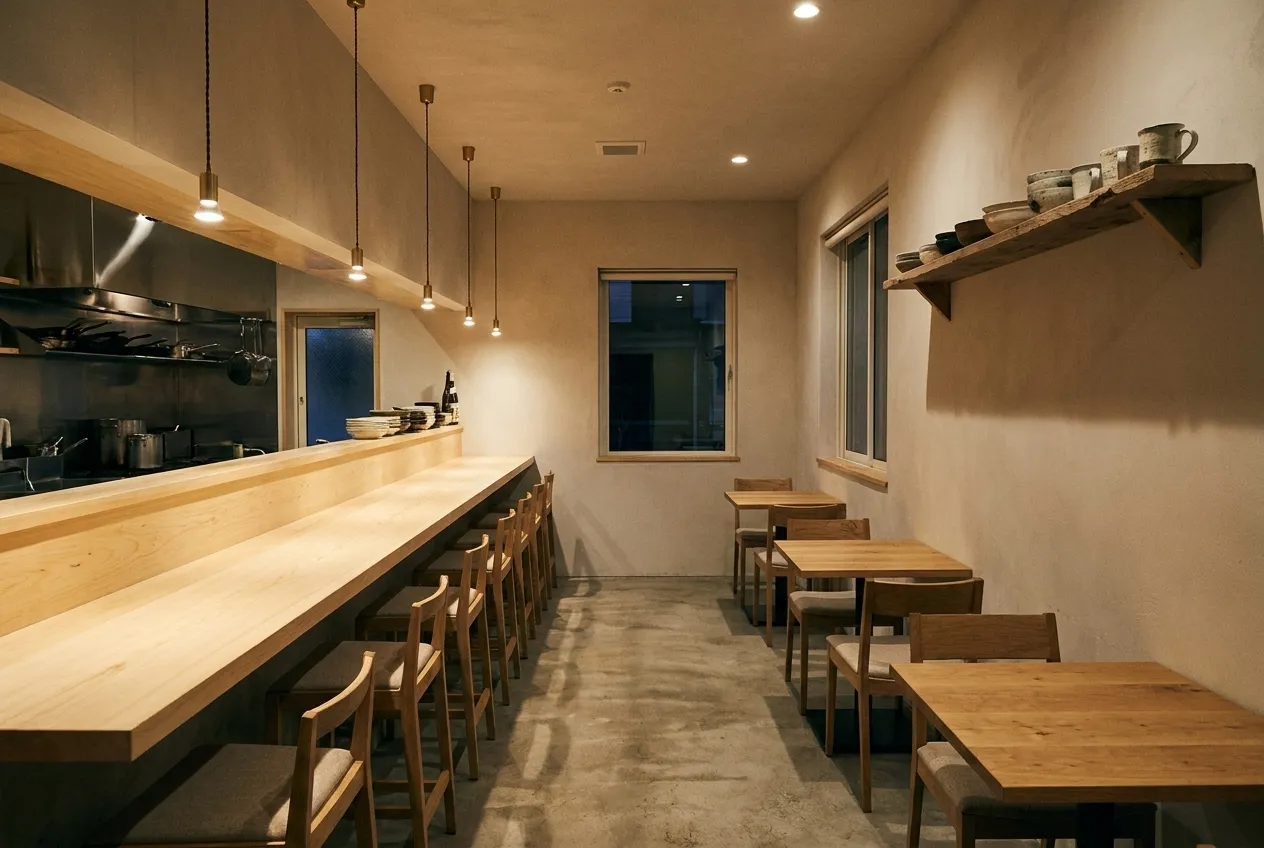
Two things about Momi Ramen at 5 Southwest 11th Street decide whether your night works, and neither of them is on the menu. The first is that it closes at midnight on Monday through Wednesday and on Sunday, and only runs to 2am Thursday through Saturday. The second is that it is cash only. Both are the kind of detail you discover at the worst possible moment if nobody tells you in advance.
Cash-only kitchens are the most common way a late meal goes wrong, and the ATM inside always charges more than you expect. Ask Karpo which late rooms near you take cards, what time each one actually stops serving, and how far the nearest one is.
The cash rule, and the ATM tax
There is an ATM inside, which sounds like a solution and functions as a surcharge — it charges roughly five percent. On a bowl at around thirty-five dollars, for two people with a small plate each, that is a meaningful addition to the bill for the privilege of not having planned. Bring notes. It is the entire fix and it costs nothing.
It is worth understanding why a restaurant does this rather than treating it as an inconvenience. Card processing on a high-ticket, low-volume menu eats a real share of the margin, and a kitchen that simmers broth for eighteen hours is already running an expensive operation. Cash-only is a choice about where the money goes, and the trade-off is visible in the bowl.
Eighteen hours of broth, and what that buys
The tonkotsu is simmered for eighteen hours and the noodles are pulled daily from flour imported from Japan. Those are the two claims the kitchen makes and they are the two that matter, because they account for the price. Eighteen hours of pork bone at a rolling simmer is what produces the opacity and the weight — the broth should coat the inside of the bowl rather than sit in it. A broth that has been on for six hours is thinner and you can see it before you taste it.
The menu is deliberately short: five ramen, running pork belly char siu, shrimp, chicken, mushroom and oxtail, plus small plates including gyoza and seaweed salad. A short menu in a ramen shop is a good sign rather than a limitation. Most bowls sit around thirty-five dollars, with the oxtail at roughly forty.

The portions are the thing nobody warns you about
The bowls are genuinely large, to the point where splitting one between two people at the end of a night is a normal and sensible order rather than an embarrassing one. If you have eaten already and this is a second dinner — which, at one in the morning in Brickell, it usually is — a shared bowl plus gyoza is a better plan than a bowl each and a lot of regret.
For a first visit, the pork belly char siu is the bowl that tells you what the kitchen is. The oxtail is the one to order when you already know you like the place and want to spend the extra five dollars on something richer. The mushroom is a real vegetarian bowl rather than a broth with the pork left out, which is rarer than it should be.
A short menu is a signal, not a limitation
Five bowls is a decision, and it is the most reliable single indicator of a serious noodle shop. A kitchen offering eighteen ramen is either freezing components or building every bowl from the same base with different toppings, and in both cases the broth is the compromise. Five bowls means five broths that somebody is tasting and adjusting through a service, which is the only way the eighteen-hour claim means anything at all.
It also tells you how to behave as a customer. In a short-menu shop, modifications are not welcomed and should not be requested — the bowl arrives as it was designed. The one adjustment worth making is timing: eat the noodles first and fast, before they soften in the heat, and finish the broth afterwards. A bowl that sits for ten minutes while you talk is a materially worse bowl, and at two in the morning that is entirely avoidable.
Why Brickell at 1am is the right setting
Brickell empties of office workers in the evening and refills with residents, and the late-night food situation reflects that — plenty of bars, a thin selection of kitchens still cooking. A ramen shop that is genuinely open at 2am on a Friday is filling a specific gap for a specific crowd, which is why the counter tends to be occupied by people eating alone or in twos rather than large groups.
Southwest 11th Street is a short walk from the Brickell Metrorail and Metromover station, though at that hour the Metromover has stopped. Realistically you are walking or riding. If you are coming from Wynwood or South Beach after a night out, factor the journey in against the closing time — arriving at 1:50am on a Thursday is not the same as arriving at 1:50am on a Wednesday, when the room has already been shut for two hours.
Practical notes
Momi Ramen, 5 Southwest 11th Street, Miami, FL 33130, in Brickell. Open noon to midnight Monday through Wednesday and on Sunday; noon to 2am Thursday through Saturday. Cash only; there is an ATM inside charging approximately five percent. Five ramen on the menu — pork belly char siu, shrimp, chicken, mushroom and oxtail — plus small plates including gyoza and seaweed salad. Bowls around $35, oxtail around $40. Tonkotsu broth simmered eighteen hours; noodles pulled daily from Japanese-imported flour. Portions are large and splitting is reasonable. Nearest transit is Brickell station, a short walk. Hours and prices change — confirm before a late trip.
Please drink responsibly. Must be of legal drinking age.
Tags: #latenightfoodnearme #momiramen #brickellmiami #ramenmiami #latenightmiami #miamieats #cashonly #tonkotsu #miamifood #openlatemiami #brickell #japanesefoodmiami #noodles #2am
All trademarks are the property of their respective owners.
Ask Karpo first
Late-night kitchens in Miami close earlier on weeknights than their weekend reputation suggests, and payment policies are almost never listed. Ask Karpo what is genuinely still serving near you at this hour, whether it takes cards, and what the backup is within a ten-minute walk.