 MiMo District Free Indoor Weekend Plan Finder for Retro Fans
Free Things to Do
Coral Gables Historic Plaza Fountain Walk: Free Miami Route
Tour Coral Gables historic Mediterranean plazas and stone fountains with free park access. Stroll De Soto Fountain and City Hall corridors on Karpo APP.
Walking through Coral Gables on a self-guided historic plaza fountain walk immerses pedestrians in the visionary Mediterranean Revival architecture and landscaped urban planning conceived by city founder George Merrick during the early 1920s. Known as The City Beautiful, Coral Gables was intentionally designed around ceremonial roundabouts, limestone gateways, and civic water features that echo the sun-drenched plazas of southern Spain and northern Italy. This pedestrian itinerary connects the ornate De Soto Plaza and Fountain with the grand civic grounds of Coral Gables City Hall, offering walkers a peaceful walking route sheltered beneath sprawling live oaks, royal palms, and flowering poinciana canopies.
As one traverses the wide residential parkways of this planned municipal landscape, the deliberate integration of decorative stone fountains becomes immediately apparent. George Merrick and his master artistic director, Denman Fink, believed that public water features provided essential spiritual repose and community gathering points in South Florida's subtropical climate. Today, these historic stone plazas remain accessible to the public completely free of charge, anchoring one of Florida's most cherished architectural walking districts.
Architecture and Craftsmanship of De Soto Plaza
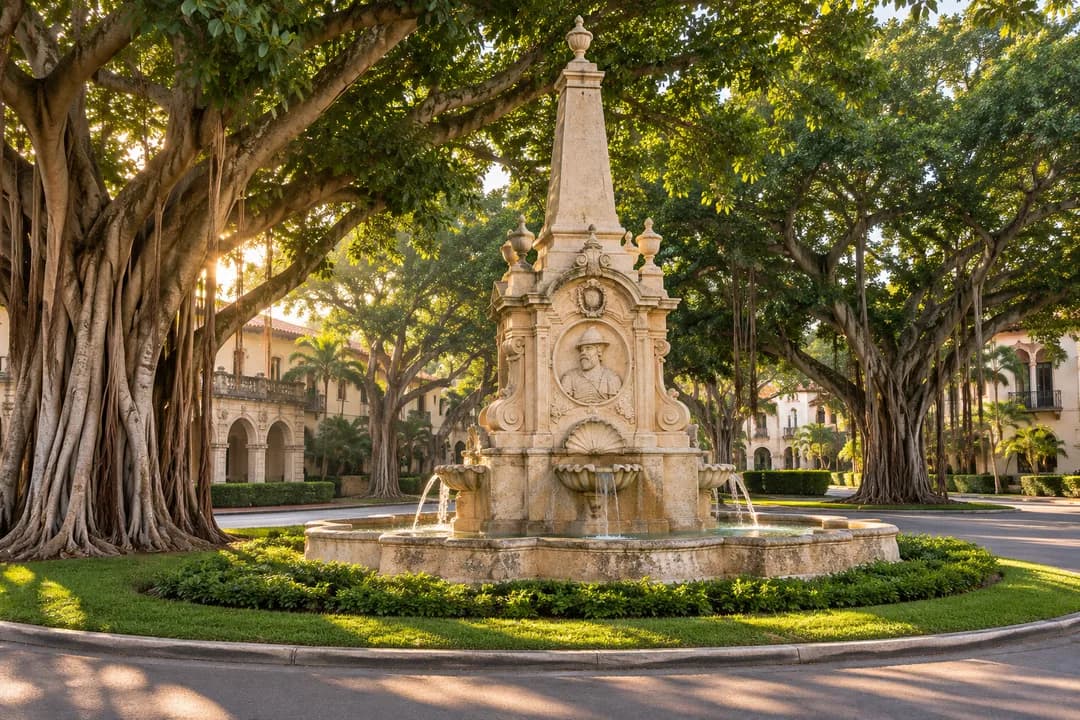
At the grand roundabout intersection of De Soto Boulevard, Granada Boulevard, and Sevilla Avenue, De Soto Plaza and Fountain stands as one of the finest architectural centerpieces in Miami-Dade County. Dedicated in 1925 by Denman Fink and architect Phineas Paist, this historic monument features a monumental carved four-sided stone fountain crowned by a classical obelisk and an ornamental iron lantern. Bas-relief stone gargoyles and spouting fish carved from native oolitic limestone discharge gentle jets of water into a broad circular basin, creating a tranquil acoustic buffer against the surrounding residential streets.
Encircling the central fountain basin is a historic wooden pergola supported by classical Doric columns, wrapped in blooming magenta bougainvillea and fragrant jasmine vines. Pedestrians can take advantage of the integrated limestone benches positioned beneath the shaded trellis to rest, read, or admire the sightlines radiating down four cardinal boulevard approaches. The open grassy park surrounding the fountain roundabout remains open to the public twenty-four hours a day, providing continuous year-round access with zero admission charge.
The meticulous masonry craftsmanship of the De Soto fountain incorporates local coquina aggregate and weathered coral rock, giving the structure an authentic Old World patina that blends harmoniously with the surrounding landscape. Denman Fink carefully studied Spanish fountain traditions in Seville and Granada before drafting the master plans, ensuring the proportions matched the wide radial street avenues. Visitors frequently spend quiet mornings sketching the classical stone capitals or listening to the soothing cascade of water beneath the sheltering boughs of native live oaks.
Municipal Civic Plazas and City Hall Grounds
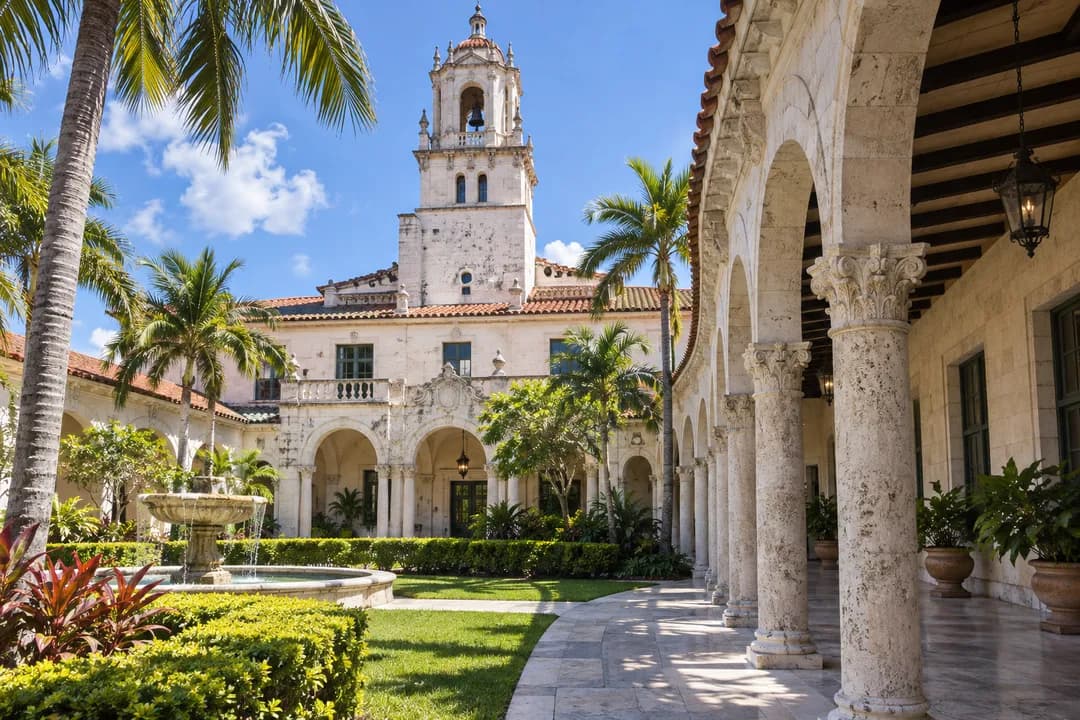
Following De Soto Boulevard southward toward Biltmore Way leads directly to Coral Gables City Hall, located at 405 Biltmore Way. Completed in 1928 and listed on the National Register of Historic Places, this grand three-story municipal hall features a Corinthian colonnade, a Spanish baroque bell tower, and a monumental bronze sculpture of George Merrick overlooking the manicured civic courtyard. While municipal offices operate Monday through Friday from 8:00 AM to 5:00 PM, the exterior civic plazas, stone balustrades, and palm-shaded gardens remain open to pedestrians daily from dawn until dusk.
Just south of the municipal complex, the open lawns of Merrick Park offer expansive brick walking paths, tiered stone seating terraces, and tranquil reflection gardens shaded by mature banyan trees. Walkers frequently gather along the stone perimeter benches to enjoy afternoon ocean breezes filtering inland from Biscayne Bay. Informational bronze historic plaques installed throughout the civic plaza detail the city's incorporation and the preservation of its distinctive Mediterranean architectural codes.
The civic complex also features ceremonial stone urns, carved balustrades, and peaceful gravel walkways lined with blooming hibiscus and gardenias. The architectural symmetry of City Hall's limestone facade provides an inspiring backdrop for photography enthusiasts, capturing the essence of 1920s civic pride. Stepping into the shaded courtyards allows strollers to pause in contemplative silence, removed from the commercial rhythm of nearby commercial avenues.
Detours to Historic Spring Waterways and Venetian Architecture
For walkers wishing to extend their historical excursion, a five-minute stroll westward along De Soto Boulevard brings you to the Venetian Pool at 2701 De Soto Boulevard. Carved in 1924 out of an abandoned coral rock quarry, this historic four-acre municipal aquatic facility features natural subterranean spring water, Venetian stone bridges, cascading rock grottos, and an island of palm trees. Even from the pedestrian perimeter walkway, visitors can appreciate the Spanish tile rooftops, wrought-iron lampposts, and rough-hewn coral stone masonry that characterize this unique National Register landmark.
The residential corridors connecting De Soto Plaza with the Venetian Pool feature historic Spanish village homes constructed between 1922 and 1926. Sidewalks are wide, flat, and paved with smooth aggregate, framed by historic coquina stone curbing and native sabal palms. Walkers will encounter minimal vehicular intrusion along these designated scenic residential parkways, making it an ideal outdoor destination for architecture enthusiasts and leisure strollers.
Along this detour route, pedestrians can also observe the historic Granada Entrance at the corner of Granada Boulevard and SW 8th Street, one of the original coral rock gate entrances established in the mid-1920s. These gateway plazas functioned as romantic thresholds welcoming visitors into Merrick's planned paradise. The lush canopy overhead forms a continuous vaulted green ceiling, keeping surface walking temperatures pleasantly mild even during bright sunny afternoons.
Practical Navigation, Restrooms, and Public Transit
Navigating Coral Gables is exceptionally convenient due to the city's comprehensive public transit network. The municipal Coral Gables Trolley operates fare-free ($0) along Ponce de Leon Boulevard from Monday through Saturday, running from 6:30 AM to 10:00 PM and providing seamless connections between the downtown commercial district and the Douglas Road Metrorail Station. Pedestrians can disembark at the Coral Way or Biltmore Way trolley stops and walk two blocks west to access the historic plaza network.
Clean, fully accessible municipal public restrooms and chilled water-bottle refilling stations are situated on the ground level of Coral Gables City Hall and within the youth center facilities located across Biltmore Way. On-street metered parking spaces are available along Coral Way and Biltmore Way, payable via mobile municipal parking applications. Designated bicycle parking corrals are installed adjacent to Merrick Park and De Soto Plaza for visitors traveling on two wheels.
Navigating Historic Plazas with Karpo APP
Utilizing the Karpo APP dramatically enriches your walking experience throughout Coral Gables by delivering real-time route guidance, architectural context notes, and localized walking trail recommendations. The interactive map highlights shaded park benches, crosswalk safety signals, and optimal viewpoints for photographing historic limestone fountains without background traffic interference.
The Karpo APP also suggests curated neighborhood detours, including quiet pedestrian garden corridors, nearby historic tree canopies, and independent local cafes situated along Miracle Mile. Strollers can save custom walking itineraries, monitor their pedestrian mileage, and explore self-guided cultural walking trails with effortless digital precision.
Ask Karpo for more information.
Keep reading
- MiMo District Free Indoor Weekend Plan Finder for Retro Fans
 Coral Gables Free Indoor Weekend Plan Finder for Book Lovers
 South Beach Free Indoor Weekend Plan Finder for Rainy Days