 MiMo District Free Indoor Weekend Plan Finder for Retro Fans
Free Things to Do

Miami Autumn Stargazing Spot: Wynwood Through Artist's Eyes
Turn a Wynwood evening into a sky observation exercise. Compare rooflines, color and one bright target while keeping the art walk relaxed and considerate.
A Wynwood autumn stargazing spot is better approached as a looking exercise than a hunt for deep darkness. The proposed art corridor here is a way to organize your attention during a neighborhood evening. It is not an observatory, a named trail or a guarantee of nighttime access. Begin with the tension between the detailed surfaces around you and the less crowded space overhead. You can enjoy that contrast without claiming that murals, rooftops or private courtyards are public astronomy sites.
Begin by looking down, then look up
Give the first part of the walk to color and shape at ordinary eye level. Notice how a wall directs your gaze, how a corner crops an image, or how a line continues across a surface. Then stop at an appropriate public standing point and apply the same questions to the sky. What creates the boundary of your view? Where does a roofline cut it? This transition makes a sky pause feel connected to the evening you were already having, rather than an unrelated assignment inserted into an art walk.
You do not need to pretend that the sky is a canvas or invent a story about an artist's intentions. Keep the comparison specific. A painted curve is fixed while a cloud edge changes. A bright facade may dominate your lower view even when the sky seems quiet. These are things you can notice directly. Leave mural authorship, dates and meanings to reliable sources if you later choose to research a particular work. For this outing, the act of comparison is sufficient.
Build a personal color record
Choose a small set of colors to notice across the evening. You might compare a muted blue overhead with warm reflected light on a building, or follow how a pale cloud differs from an illuminated wall. Write the colors in your own words instead of trying to make a precise scientific measurement. Your eyes adapt to the scene, and photographs may render it differently. The record is a description of your experience, not a calibrated statement about atmospheric conditions or the neighborhood's light pollution.
For a creative companion, make two quick sketches of the same sky opening. One can record outlines only, while the other records areas of light and shade. Compare them after moving away from the observation point. You may discover that one person attended to the buildings and the other to the empty space. That conversation gives the walk a satisfying result even if the sky supplies very few visible objects. It also makes the activity welcoming to someone who has never used a star chart.
Keep the target simple and verifiable
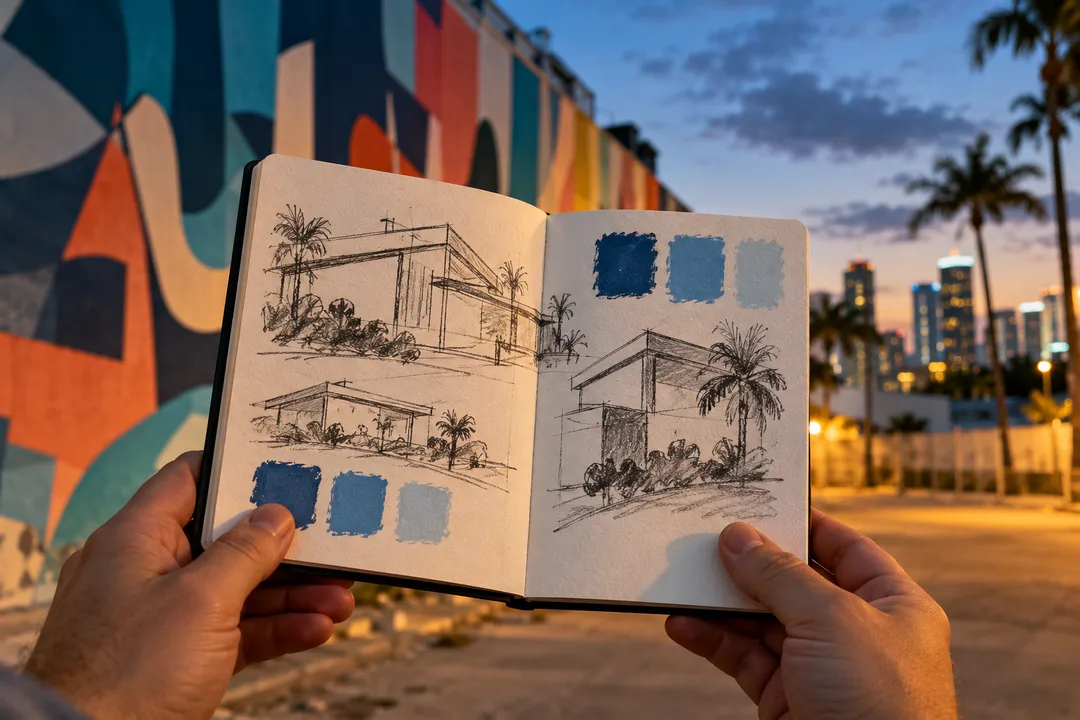
If you want an astronomical identification, select just one target using a dated chart for Miami and your intended observation time. The Moon can be a useful possibility when its position suits the outing, but it should not be promised in advance without that check. Do not announce a planet based on a bright point you happen to see between roofs. Compare direction and position with the chart. If the identification stays uncertain, record the uncertainty rather than forcing a confident label.
A narrow opening can disappear from view after only a small move along the pavement. This is a reason to choose a comfortable stopping point before taking out a chart, not a reason to follow the object into a driveway or across traffic. Resist the urge to improve the composition by entering a private space. A good observation can include the limits of your view. Noting that a roof blocked the desired direction teaches more than pretending the neighborhood supplied an unobstructed panorama.
Try an evening without a camera assignment
Wynwood can invite constant photography, so consider giving the sky portion a different rule: no image needs to be made. Leave your phone available for navigation but avoid holding it in front of your face throughout the pause. Describe what you see before reaching for a screen. A companion can repeat the description back, adding only what they actually noticed. This small exercise slows the conversation and makes the distinction between seeing something and expecting to see it more apparent.
If you do take photographs, treat them as records of the setting. A brightened sky, a sharpened cloud or an extra point introduced by processing can complicate later interpretation. Keep an unedited version if you want to compare it with your notes. You can make an attractive picture without using it as proof of what was visible to the unaided eye. For an art-focused walk, that separation is useful: photography and observation can each have their own purpose.
Plan the pause around movement
An art corridor is still a working neighborhood. Keep entrances, loading spaces and the path of other pedestrians clear. Stand where your group can remain together without spreading across the route. Before the sky portion, agree on a simple signal for moving on. That removes the awkwardness of one person feeling finished while another waits silently for a better view. An observation can be brief and still contain a genuine discovery. The length should follow the group's attention rather than a number chosen to sound substantial.
Build an easy continuation into your evening. Perhaps the sky break sits between two periods of walking, or it becomes the last reflective stop before heading home. Do not make the continuation depend on an unverified business or an assumption that a particular space remains accessible. Use your own researched destination information for those choices. The article's corridor is a planning frame, and a plan should remain able to absorb a blocked approach or a companion who would prefer to stop.
Give Karpo a creative brief
A useful request describes the experience you want: an art-focused Wynwood evening with a short sky pause and time for conversation. Ask for ideas to arrange the outing, then use a dedicated astronomy resource for celestial positions and a weather service for cloud information. Karpo APP's role in this plan is conversational assistance with your city evening. It is not a telescope controller, a live darkness meter or a guarantee of public access. Keep those boundaries clear when turning a suggestion into a destination.
Practical Notes
Before leaving, choose one detail from the walls and one from the sky. Explain how they differed: sharp versus soft edges, steady versus changing shapes, or reflected light versus a faint point overhead. Do not worry about producing an elegant conclusion. The exercise works because the observations are your own. On the next neighborhood walk, you may notice a sky opening before you notice a photo opportunity. That shift is enough to make a modest city stargazing attempt feel worthwhile.
Ask Karpo for more information.
Keep reading
- MiMo District Free Indoor Weekend Plan Finder for Retro Fans
 Coral Gables Free Indoor Weekend Plan Finder for Book Lovers
 South Beach Free Indoor Weekend Plan Finder for Rainy Days