Students and remote workers in Miami search for Agnez Mo when they need high-energy, multilingual pop to push through problem sets or supply runs. The Indonesian artist's catalog—spanning English and Bahasa tracks—has become study-session fuel for the city's international student population, especially around University of Miami and Florida International campuses. The search spikes hardest during back-to-school weeks when people are building playlists that won't distract but will keep momentum through long library stretches.
Text Karpo before you leave campus or your apartment. It'll map a live route from your starting point to every stop on this list, flag bridge closures, and reroute you around afternoon storms in real time.

Why Agnez Mo Shows Up in Miami Study Searches
The practical problem is that Miami's August and September heat makes multi-stop errands brutal. You cannot walk fifteen minutes between a bookstore, a print shop, and a quiet café without arriving soaked. Agnez Mo's tempo works for the hustle, but the route has to collapse distance. Downtown Miami is the only district where you can chain study-prep stops within a eight-block radius, all connected by covered walkways or very short outdoor segments, and still find spaces quiet enough to review notes between errands.
Most students default to Brickell or Coral Gables, but Brickell's rideshare pickup points are jammed during school hours, and Gables parking meters run out by 10 a.m. Downtown has structured parking that doesn't fill until courthouse crowds arrive after nine, and the Metromover is free. If you time the route to end before 3 p.m., you miss both the causeway backup and the daily storm cell that rolls in from the west.
Downtown's Compact Study-Prep Zone

Start at the main Miami-Dade Public Library on Flagler Street and Second Avenue. It opens at 9 a.m. on weekdays, has free WiFi, and the second floor stays quiet even when the ground level fills with computer users. The study carrels near the east windows get indirect morning light and stay cool. You can print syllabi or scan documents at the self-service stations on the first floor—confirm you have your library card or bring a driver's license to get a day pass at the desk.
Walk two blocks west on Flagler to the Office Depot at 69 West Flagler. It's a standard big-box store, but it's the only place in this radius that stocks three-ring binders, poster board, and lab notebook formats without requiring a Target run in Midtown. The store has its own small lot, but street parking on the south side of Flagler is metered and usually open mid-morning. Avoid the stretch between noon and 1 p.m. when office workers flood the block for lunch.
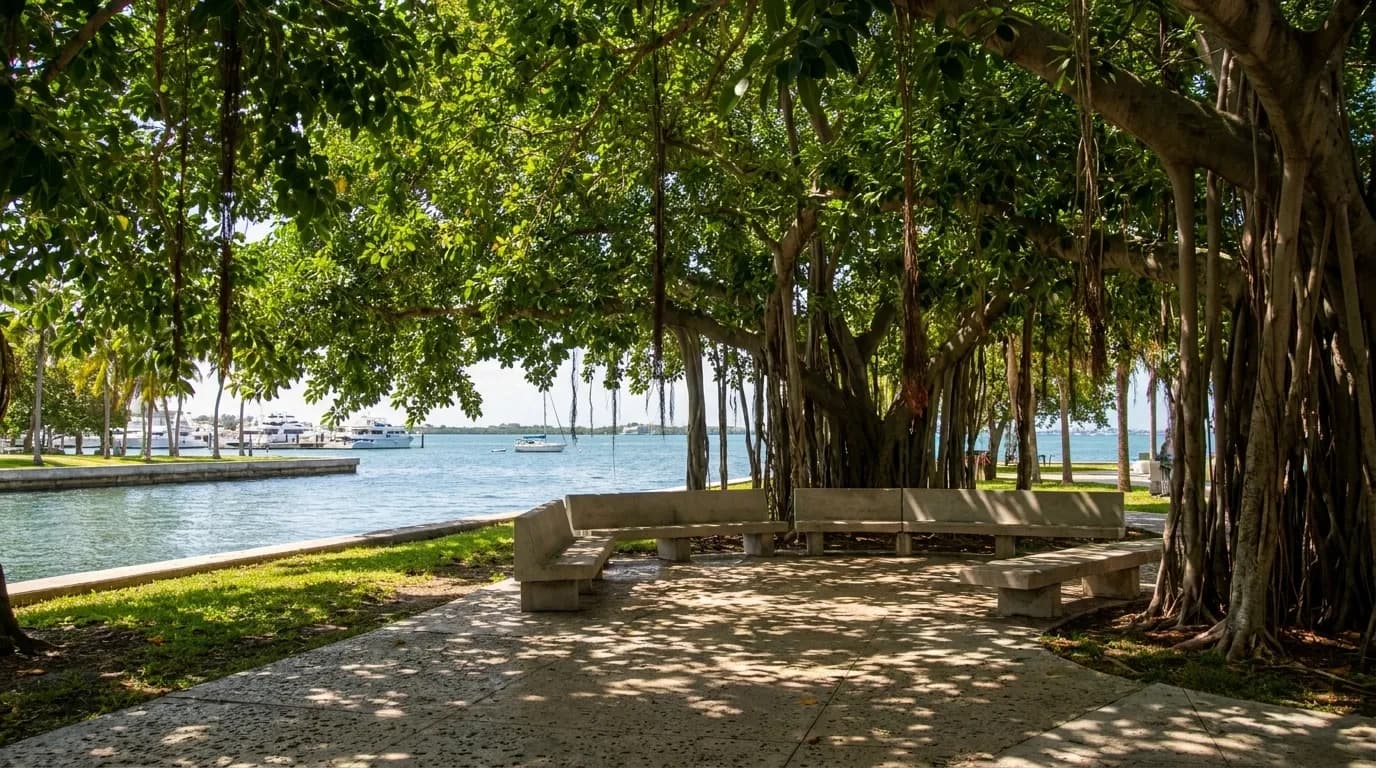
From there, cut north on Miami Avenue to Northeast First Street and walk east to Bayfront Park. The park's northwest corner, near the Torch of Friendship, has concrete benches under ficus trees that stay shaded until early afternoon. It's not silent, but the bay breeze and distance from Biscayne Boulevard traffic make it workable for review or a phone call with a study group. The park's restrooms are near the amphitheater, and they're maintained better than most public facilities in the city. If you need a second indoor stop, the AmericanAirlines Arena box office lobby—now called FTX Arena on some maps, though locals still use the old name—has air conditioning and seating, but it's only reliably open on event days; check the schedule online before relying on it.
For a café stop that isn't Starbucks, walk to All Day on Northeast Second Avenue near Flagler. It's a small counter-service spot with cold brew, pastries, and a handful of two-top tables. The space is narrow, so it's better for a quick regroup than a two-hour laptop session, but it's genuinely local and the WiFi works. The playlist skews indie and electronic, which pairs well if you've been running Agnez Mo on your own headphones and need a sonic break.
When to Start and When to Bail
Begin this route by 9:30 a.m. if you're driving. The parking garage at 40 Northwest Third Street fills slowly in the morning, and street meters along Flagler are two-hour limits that reset at noon. If you arrive after 10:30, the library's quiet floor may already have claimed seats, and the Office Depot lot will be tight. Metromover riders should board at Government Center and take the loop to College/Bayside; it's free and drops you one block from the library's main entrance.
Finish your last stop by 2:30 p.m. The causeway traffic toward Miami Beach and the airport connector builds by three, and the daily thunderstorm usually arrives between 3 and 4 p.m. from late May through October. If you're in Bayfront Park when the sky darkens to the west, the covered walkway under Bayside Marketplace will keep you dry, but it's a tourist zone and gets loud. A better storm refuge is the library—just retrace your steps on Flagler.
Rideshare pickup at Bayfront Park is tricky. Drivers are supposed to use the designated zone on Biscayne Boulevard near Northeast Fourth Street, but many circle the block or wait on side streets. Pin your location precisely in the app and watch the driver's route; if they're stuck on the boulevard, walk toward them rather than waiting. The park's size makes it easy to lose five minutes in miscommunication.
The Coral Gables Alternative for Quiet
If you need absolute silence and don't mind driving fifteen minutes south, the University of Miami's Richter Library allows public access to its main reading room on weekdays. Parking in the Ponce Garage costs a flat rate—verify the current daily fee on the university's parking website before you go—and the library's ground floor has study carrels that rival any public space in the county. The trade-off is that you'll need to make a separate trip for office supplies; the nearest full-stock store is a Staples on U.S. 1 near Sunset Drive, and that's a ten-minute drive with no walkable connection.
Coral Gables also has better café options—Panther Coffee on Sunset and Books & Books on Aragon both have seating and strong espresso—but street parking in the downtown Gables grid is a gamble. Meters are enforced until 9 p.m., and the residential blocks surrounding the commercial district prohibit non-resident parking. The Gables is worth the detour if you're planning a single long study session in one location, but it doesn't support a multi-stop errand chain the way Downtown Miami does.
The other advantage of staying in Downtown Miami is Metromover access. If your errands stretch longer than planned or the storm arrives early, you can hop on at any station and loop back to your car or a rideshare point without getting drenched. Coral Gables has no rail option; you're either in your car or waiting for a bus on Ponce de León Boulevard, which runs every twenty minutes off-peak.
What to Double-Check Before You Go
Call the Miami-Dade Public Library's main branch or check its website the morning of your trip. The building occasionally closes for county maintenance, and those updates don't always appear on Google Maps. The library's phone line is staffed starting at 9 a.m., and the recording will tell you if the building is open that day. If it's closed, the Pérez Art Museum Miami library—technically a research facility, but open to the public—is a fallback; it's smaller, but the reading area overlooks the bay and stays very quiet.
Verify Bayfront Park's event calendar. The park hosts free concerts, festivals, and cultural programs year-round, and when an event is being set up or torn down, the northwest corner where the shaded benches sit may be fenced off or noisy. The city's parks website lists events by date, and the park's own social accounts post updates the day before. If the park is blocked, the baywalk along Biscayne Boulevard south of the AmericanAirlines Arena has benches with similar views and shade from the building's overhang, though it's more exposed to wind.
Check the bridge schedule if you're coming from Miami Beach or Key Biscayne. The Venetian and MacArthur causeways both have drawbridge segments that open for marine traffic, and while the delays are usually short, they stack up during morning and late afternoon. The city's traffic website shows real-time bridge status, and apps like Waze will reroute you if a bridge is up, but you'll save ten minutes by checking before you leave. If you're driving west from the beach, take the MacArthur and exit at Biscayne Boulevard; it's the most direct line into Downtown's core and avoids the I-95 interchange mess.
Practical notes
- Start by 9:30 a.m. to claim library seats and parking; finish by 2:30 p.m. to avoid causeway traffic and storms.
- Metromover is free and connects all Downtown stops; Government Center is the transfer hub.
- Street parking on Flagler is two-hour metered; the garage at 40 NW Third Street is flat-rate all-day.
- Bayfront Park's northwest benches are shaded until early afternoon; check the event calendar to avoid closures.
- Rideshare pickup at Bayfront Park requires precise location sharing; drivers often circle Biscayne Boulevard.
- Confirm the main library is open that morning; county maintenance closures happen without much notice.
Tags: #karpo #miamistudents #downtownmiami #agnezmo #backtoschool #studyroute #miamibacktoschool #metromover #bayfrontpark #miamidade #miamierrands #studyprep #miamiheat #miamistorms #miamitransit
Sources consulted: Miami-Dade Public Library · Miami Metromover · Bayfront Park · Miami-Dade County Traffic
All trademarks are the property of their respective owners.
Ask Karpo first
Text Karpo your starting point and ask for a live route through Downtown's study-prep stops. It'll tell you which parking garages have space right now, whether Bayfront Park has an event blocking the quiet zone, and when the next storm cell is forecast to hit. If the library is closed, Karpo will reroute you to the PAMM library or another backup with current hours.