You search for Mediterranean food near me and the map lights up with fifty pins, all of them serving some version of the same menu: hummus, baba ghanoush, kebabs, rice, salad. You pick the closest one with decent reviews, order the mixed grill platter, and leave satisfied but not curious. The problem is not the food. The problem is that the search term treats Armenian lahmajoun, Persian tahdig, Levantine musakhan, Greek horiatiki and Turkish manti as interchangeable, and the restaurants that show up in the results have learned to play along. Los Angeles has enough depth in each tradition to make the distinctions worth learning, but only if you stop searching generically and start asking which tradition you are actually standing in front of.
Ask Karpo which Armenian, Persian, Levantine, Greek or Turkish room is open right now in your corner of Los Angeles, and what to order once you know which tradition you have walked into.
You Think You Are Ordering Kebabs, but Kebabs Are Not One Thing
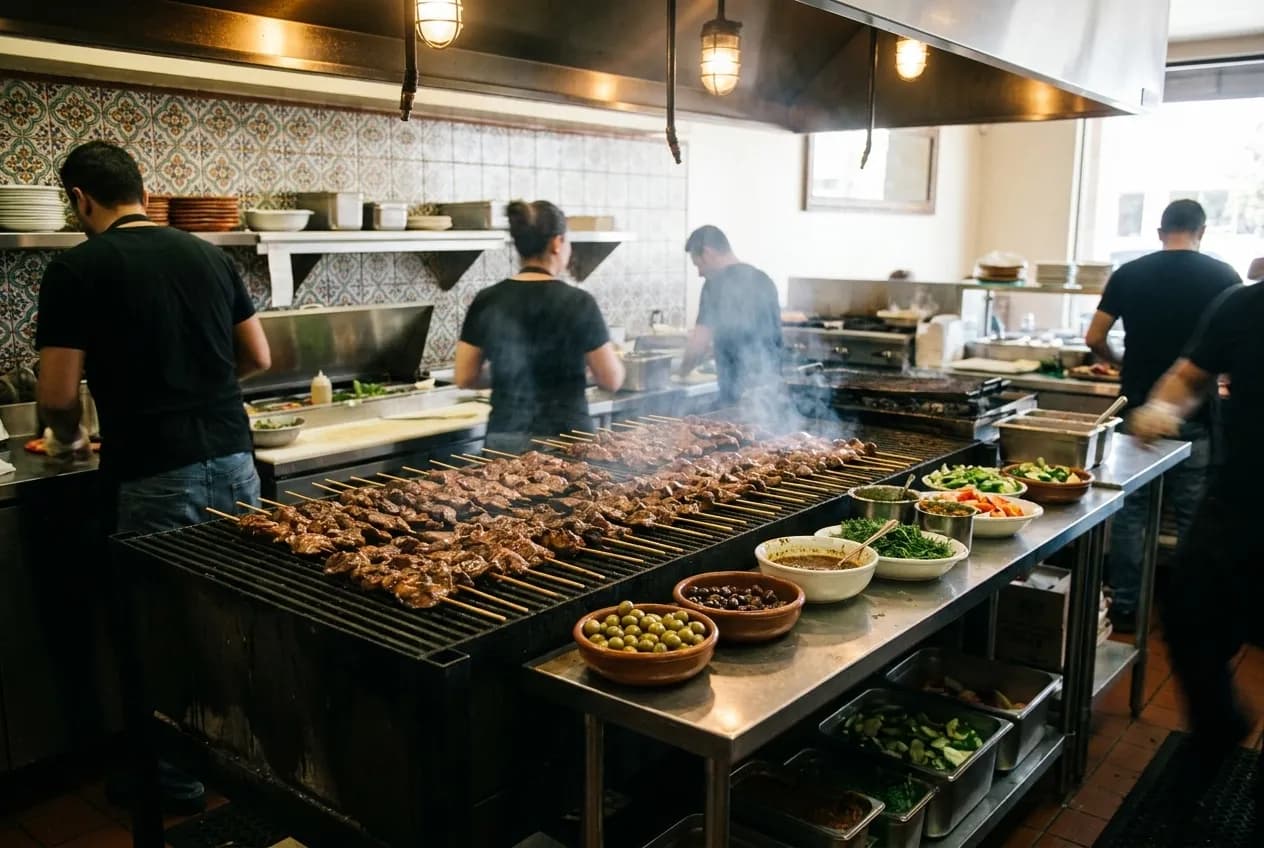
The first failure mode is assuming that kebabs are kebabs. They are not. Armenian khorovats uses pork and beef in equal measure, marinated overnight with onion and sometimes pomegranate molasses, grilled over fruit wood, and served with lavash so thin it tears when you wrap it. Persian kabob koobideh is ground lamb or beef mixed with grated onion and turmeric, formed onto flat skewers, and cooked over charcoal until the edges char black while the center stays soft. Levantine shish taouk is boneless chicken thigh marinated in yogurt, garlic and lemon, grilled fast and served with toum so sharp it clears your sinuses. Greek souvlaki is pork shoulder cubed small, marinated in olive oil and oregano, and served with tzatziki that is thicker and less garlicky than what you get in a Levantine room. Turkish shish kebab uses lamb shoulder, no marinade beyond salt and pepper, grilled rare if you let them, and plated with grilled tomatoes and peppers that have been cooking alongside the meat.
The Armenian corridor runs through Glendale and into Montrose, where the groceries and bakeries cluster on San Fernando Road and the grills open late. The Persian concentration is on the Westside, especially the blocks around Westwood Boulevard south of Wilshire, where the kabob houses serve tahdig as a side and close after lunch on Fridays. Levantine cooking is spread across the Valley, with Syrian and Lebanese rooms in Encino, North Hollywood and Van Nuys, often attached to groceries that sell bulk spices and flatbreads baked that morning. Greek and Turkish rooms are scattered: Greek in Tarpon Springs and along Pico near Normandie, Turkish in Studio City and Los Feliz, often small and owner-operated.
The fix is to notice which tradition you are in before you order. If the menu lists lahmajoun or manti, you are in an Armenian or Turkish room and the dumplings or flatbreads will be better than the kebabs. If the menu lists tahdig or gheimeh, you are in a Persian room and the rice dishes are the move. If the menu lists musakhan or makloubeh, you are in a Levantine room and the chicken and rice preparations cooked in stock will outperform the grilled options. If the menu lists moussaka or pastitsio, you are in a Greek room and the baked casseroles are what the kitchen does best. The combo platter is the tourist option in every one of these traditions. Order the thing that does not translate.
You Are Eating Lunch Food at Dinner and Missing the Night Menu
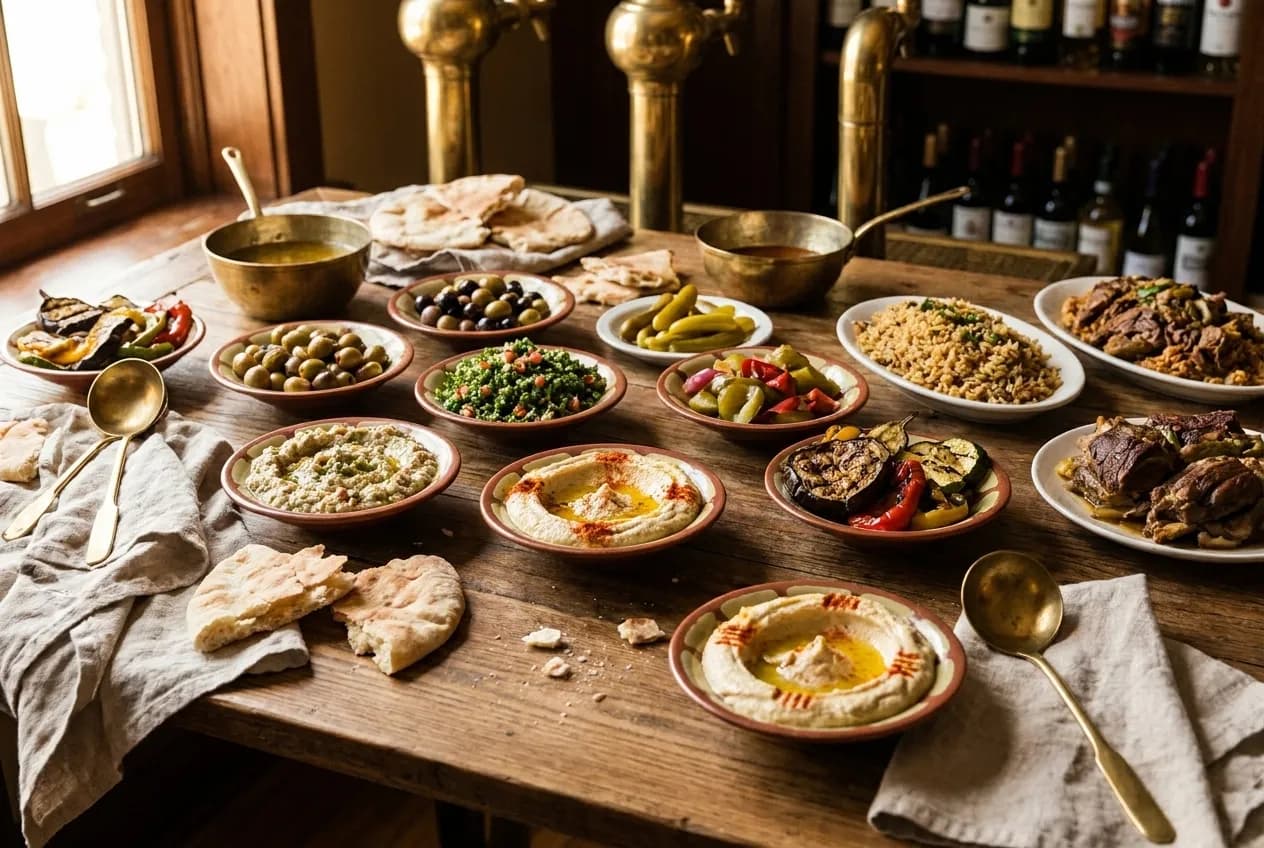
The second failure mode is not knowing that many of these rooms operate two menus. The lunch menu is designed for speed and serves the kebabs, wraps and salads that can be assembled in six minutes. The dinner menu is slower and includes the braises, baked dishes and stuffed vegetables that take two hours and only make sense if the kitchen started them at three in the afternoon. You search at seven, walk in at seven-thirty, and order from the lunch menu because you do not know to ask what else is available. The kitchen has kibbeh baked in a tray, stuffed grape leaves that have been simmering since four, and lamb shanks braised with okra and tomato, but none of it is listed on the printed menu and the server will not offer it unless you ask.
This is most common in Levantine rooms, where the printed menu is a compromise designed to satisfy the lunch crowd and the dinner menu is transmitted verbally. The tells are handwritten specials taped to the wall, a steam table near the register with trays of food that are not listed, or a server who asks if you want to see what they have today. Armenian rooms do this with weekend-only dishes: khash on Sunday mornings, harissa on Saturday afternoons, dolma that only appears when the kitchen has time. Persian rooms do this with ash and khoresh, the soups and stews that take half a day and only show up on the menu two or three days a week.
The fix is to arrive after six-thirty and ask what is slow. The phrasing matters. If you ask what is good, the server will point you toward the kebabs because that is what most people order. If you ask what takes time, or what they are cooking today, or what is not on the menu, you will get the real answer. The other tell is the steam table. If you see trays of food near the register, point at them and ask what they are. The kitchen made them for the family meal or for regulars, and they will sell them to you if you ask. The third tell is the number of older men eating alone at small tables in the back. They are eating the food that does not appear on the menu, and you can see what they ordered by walking past their tables on the way to the bathroom.
You Are Ordering Dessert from the Wrong Tradition and It Shows
The third failure mode is ordering baklava in every tradition and not noticing that baklava is not one thing either. Armenian baklava uses walnuts, not pistachios, and the syrup is lighter and cut with lemon so it does not coat your mouth. Persian baklava uses rosewater and saffron in the syrup and slices the pastry into diamond shapes so small you can eat three without feeling heavy. Levantine baklava uses pistachios and orange blossom water and cuts the pastry into rectangles twice the size of the Persian version. Greek baklava uses more honey than sugar and cuts the pastry into triangles that hold together better when you pick them up. Turkish baklava uses clarified butter instead of oil and the layers are thinner and crispier than any other version.
The better move is to ignore baklava and order the dessert that belongs to the tradition you are in. Armenian rooms make gata, a buttery pastry filled with flour and sugar that is less sweet than baklava and pairs better with coffee. Persian rooms make bastani, saffron ice cream with chunks of frozen cream and pistachios, served between two wafers. Levantine rooms make knafeh, shredded phyllo soaked in syrup and layered with cheese, served warm and topped with pistachios. Greek rooms make galaktoboureko, custard baked between phyllo layers and soaked in honey syrup. Turkish rooms make sütlaç, rice pudding baked until the top caramelizes, served cold with cinnamon.
The fix is to notice what the families are ordering. If you see a table of four sharing a tray of something that is not baklava, that is the dessert the kitchen is proud of. The other tell is the display case. If the baklava is sitting in a case near the register and looks like it has been there since morning, and there is a tray of something else behind the counter that the server has to retrieve from the kitchen, order the thing behind the counter. The third tell is temperature. If the dessert is served warm, it was made that day. If it is served cold, it was made yesterday or bought from a supplier. The warm dessert is always better.
The transferable habit is this: before you order, look at the menu and count how many traditions are represented. If the menu lists lahmajoun and shawarma and souvlaki and koobideh on the same page, you are in a generic Mediterranean room that is trying to serve everyone, and the kitchen is not doing any one tradition well. If the menu lists ten versions of one dish, or if half the menu is in a language you do not read, or if the appetizer section is longer than the entree section, you are in a room that is cooking one tradition deeply, and everything on the menu will be better than the combo plate you were about to order. The search term is a trap. The solution is to stop searching generically and start asking which tradition you are standing in, and then ordering the thing that does not translate.
Tags: #MediterraneanFoodLosAngeles #LosAngelesDining #ArmenianFoodLA #PersianFoodLA #LevantineCuisine #GreekFoodLA #TurkishFoodLA #GlendaleDining #WestwoodRestaurants #SanFernandoValleyFood #LAFoodScene #MediterraneanCuisine #LARestaurants #AuthenticMediterranean #LosAngelesEats
All trademarks are the property of their respective owners.
Ask Karpo first
Ask Karpo which Armenian grill in Glendale, Persian kabob house in Westwood, or Levantine room in the Valley is open right now, what the slow-cooked dishes are today, and how long the drive will take from where you are standing. The Karpo app knows which tradition you are looking for and which rooms are still seating.