Brunch in San Francisco was for years a fixed set of dishes: eggs benedict, a hash, avocado on sourdough, a mimosa. The most interesting Mediterranean food in San Francisco has quietly taken that slot over, and the shift is more than cosmetic — a Levantine breakfast is structurally different, built around a spread of small cold things plus one hot centrepiece rather than a single plate per person. It shares better, it costs less per head, and it is far more forgiving of a table where everyone wants something different.
These rooms fill fast and the queue moves in waves. Ask Karpo which mezze breakfasts near you are seating right now.
What you are actually ordering
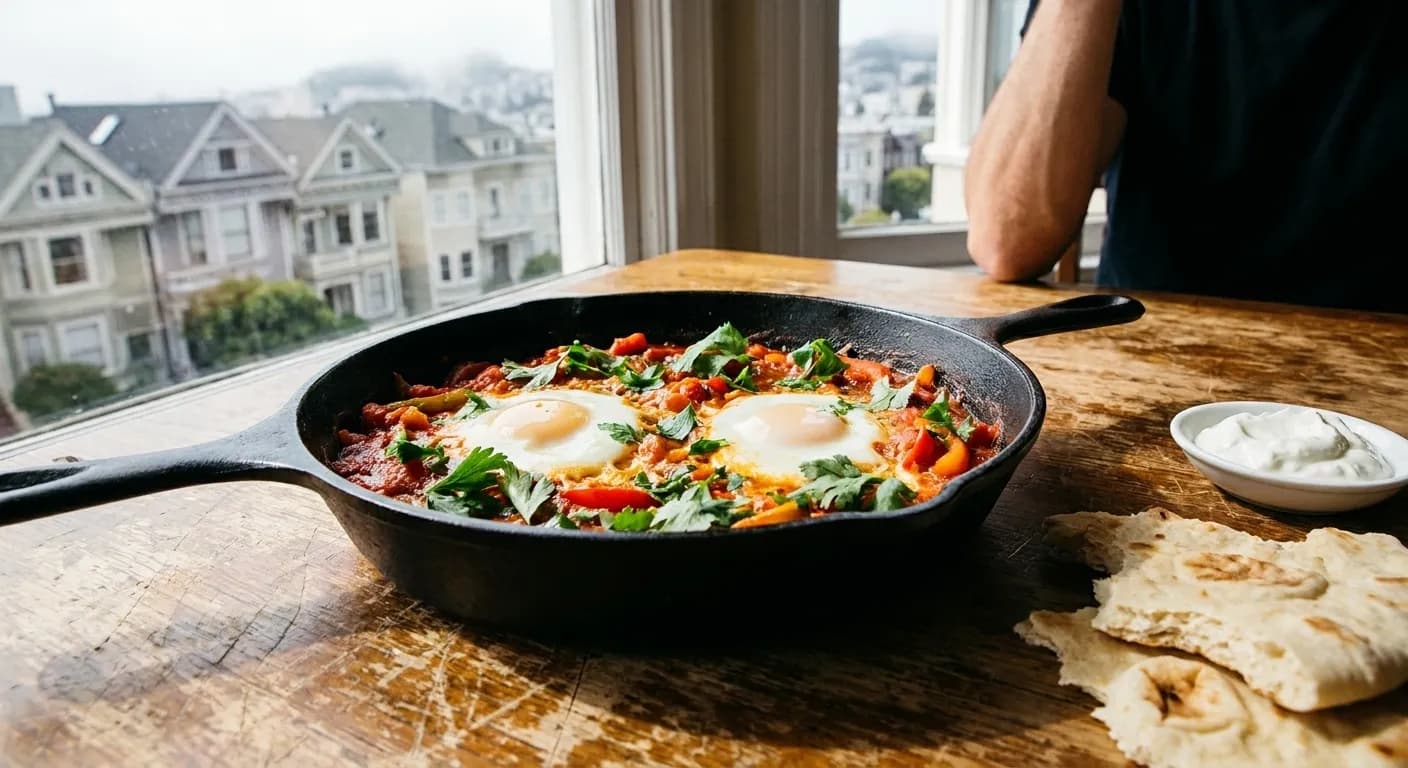
The centrepiece is usually shakshuka — eggs poached in a tomato and pepper base, served in the pan with bread to tear into it — or a plate of eggs with herbs and spice butter. Around it go labneh, a cucumber and tomato salad, olives, pickles, hummus, and whatever the kitchen bakes. Mana'eesh, the flatbread baked with za'atar or cheese or a topping of caramelised onion and braised meat, is the item most worth building an order around and the one most people under-order.
The practical version: order one hot dish per person and three or four cold ones for the table, not one of each per head. Kitchens portion these expecting sharing, and a table that orders individually ends up with too much food and a bill twenty per cent higher than it needed to be.
Where it clusters
The Mission carries the densest concentration, with a run of rooms doing Levantine and Palestinian cooking that all serve some version of this at weekends. Hayes Valley and the Fillmore have the more polished versions. There is a strong Greek and Eastern Mediterranean presence closer to the waterfront, which does a different thing — larger plates, less of the small-dish structure — and is better for a sit-down lunch than for a brunch spread.

The Richmond is the underrated one. There are Persian, Afghan and Turkish rooms out there doing breakfast that almost never appear on brunch lists, mostly because they open at eight for their regulars and are past their rush by the time a brunch crowd surfaces.
The queue question, answered honestly
Most of these places do not take reservations at weekends, and the wait between eleven and one at the popular ones runs forty-five minutes to an hour and a half. That is genuinely too long for eggs, and the fix is not to avoid the restaurant but to move the hour. Nine to ten on a Saturday is empty at almost every one of them. So is a Friday, which most people forget is an option.
If you do queue, the tells for whether it is worth it are the same everywhere: is the bread being baked on site, and is the queue mostly people who look like they live within ten blocks. Both are visible from the pavement, and both predict the meal better than any rating.
Price, and where it lands
A shared Levantine brunch for two in San Francisco generally comes in between thirty and forty-five dollars before drinks, which is meaningfully below the equivalent American brunch once you account for the fact that nobody needs a side. The exception is the wine-forward Mediterranean rooms in the more expensive neighbourhoods, where the same food arrives with a different mark-up attached.
Coffee is where these places diverge from brunch convention, usually for the better. Cardamom coffee, Turkish coffee and proper mint tea are standard and are a genuine improvement on a diner refill. Order the tea for the table; it is almost always priced as a pot rather than a cup.
If you only do one thing
Order the bread course seriously. The single biggest difference between a good and a great meal in this category is whether the kitchen bakes its own flatbread, and the difference is enormous — a hot mana'eesh straight from the oven is one of the best things you can eat in San Francisco for under fifteen dollars, and a room that buys its bread in cannot compete with that regardless of how good the rest of the menu is.
The corollary is that ordering only the photogenic dishes misses the point. Shakshuka is what gets photographed and the bread is what people come back for.
Naming the thing accurately
Mediterranean is doing a lot of work as a category label here, and it flattens some real differences. What most of these San Francisco kitchens are actually cooking is Levantine — Palestinian, Lebanese, Syrian, Jordanian — with a separate cluster of Israeli-influenced rooms, a Persian and Afghan strand in the Richmond, and Greek and Turkish restaurants doing something else again. The menus overlap in the dips and diverge everywhere else.
This matters practically rather than pedantically. If you liked the breakfast at one place and want more of the same, looking for the same regional tradition will get you there faster than looking for the same category word on a sign. A Greek room and a Palestinian room will both be listed as Mediterranean and will give you completely different mornings.
Dietary logistics, which for once are easy
This is the most accommodating brunch format in the city for mixed tables. Most of the cold dishes are vegan by default, most of the rest are vegetarian, the bread is usually dairy-free, and the hot dishes are the only place where anything needs substituting. A table of six with three different requirements can order from the same menu without a negotiation, which is not true of an American brunch menu built on eggs, bacon and butter.
Gluten is the one genuine constraint, since the bread is the centre of the meal. A few kitchens will do a rice or salad substitution and most will simply shrug, so it is worth asking on the way in rather than after you have queued.
Tags: #SanFrancisco #SFBrunch #MediterraneanFood #Shakshuka #Levantine #MissionDistrict #HayesValley #SFEats #WeekendBrunch #Mezze #Manaeesh #BayArea #BrunchSF
All trademarks are the property of their respective owners.
Ask Karpo first
Ask Karpo which Mediterranean brunch spots near you in San Francisco are open now, how long the queue is, and whether they bake their own bread.