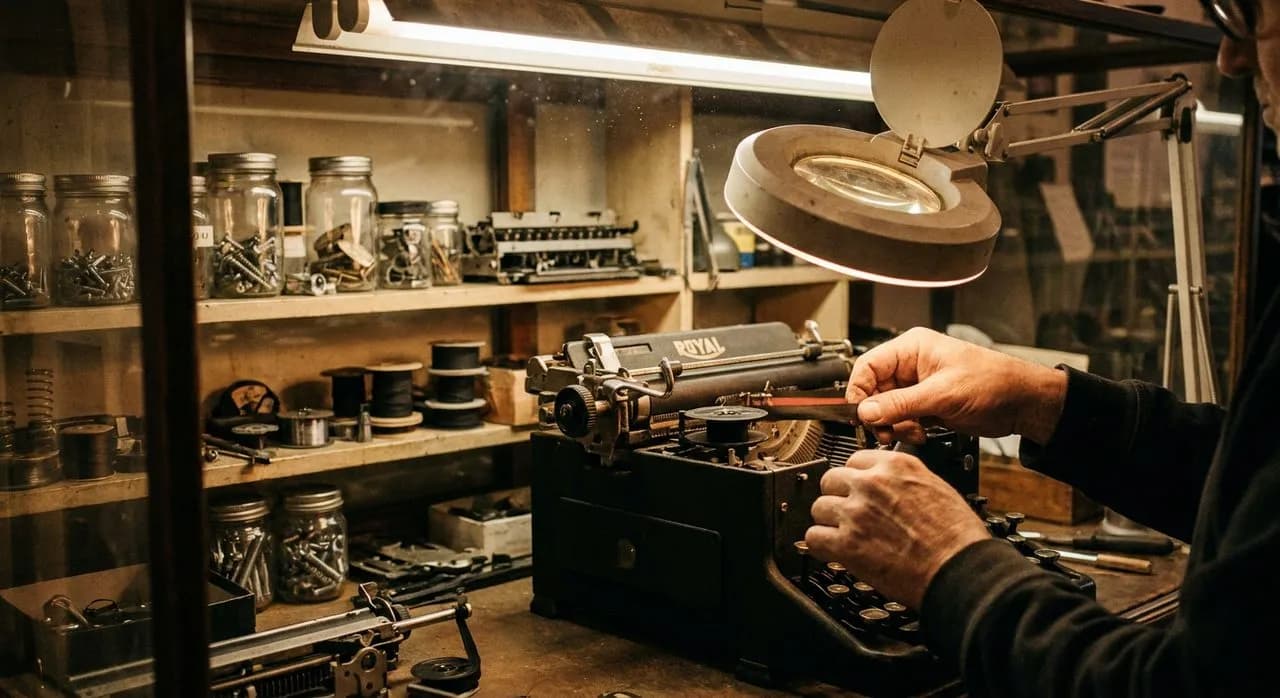
The stairwell smells like radiator paint and old wood, four flights up past propped bicycles and a ficus someone optimistically placed on the third-floor landing. At the top, if it's Thursday through Saturday afternoon, you'll find a door propped open with a wedge of two-by-four, and beyond it a room full of dissected machines. This is not a museum. The Underwood on the jeweler's mat has been stripped to its type bar assembly; the Royal beside it waits for a replacement spring the proprietor found last month at an estate sale in Riverdale. The light through the eastern windows is sharp in late 2026, unfiltered by curtains, illuminating dust motes and the contents of a card catalog that tracks carriage measurements by make and decade.
The Workshop Architecture
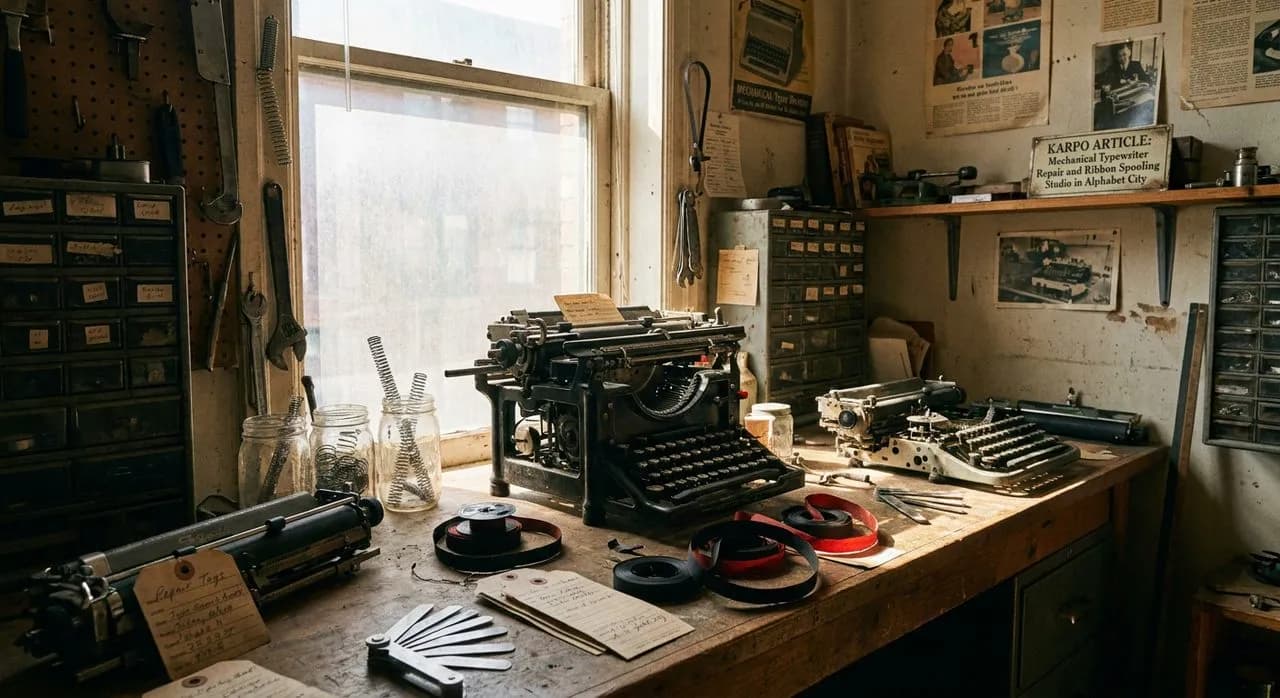
The studio occupies a single room east of Avenue C, configured more like a watchmaker's bench than a retail storefront. Machines in various states of undress crowd two long work tables. Calipers hang from pegboard hooks. A soldering station occupies the corner near the window, its fume extractor duct snaking toward a half-open sash. The air carries the faint metallic tang of flux and oil, occasionally cut by the sweeter note of cotton ribbon ink.
There is no counter, no cash register, no signage facing the street. The proprietor works alone, sleeves rolled, moving between stations with the unhurried focus of someone who has learned that mechanical sympathy cannot be rushed. A visitor arriving for the first time might wonder if they've interrupted something private. They have not. Ring the bell twice.
The Machines and Their Provenance
Most of the typewriters passing through date from the 1920s through the early 1950s—Underwood Standards, Royal Quiets, the occasional Smith-Corona Sterling. They arrive by referral, carried up the stairs in tote bags or secured in vintage cases with fraying leather straps. Some come from writers nursing machines inherited from grandparents; others from set designers hunting a specific carriage width. The proprietor does not advertise and does not need to.
On the back shelf, a 1930s Remington Noiseless sits apart from the repair queue, its cream-colored body buffed to a soft luster. It is reserved for a regular client who climbs the stairs every Sunday morning to type manuscript drafts in longhand transcription, feeding in cotton bond one sheet at a time. The machine is never for sale, and the proprietor has long since stopped fielding offers.
Ribbon Spooling as Craft
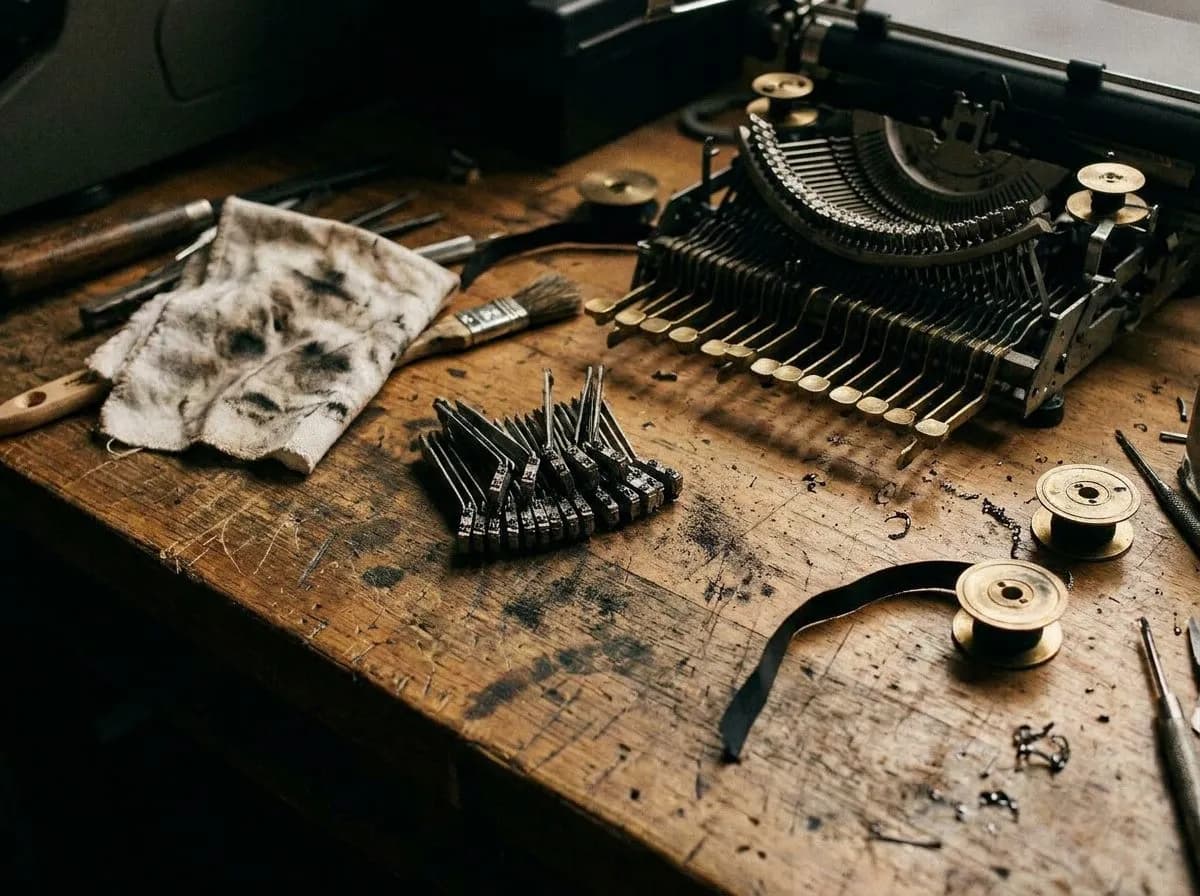
Carbon ribbon work happens at a dedicated station near the north wall, where spools in metal tins are organized by diameter and eyelet configuration. The proprietor stocks cotton only—no nylon, no polyester—and winds each ribbon by hand onto vintage spools salvaged from decommissioned machines. The service runs twelve dollars per spool, a price that has held steady while the surrounding neighborhood has not. Custom colors require 48 hours' notice, long enough to source the dye lot and test it on scrap fabric for bleed.
The process is quiet and methodical. The spool turns on a wooden mandrel; the proprietor's hands guide tension with the same attention given to platen resurfacing and key realignment. It is the kind of task that reads as anachronism until you need it done, at which point it becomes clear how few people still know how.
When to Visit
There are no appointments. The door is propped open Thursday through Saturday afternoons, typically after the morning's soldering work has finished and the station has cooled. Thursday afternoons between two and four o'clock are the quietest window, before the weekend repair queue begins to assert itself. If you arrive during that stretch and express genuine curiosity, the proprietor may lift the hood on a carriage return mechanism and demonstrate how the escapement pawl governs letter spacing, or why a bent type bar must be straightened rather than replaced.
Weekend plans in this part of the city often tilt toward the expected—brunch queues, vintage clothing racks, the usual cadence of a neighborhood that has learned to perform its own bohemian past. The typewriter studio does not perform. It simply continues, four flights up, doing work that was obsolete before most of its clients were born.
What the Work Requires
Restoration here means original parts or nothing. The proprietor maintains a network of estate sale scouts and attic cleaners, people who text photographs of rusted type bar assemblies and ask if the spring tension is salvageable. Sometimes it is. A machine that arrives with a cracked platen may wait months for a donor carcass with the correct durometer. There is no Amazon cart for a 1938 Underwood Champion carriage rail.
The card catalog against the eastern wall is not decorative. Each drawer holds index cards documenting carriage widths, platen circumferences, and keyset configurations by year and model. It is a reference library built incrementally, one measurement at a time, cross-checked against machines that passed through and machines still waiting. In a city guide sense, this is not the kind of attraction that scales. It is small, specific, and built for longevity rather than volume.
Why It Matters
There is something clarifying about a room where function dictates form and nothing is cosmetic. The typewriters that leave this studio do not sit on shelves. They are used—by novelists allergic to the internet, by artists setting broadsheets, by people who prefer the accountability of ink on paper and the mechanical honesty of a key strike that cannot be undone with a backspace. The work is not nostalgic. It is practical, patient, and arcane in the best sense.
The proprietor does not romanticize the machines or the era that produced them. They are tools, ingenious and over-engineered, designed before planned obsolescence became doctrine. What the studio offers is the repair and maintenance those tools require to remain functional, executed with the skill those tools deserve. It is a quiet argument, made in solder and ribbon and realigned type bars, for the value of things built to last.
Practical Notes
The studio is located on the fourth floor of a walk-up east of Avenue C in Alphabet City; exact address available by referral or neighborhood inquiry. Nearest subway: L train to First Avenue, then a fifteen-minute walk east. Street parking is scarce; consider cycling or walking from nearby transit. Open Thursday through Saturday afternoons, hours variable. No elevator access. Bring your machine if it fits in a bag; bring patience if it doesn't. Ring the bell twice. Cash preferred.
Tags: #MechanicalTypewriter #AlphabetCity #TypewriterRepair #TheOddEdit #NYCCityGuide #EastVillage #VintageTypewriter #CarbonRibbon #AnalogueCraft #NYCWeekendPlans #HiddenNYC #PreWarTypewriters #RepairCulture #LowerManhattan #NYCWorkshops
Please drink responsibly. Must be of legal drinking age.
Sources consulted: Typewriter · Alphabet City, Manhattan · NY Times New York Region · Time Out New York · NYC.gov
All trademarks are the property of their respective owners.