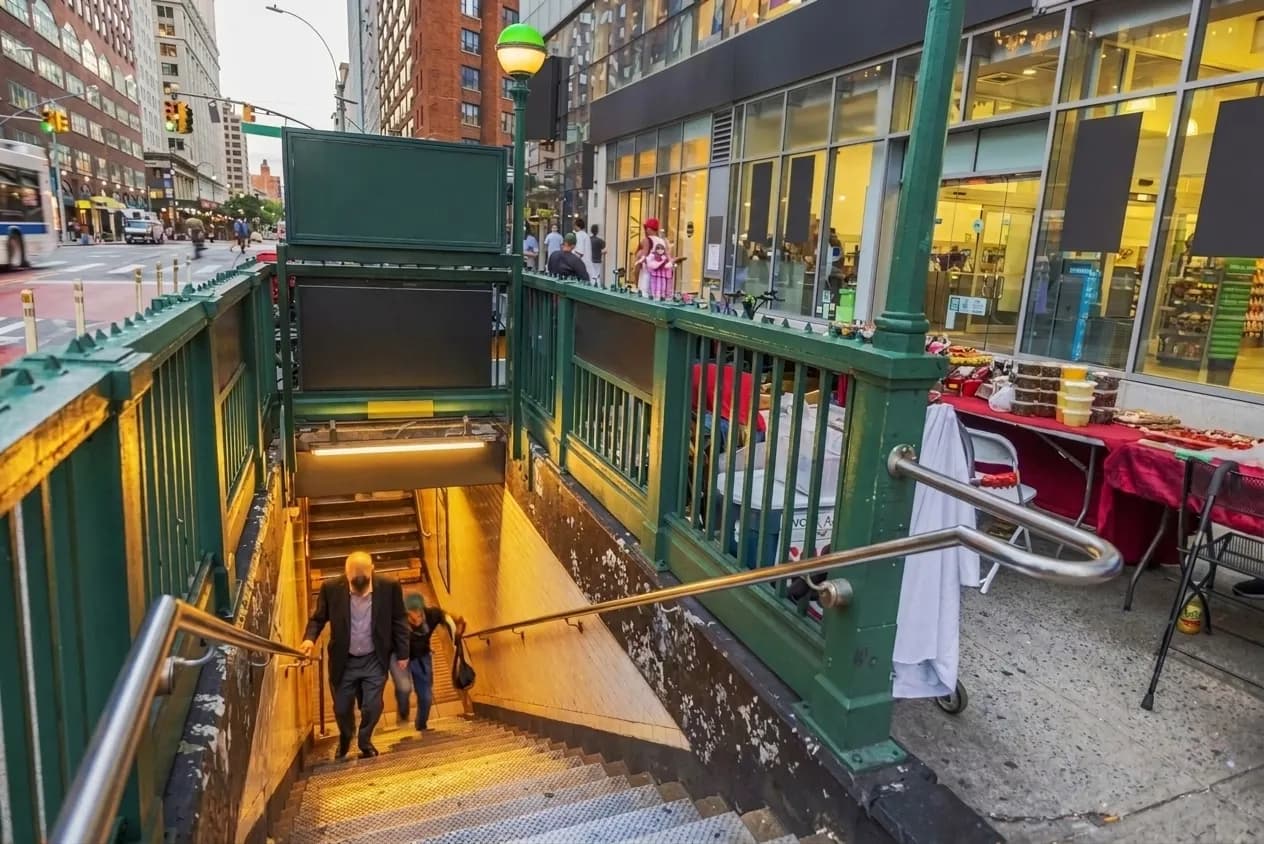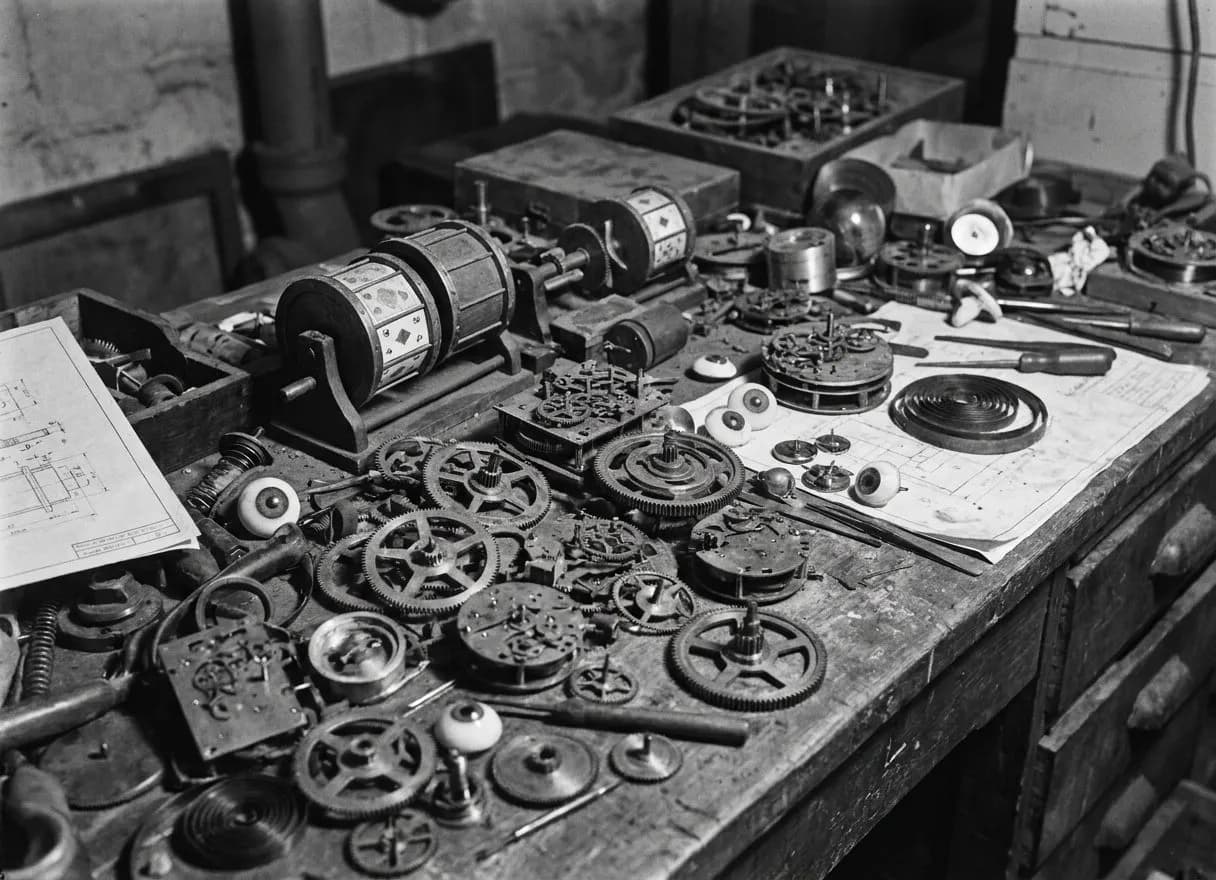
The entrance is easy to miss: a narrow doorway beside a Mott Street herbalist, the kind of threshold that suggests storage rather than destination. Buzz upstairs, wait for the click, descend into a basement thick with the scent of machine oil and old paper. Here, beneath the everyday hum of Chinatown foot traffic, a clockmaker restores mechanical fortune tellers—Zoltar machines, gypsy seers, grandmotherly oracles—using techniques learned during a 1980s apprenticeship in the vanishing arcade shops of Coney Island. The workbench holds cam profiles, spools of cloth-covered wire, and rows of replacement parts salvaged from a bygone era of coin-operated prophecy. It is meticulous, analog work, and winter 2026 finds the shop as busy as ever.
The workshop and its inventory
The basement is organized with the precision of someone who knows exactly where every spring and solenoid belongs. Shelving units line the brick walls, stacked with labeled bins of brass gearing, coin mechanisms in various states of disassembly, and fortune card drums wrapped in protective cloth. One corner cabinet holds the most striking collection: more than two hundred glass eyes, sorted by color and pupil size, all salvaged from scrapped Coney Island machines over decades of dismantling and rescue operations. They catch the overhead light in eerie unison, amber and blue and green, each pair waiting to animate some papier-mâché fortune teller back into uncanny life.
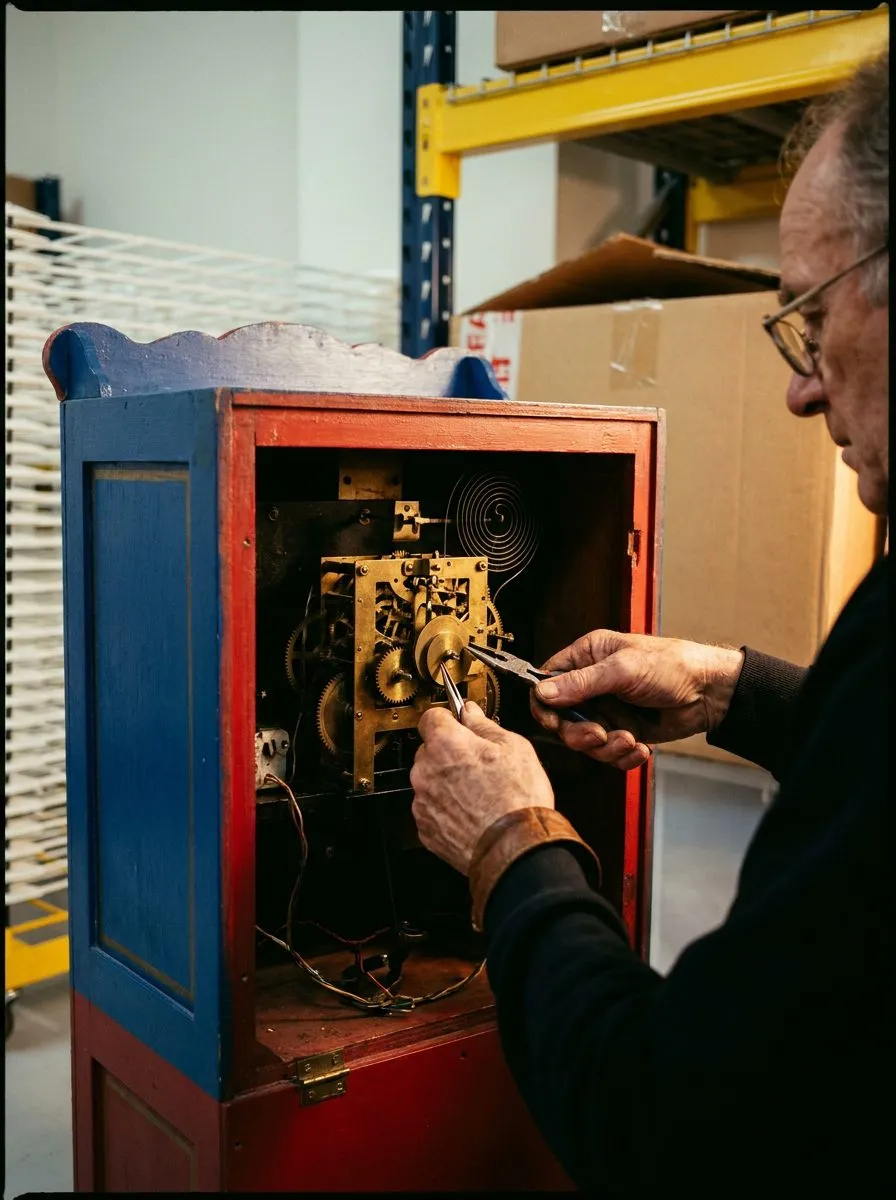
The clockmaker moves between projects with the calm fluency of someone who has spent years negotiating the mechanical vocabularies of different eras. A 1950s Zoltar sits open on the main bench, its torso panel removed to expose a tangle of wiring that must be traced, tested, and occasionally replaced with period-appropriate cloth-covered wire. Nearby, a drawer holds cam profiles—the metal templates that choreograph an automaton's gestures—each one a tiny script for nodding, pointing, or dealing cards. The work requires patience and an inventory deep enough to bridge the gap between what broke and what still exists.
The sound of overlapping fortunes
Monday afternoons in the workshop have a particular character. That is when the clockmaker tests restored voice boxes, the tinny solenoid-driven recordings that give each fortune teller its eerie, scratchy proclamations. The effect is disorienting and oddly charming: three or four machines speaking at once, their 1940s audio layered into a chorus of cryptic advice and vague encouragements. The voices overlap, delay, echo off the brick. It sounds like a séance conducted by broken radios, and it is one of the free things to do in the city if you are curious enough to visit during those testing sessions—just buzz upstairs and ask.
The clockmaker calibrates volume and timing by ear, adjusting potentiometers and checking the travel of the solenoid hammer against the metal resonator. Each voice box is a small miracle of pre-digital engineering, and each restoration is an argument for the irreplaceable texture of analog sound. When the voices finally sync with the automaton's gestures—head tilt, hand wave, card dispense—the effect is seamless, almost alive. Boardwalk operators and private collectors pay well for that illusion.
Grandma in the corner
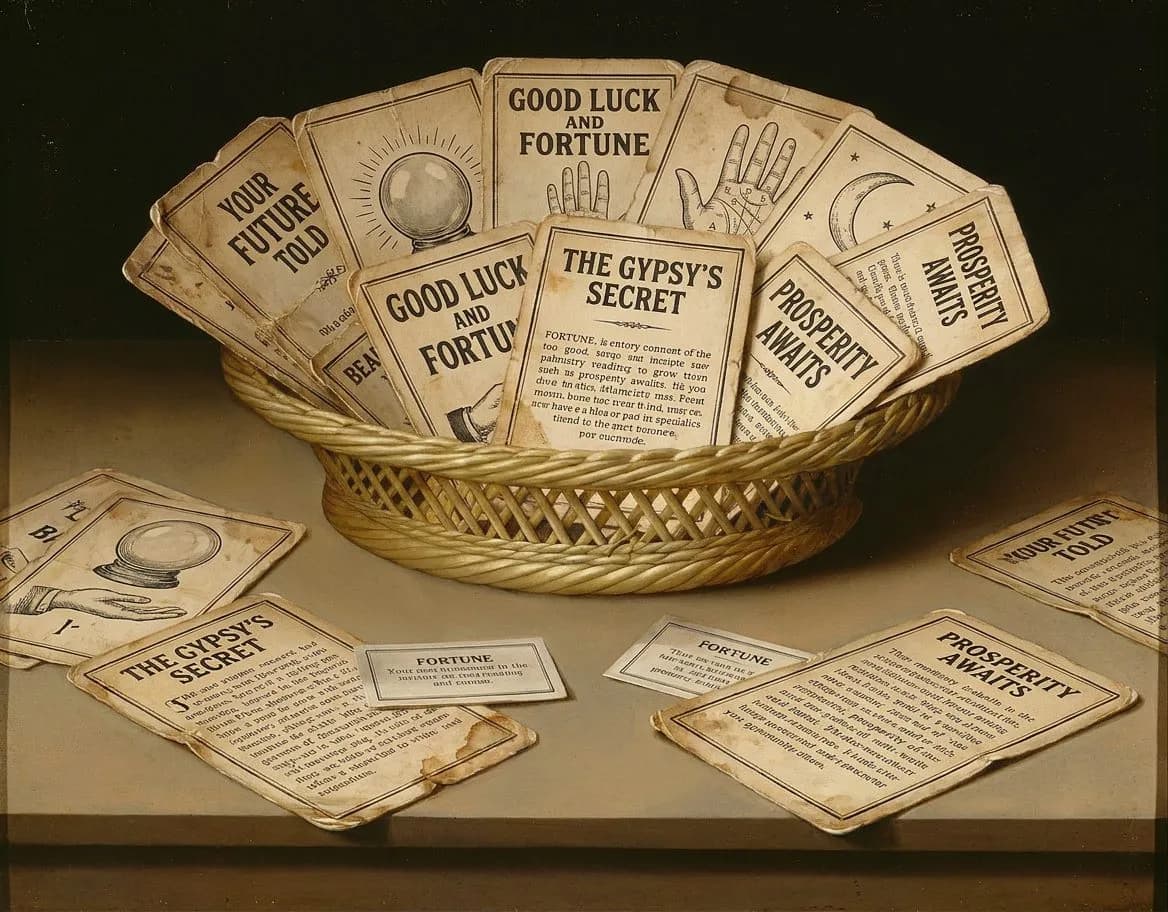
In the far corner of the basement, half-shrouded by a canvas drop cloth, sits a 1940s 'Grandma' fortune teller in mid-restoration. Her papier-mâché hands are frozen in a gesture that might be welcoming or warning, her painted face serene and faintly unsettling under the dim light. She was rescued from a demolished Rockaways arcade in 2019, hauled out just before the wrecking crew arrived. When the clockmaker opened her cabinet for the first time, he found her original fortune card drum still intact, loaded with cards printed in the 1960s—optimistic, vaguely spiritual messages about love and prosperity and hidden talents. He has kept them, planning to restore the drum mechanism so Grandma can dispense her anachronistic wisdom once more.
The restoration is slow, pursued in the margins of paying work. Her internal frame needs reinforcing, her voice box rewiring, her coin mechanism a full rebuild. But there is no rush. The clockmaker has learned that these machines reward patience, that hurrying a solder joint or forcing a stuck gear only creates more work. Grandma will speak again when she is ready, her decades-old fortunes no less relevant—or irrelevant—than they were when Eisenhower was president.
Clients and the boardwalk economy
The shop serves a narrow but loyal clientele: private collectors hunting for centerpiece automatons, boardwalk operators keeping their arcades running, and the occasional museum curator looking for someone who can coax a century-old mechanism back to life. Most clients find the workshop through word of mouth or obscure online forums dedicated to coin-op restoration. Appointments are scheduled around the clockmaker's availability, typically Monday and Wednesday afternoons, though emergency repairs sometimes stretch into evenings.
Repairs range from simple cleaning and lubrication to full mechanical overhauls. A jammed coin slot might take an hour; a complete rewiring and gesture recalibration can take weeks. The clockmaker does not advertise rates publicly—each job is quoted individually based on condition, rarity, and the client's timeline. What he offers is increasingly rare: not just technical skill, but an institutional memory of how these machines were built, maintained, and kept running during their heyday. As that knowledge disappears, the basement on Mott Street becomes something closer to an archive than a repair shop.
The apprenticeship and the trade
The clockmaker's education began in the 1980s, apprenticing at the arcade repair shops that once dotted Coney Island. Back then, the boardwalk still hummed with coin-operated attractions, and someone who could fix a Skee-Ball machine or a fortune teller had steady work. He learned to read circuit diagrams by flashlight, to true a cam by feel, to diagnose a problem from the quality of a click or hum. The trade was tactile, improvisational, and rapidly vanishing as digital games replaced mechanical ones.
When the arcades began closing in the 1990s and 2000s, he salvaged what he could—parts, schematics, entire machines—and eventually set up his own shop. The Chinatown basement came later, a fortunate connection through a family friend who owned the herbalist upstairs. It is quiet, affordable, and discreet, the kind of space where someone can spend an afternoon aligning gears without interruption. The work has never made him wealthy, but it has kept a small, strange corner of mechanical history alive.
Practical notes
The workshop is described as being in Manhattan's Chinatown, but the exact address should be removed unless independently verified. The nearest subway and parking details should be verified before publication or removed if unconfirmed. Appointments are by request; specific weekly hours should be omitted unless confirmed. The space is not wheelchair accessible due to steep basement stairs. Bring curiosity and patience; the clockmaker is generous with explanations but protective of his work schedule. Verify current availability directly before planning a visit, as hours shift seasonally and around large restoration projects.
Tags: #MechanicalFortunetelling #ChinatownNYC #AutomatonRepair #VintageArcade #TheOddEdit #ZoltarMachine #CoinOperated #HiddenWorkshop #NYCCuriosity #ClockmakerCraft #PennyArcade #ConeyIslandHistory #WinterInTheCity #ObscureNYC #UrbanArchive
Sources consulted: Fortune Teller Machines · Chinatown, Manhattan · Coney Island · Coney Island Parks · Atlas Obscura NYC
All trademarks are the property of their respective owners.