What Manhattanhenge Actually Is
Manhattanhenge is the moment, four times a year, when the setting sun aligns precisely with the Manhattan street grid — the grid Commissioner DeWitt Clinton's 1811 surveyors laid out at 29 degrees east of true north, rotated to fit the island. The geographic alignment of that rotation means the sun sets exactly along the centerline of every east-west cross-street for two consecutive evenings in late May and two in mid-July. Neil deGrasse Tyson named the phenomenon in 2002 after the comparable sunset alignment at Stonehenge.
The May 2026 dates per the Hayden Planetarium are:
- May 28: half-sun on the grid at 8:13pm.
- May 29: full sun on the grid at 8:12pm.
Sun above the horizon for about three minutes either side of the listed time. The sunset itself is the four-second moment when the disk crosses the visible building edge.
Why 42nd Street, Specifically
There are dozens of east-west cross-streets where Manhattanhenge plays. 14th, 23rd, 34th, 42nd, 57th, and 79th are the canonical ones because they are wide thoroughfares that give the sun room to breathe and have unobstructed lines of sight to the Hudson. Of those, 42nd Street is the one with the most theatrical setting — the New York Public Library on Fifth, Bryant Park, Times Square at Seventh, the Bank of America Tower, the McGraw-Hill Building, Times Square Plaza, the entire deck of the Hudson at the end.
42nd Street is also where Tudor City Overlook is — and that is the secret. Tudor City Overlook is an elevated pedestrian bridge spanning 42nd Street at First Avenue. Neil deGrasse Tyson himself recommended it as the best Manhattanhenge viewing position in Manhattan in his 2014 op-ed. The Overlook lifts you 30 feet above the street, which means you are looking down the entire length of 42nd Street to the Hudson with no parked truck in your foreground.
The 7:30pm Start at Tudor City Overlook
Tudor City Place crosses 42nd Street at First Avenue between Tudor City Place's south leg and north leg. The Overlook is the pedestrian bridge spanning 42nd Street between those two halves of Tudor City. To get there: walk to East 42nd Street and First Avenue. Look up at the two stone-clad apartment towers at the top of the small slope. The bridge between them is the Overlook. There is a small park on each side. Both are public, both are open until 11pm, both are free.
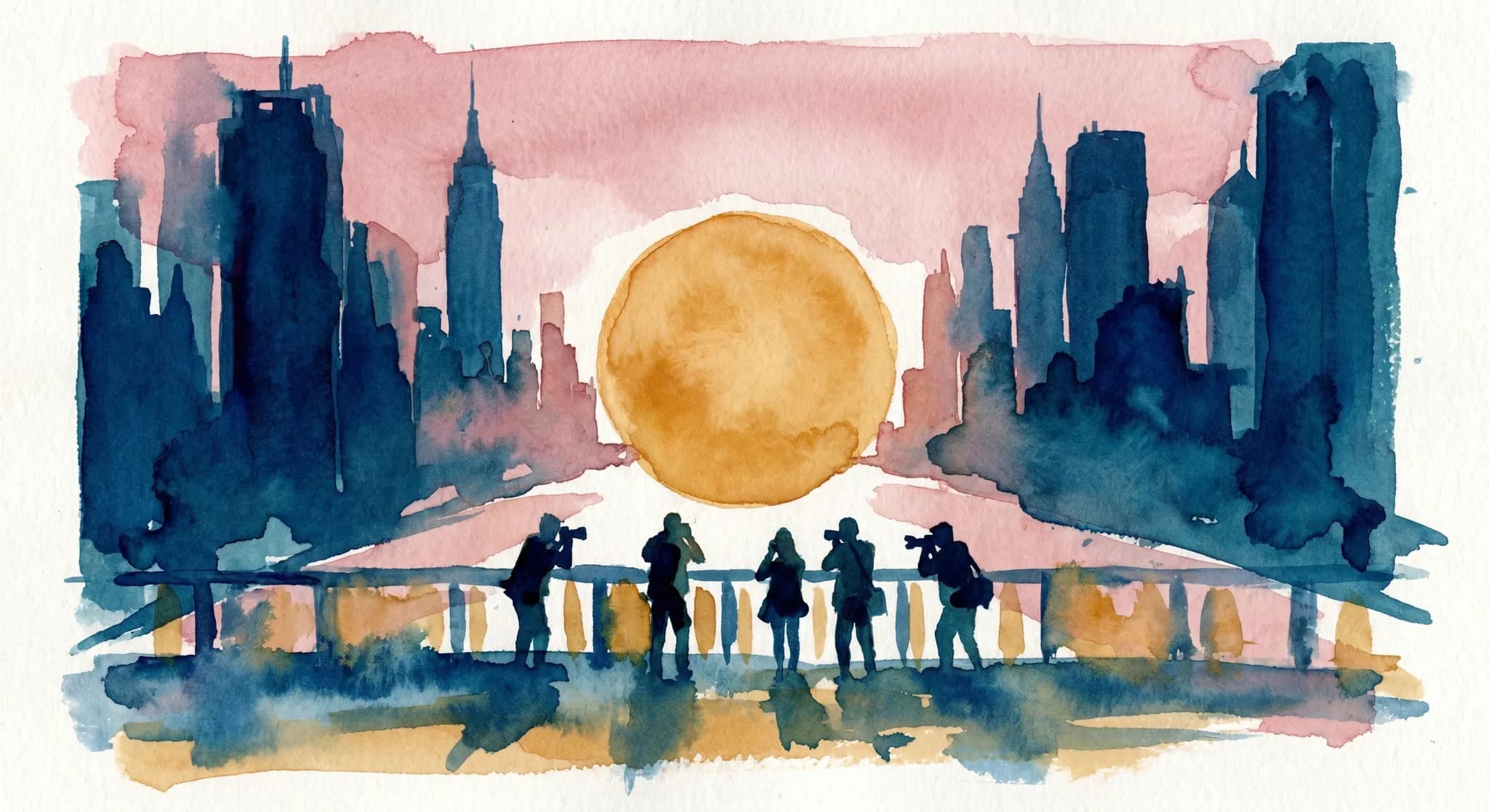
Arrive at 7:30pm. The crowd is roughly 200 people on a normal May 28 evening — photographers, locals who heard from Hayden Planetarium, tourists with smartphones who saw it on TikTok. Find a railing position facing west. Stay for 40 minutes. The alignment moment is 8:13pm. The peak photographable moment is 8:11pm to 8:14pm.
After the Alignment, the Walk Begins
Most people stay at Tudor City for an hour and go home. The walk uses the moment as the start, not the end. At 8:18pm, leave the Overlook, take the stairs down to 42nd Street, and start walking west.
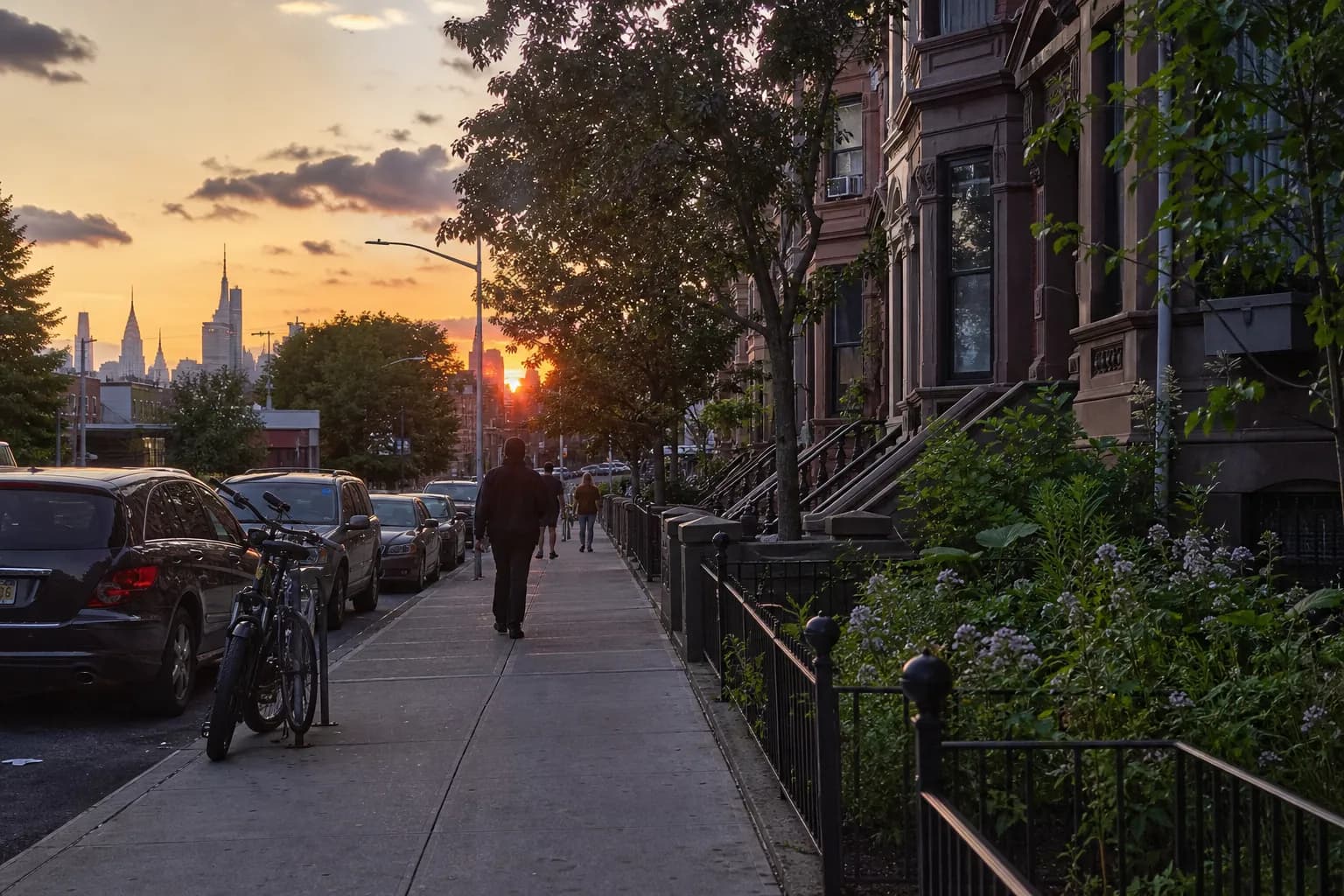
42nd Street has the warmest residual light of any east-west cross-street in Manhattan during the ten minutes after the Manhattanhenge alignment. The buildings on either side bounce the dying ochre wash off their cobalt glass. You are walking inside a furnace of soft pink and warm orange that will not exist again until July.
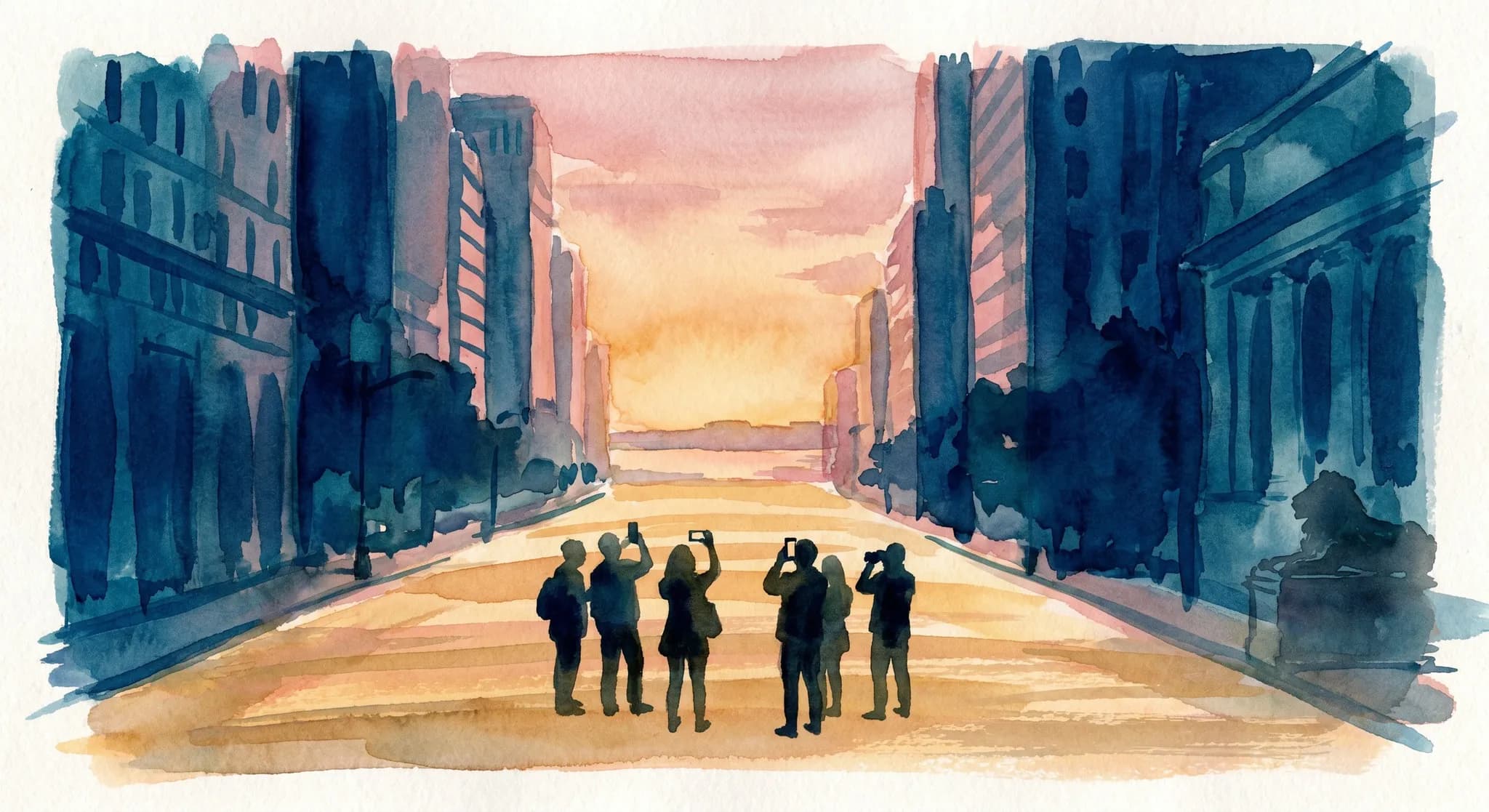
Block by Block, Westbound
- First to Second Avenue. Leaving Tudor City. The Chrysler Building, the most photogenic Art Deco tower in the city, appears on your right at Lexington.
- Second to Fifth. You pass Grand Central on the right at Vanderbilt. The Pershing Square viaduct overhead.
- Fifth to Sixth. The New York Public Library main branch on the right, Bryant Park on your left. The lion statues are eight feet from your shoulder.
- Sixth to Seventh. The Bank of America Tower on the right. One of the few skyscrapers in the city that lights its mast in a slowly rotating warm-tone gradient at this hour.
- Seventh to Ninth. Times Square. You are walking through the late-stage west wall of Times Square as the LED billboards take over the light source the sun just abandoned.
- Ninth to Twelfth. The Westside Highway corridor. Port Authority Bus Terminal recedes behind you. Hell's Kitchen apartment blocks on either side.
- Twelfth and 42nd to Pier 84. Cross the Westside Highway at the pedestrian crossing. Pier 84 is the wide free public pier directly at the end of 42nd Street.
At Pier 84, What You See
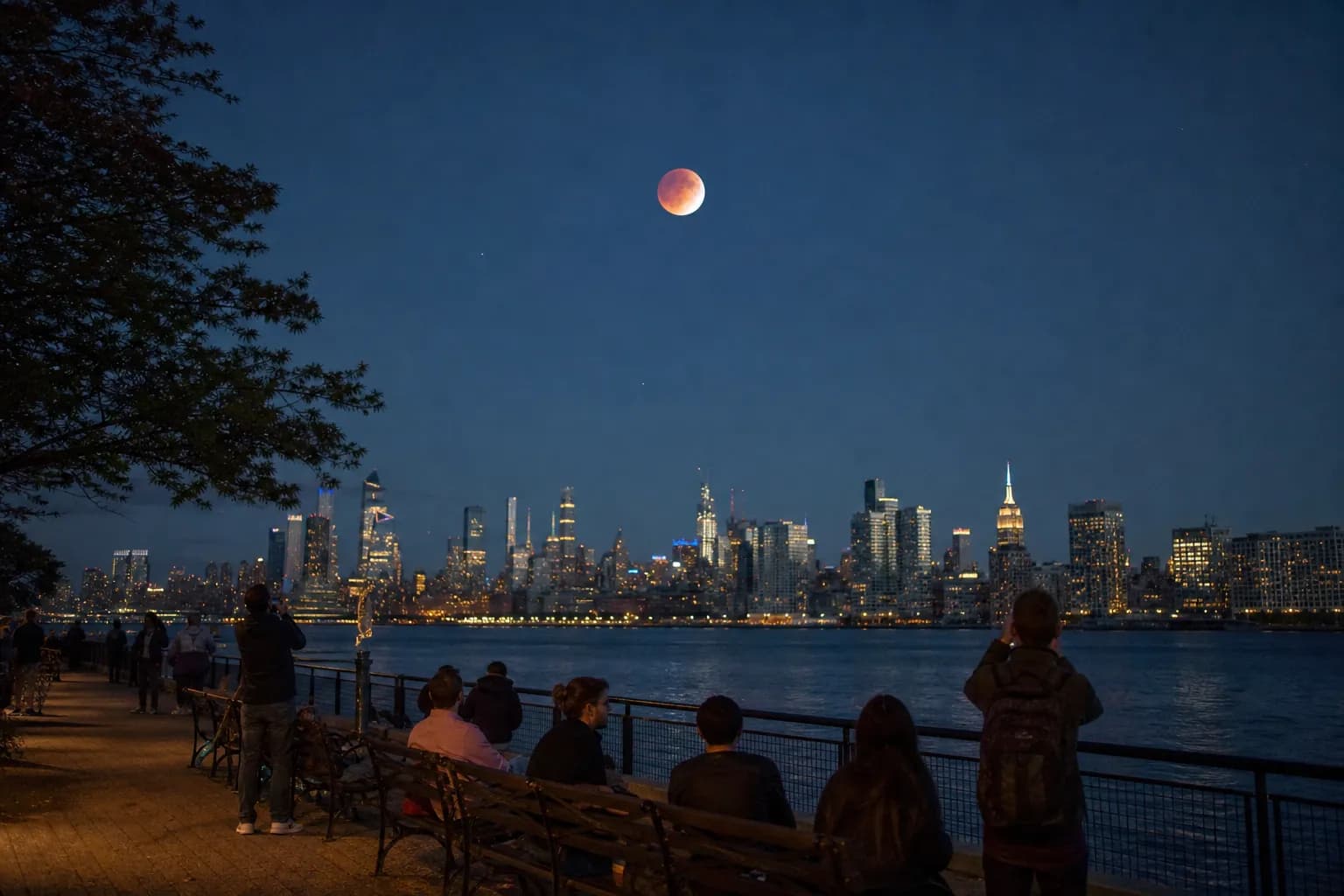
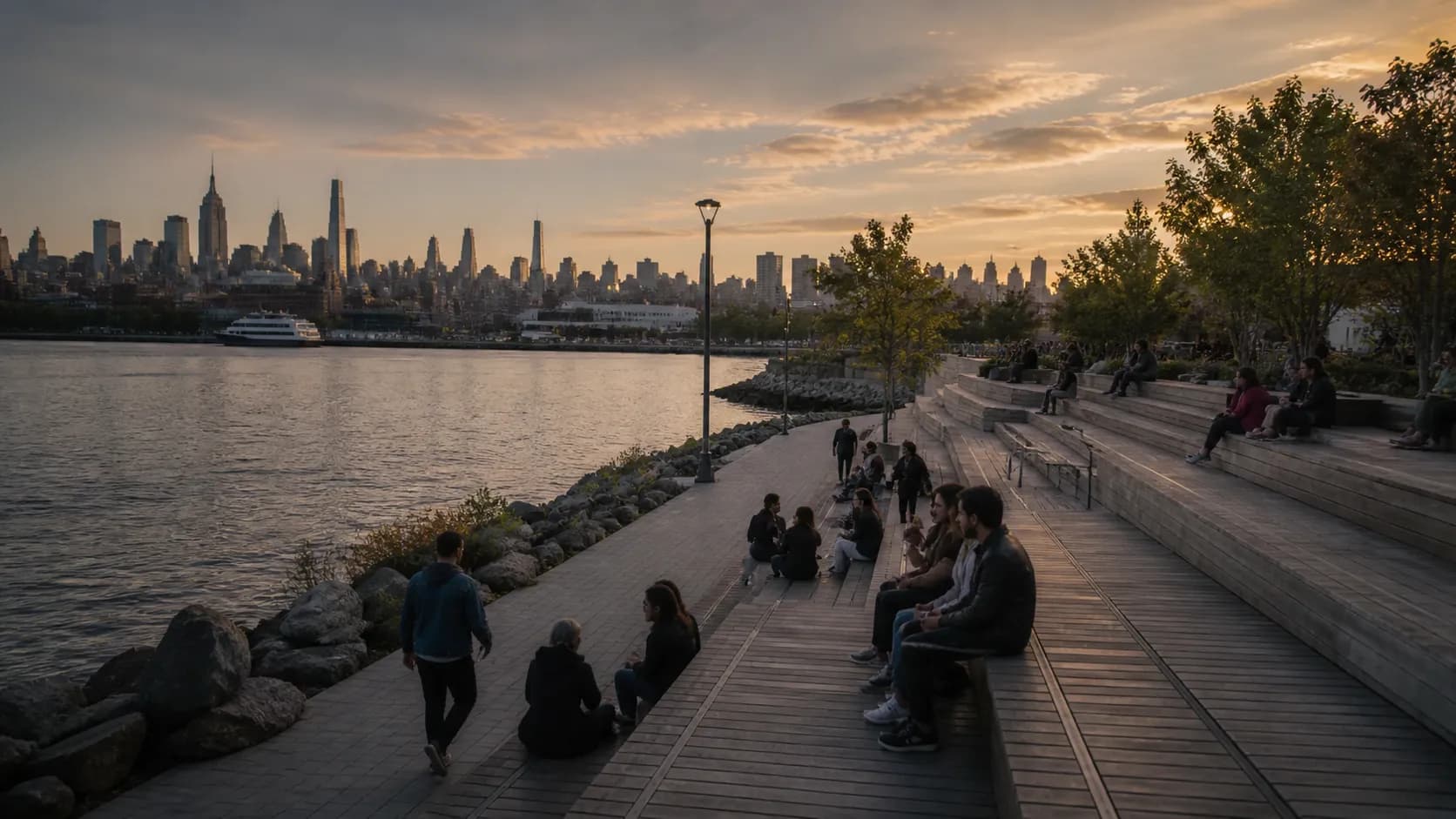
By the time you arrive at Pier 84 it is 8:25pm. The sun is fully below the horizon. The sky over New Jersey is graduating from warm pink at the horizon through dusty pink to deep cobalt at the top. The Hudson is a long flat sheet of cobalt water reflecting the gradient. You can see all the way north to the George Washington Bridge — pin-points of lights — and south to the Statue of Liberty silhouetted against the deeper sky.
Pier 84 has benches, a public restroom, free wifi, and a small kiosk that closes at 9pm. Stay for 15 minutes. The light is changing fast. By 8:45pm it is fully blue hour. By 9pm it is night, the New Jersey skyline is all lights, and the walk is complete.
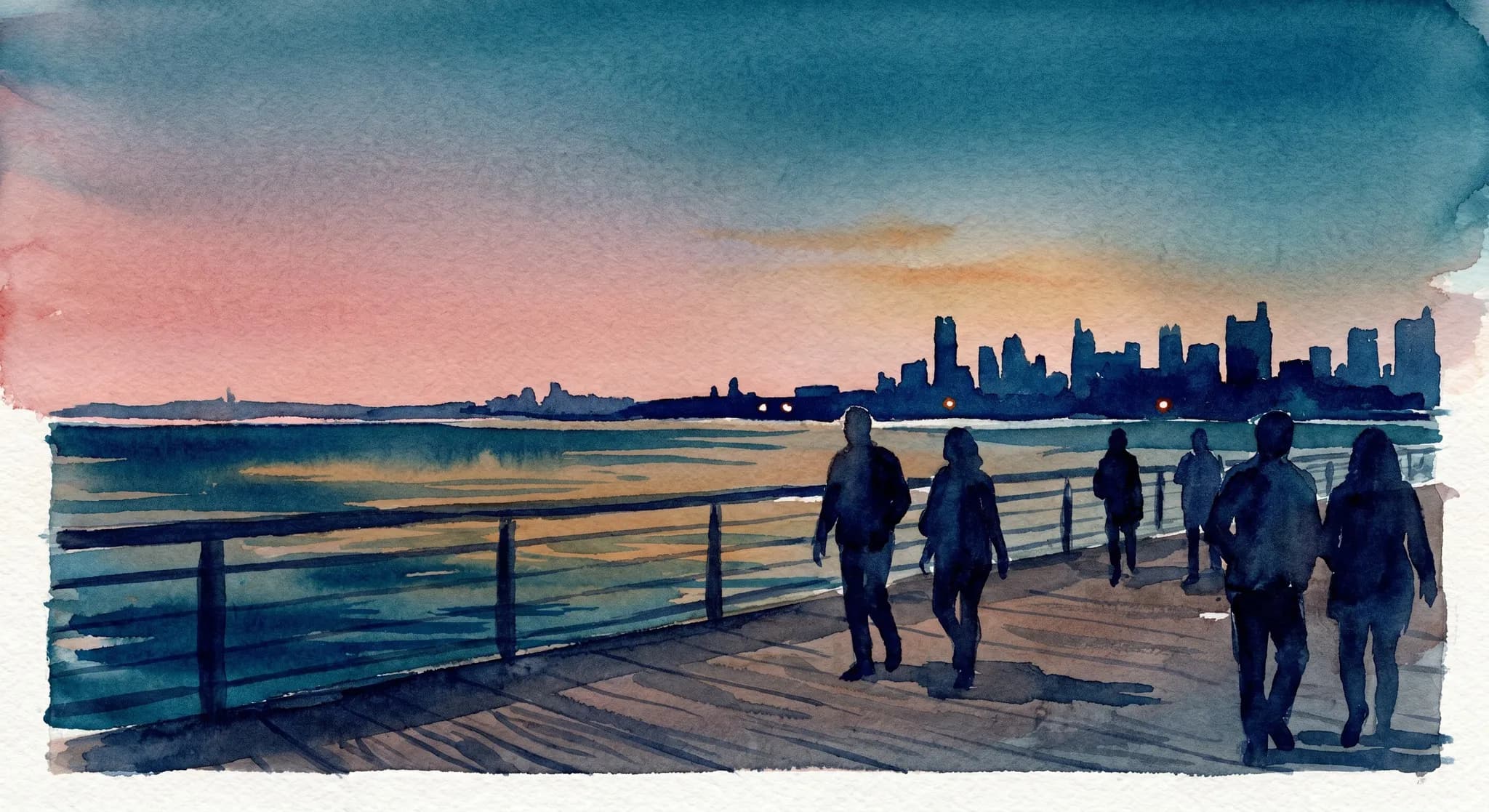
Why The Walk Is Better Than The Photograph
Most of the 250,000 people who attempt Manhattanhenge stand in one place — usually 23rd, 34th, or 42nd at Fifth — phone up, get a fifteen-second photo, post it to Instagram, and leave. The photograph is fine. The phenomenon is more than the photograph. The actual visual event is the slow rotation of the city's light temperature from gold to cobalt over forty minutes, framed by the same Manhattan grid Commissioner Clinton imagined in 1811.
The walk is the only way to experience the full duration. By doing 42nd Street river-to-river, you start at the alignment moment, walk through its residual minutes, watch Times Square swap natural for synthetic light, and end at the river in full blue hour. The phenomenon is what makes the walk worth doing. The walk is what makes the phenomenon comprehensible.
The Practical Window
- Distance: 2.5 miles (4 km) from Tudor City Overlook (42nd and 1st) to Pier 84 (42nd and 12th).
- Time: 55 minutes including the 40-minute Tudor City stop.
- Best dates: May 28, 2026 (half-sun 8:13pm), May 29 (full sun 8:12pm). Backup: July 11–12.
- Tickets: free. Tudor City is public. Pier 84 is public. 42nd Street is public.
- Getting there: 4/5/6/7/S to 42 St Grand Central, walk three blocks east to First Avenue then south to Tudor City.
- Getting back: from Pier 84, walk one block north to 12th Avenue and 43rd Street for the M11/M42 bus. Or walk east five minutes to the A/C/E at 42 St Port Authority.
- Photographer tip: 70-200mm lens compresses the perspective. Phone tip: zoom in 3x.
- Weather: cloudy western horizon kills it. Check NYC weather at 6pm.
- Crowd timing: arrive Tudor City by 7:25pm to get a railing spot. By 7:50pm the bridge is full.
Why This Walk This Week
Manhattanhenge is the only urban-planning phenomenon in any American city that produces a four-minute astronomical event the entire population stops for. May 28 and 29 are circled on every New Yorker's calendar. The search trend is climbing this week, will spike on the 27th, peak on the 28th, and reset to background by the 31st.
The walk takes the phenomenon and turns it from a fifteen-second photograph into a 55-minute experience of one specific cross-street at one specific kind of light. 42nd Street, river-to-river, from a Hayden-Planetarium-recommended overlook to the same Hudson pier the Half Moon docked at in 1609. The alignment lasts four minutes. The walk lasts an hour. The difference is what you get to remember.
Right on time, May 28 and 29, 2026, 7:30pm.
Tags: #manhattanhenge #manhattanhenge2026 #nyc #42ndstreet #tudorcity #hudsonriver #pier84 #thelongwayhome #karpofinds #nycsunset #bluehour
Sources consulted: Hayden Planetarium — Manhattanhenge · Tudor City Greens · Pier 84 — Hudson River Park
All trademarks are the property of their respective owners.