 Clapham Board Game Night Finder: New to London Meetups
Weekend Plans
Science Museum Near Me in Mayfair: Faraday's Lab at the Royal Institution
The Faraday Museum inside the Royal Institution at 21 Albemarle Street is free and open Monday to Friday 9am–5pm. See Faraday's 1850s magnetic lab, Davy's safety lamp and Dewar's first flask.
Michael Faraday's magnetic laboratory survives in the basement of 21 Albemarle Street, London W1S 4BS, set up as it was in the 1850s, and you can see it for free. The Faraday Museum inside the Royal Institution opens Monday to Friday from 9.00am to 5.00pm only, closes on every public and bank holiday, and sits five minutes on foot from Green Park station. Anyone searching science museum near me in Mayfair will find the smallest entry on the London list, but it is the one where the electric motor, the transformer and the vacuum flask were actually invented.
Weekday Hours and When to Phone First
Weekend visitors are out of luck: the doors are shut on Saturdays and Sundays, and the building hosts private events that can limit access on weekdays too. October had closures on the 1st and from the 12th to the 15th, so if you are reading this mid-October the building has just reopened.
The entrance on Albemarle Street is step-free through manual double doors, and a single lift in the Atrium serves all public floors. Large bags and rucksacks go into a small unattended cloakroom, and staff may also ask you to leave briefcases, walking sticks or umbrellas there. The Ri Café inside keeps shorter hours than the museum, Monday to Thursday from 9.00 to 15.00, so do not count on lunch here on a Friday.
What Is Down in the Basement
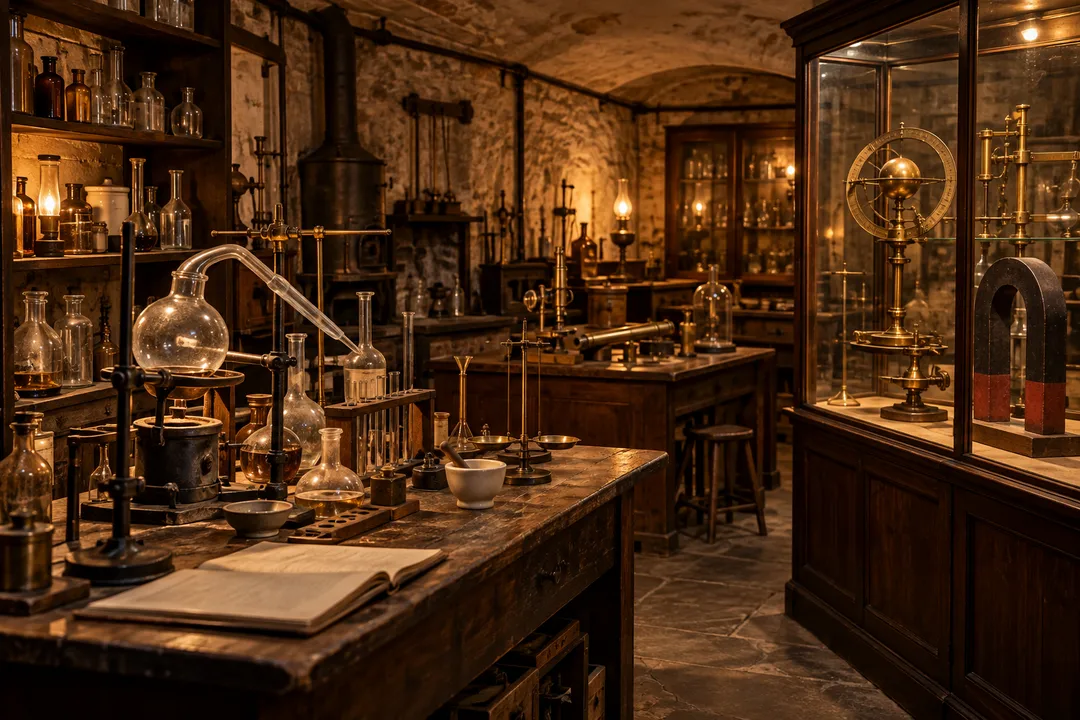
Start on the lower ground floor. Faraday's magnetic laboratory is preserved as it looked in the 1850s, and directly opposite through the glass is a working nanotechnology lab, which makes the point of the building in one glance: research has been done in these rooms for more than two centuries. The same floor shows the first electrical transformer, John Tyndall's tube that explained why the sky is blue, and an archive case that rotates temporary displays from the collection.
The Ri lists its iconic objects online, and most of them are within a few metres of each other here. Look for Faraday's ring-coil apparatus from August 1831, his 1822 electromagnetic rotation apparatus that counts as the first electric motor, Humphry Davy's 1815 prototype miners' safety lamp, James Dewar's 1892 vacuum flask, a sample of benzene that Faraday isolated in 1825, and his ruby-coloured gold colloids, which are still suspended in their glass.
Ground Floor Stories and the Grand Staircase
Upstairs, the ground-floor displays cover Faraday, Davy and Ada Lovelace, and a wall that counts the 14 Nobel Prize winners who worked at the Ri. William Bragg's ionization spectrometer from 1912 to 1913, the instrument behind X-ray crystallography, belongs to this part of the story. The first floor turns to the famous lecturers and their props, with short film clips from past Christmas Lectures.
Take the Grand Staircase rather than the lift at least once. The marble statue of Faraday by Foley and Brock, unveiled in 1876, stands on it, and four portraits by Henry William Pickersgill hang along the walls. The museum was accredited on 20 September 2009, but the building itself is Grade I listed, and the staircase is where the institution still feels like a Georgian gentlemen's society rather than a gallery.
The Lecture Theatre and the Paid Tour
The free museum does not include the famous lecture theatre, the room where the Christmas Lectures for young people have been held. To see it, along with the Faraday Lab and the library, you need the 45-minute Welcome tour, which is free for members and £10 for non-members plus an Eventbrite booking fee. The fee is refunded if you join on the day. Tours run on set dates published on Eventbrite rather than daily, so book a slot before you travel instead of turning up hoping to join one, and leave your large bag at the hotel because the tour moves between floors.
Our honest advice: if you are short on time, skip the first-floor lecture displays and spend the minutes downstairs. The basement objects are the originals, while the upper floors lean on film clips and reproductions. Pair the free basement with the paid tour only if the lecture theatre itself is the draw, since the tour covers the lab again.
A Society Founded in Soho Square
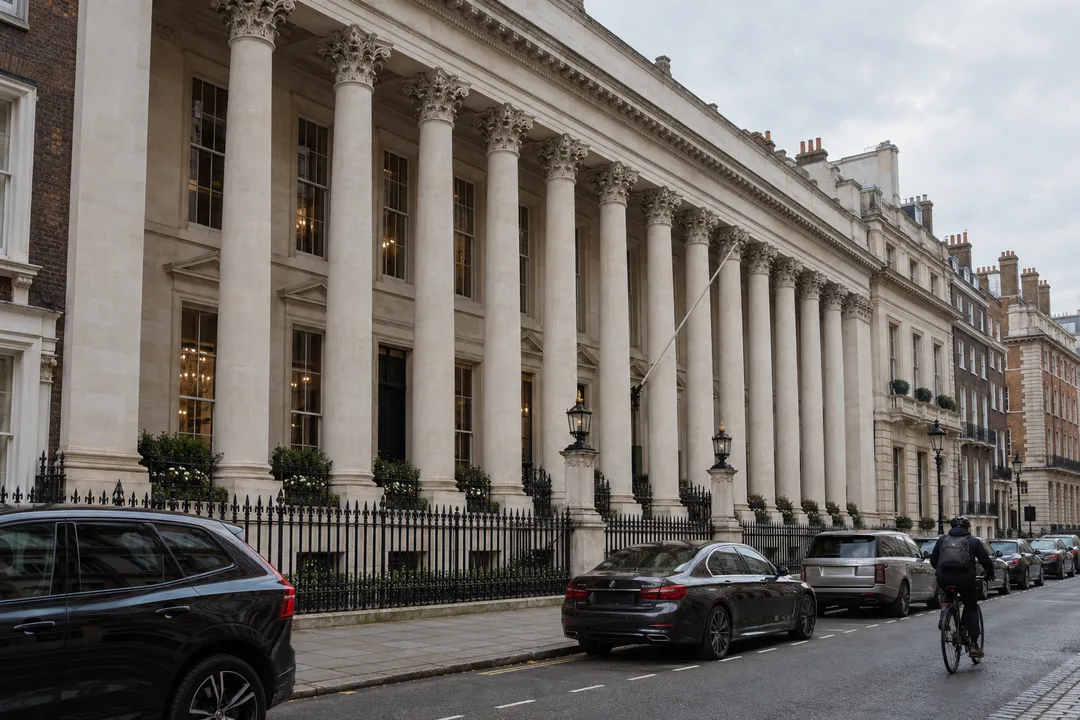
The Royal Institution was founded at a meeting in Sir Joseph Banks's house on Soho Square on 7 March 1799, bought 21 Albemarle Street that July and received its Royal Charter in 1800. Thomas Webster designed the lecture theatre in 1800, and the long row of columns on the street front, the reason passers-by stop to photograph a building on such a narrow Mayfair street, came with Lewis Vulliamy's 1837 facade.
Faraday arrived as Humphry Davy's assistant and stayed for most of his working life, living and working in the building. That continuity is why the collection is so concentrated: the apparatus never had to travel far from where it was used. The Ri became a membership organisation in 1810 and still runs public talks, which is why the Atrium can be busy in the early evening long after the museum closes.
Practical Notes and a Mayfair Loop
Green Park station on the Jubilee, Victoria and Piccadilly lines is the closest, about five minutes away; Piccadilly Circus and Oxford Circus are both within ten minutes. Buses 9, 14, 19, 22 and 38 run along Piccadilly at the bottom of the street. Allow forty-five minutes to an hour for the museum, more if a school group is working through the basement.
Make a loop of it. Walk south to Piccadilly and turn left for Fortnum and Mason and the Royal Academy of Arts at Burlington House, both within five minutes of Albemarle Street, then cut through Burlington Arcade back toward Bond Street. If you would rather finish with green space, cross Piccadilly into Green Park and walk down to Buckingham Palace, about fifteen minutes from the Ri's front door.
Ask Karpo for more information.
Keep reading
- Clapham Board Game Night Finder: New to London Meetups
 Marylebone Board Game Night Finder: Baker Street Mysteries
 Notting Hill Board Game Night Finder: Two-Player Rainy Dates