 Richmond Park Sunset Viewing Planner: Deer Meadow Horizons
Weekend Plans
London Scenic Pedestrian Bridge Route for a Riverside Sketch
Build a London scenic pedestrian bridge route at Teddington Lock around a riverside sketch, comparing the suspension crossing with the rural Ham bank.
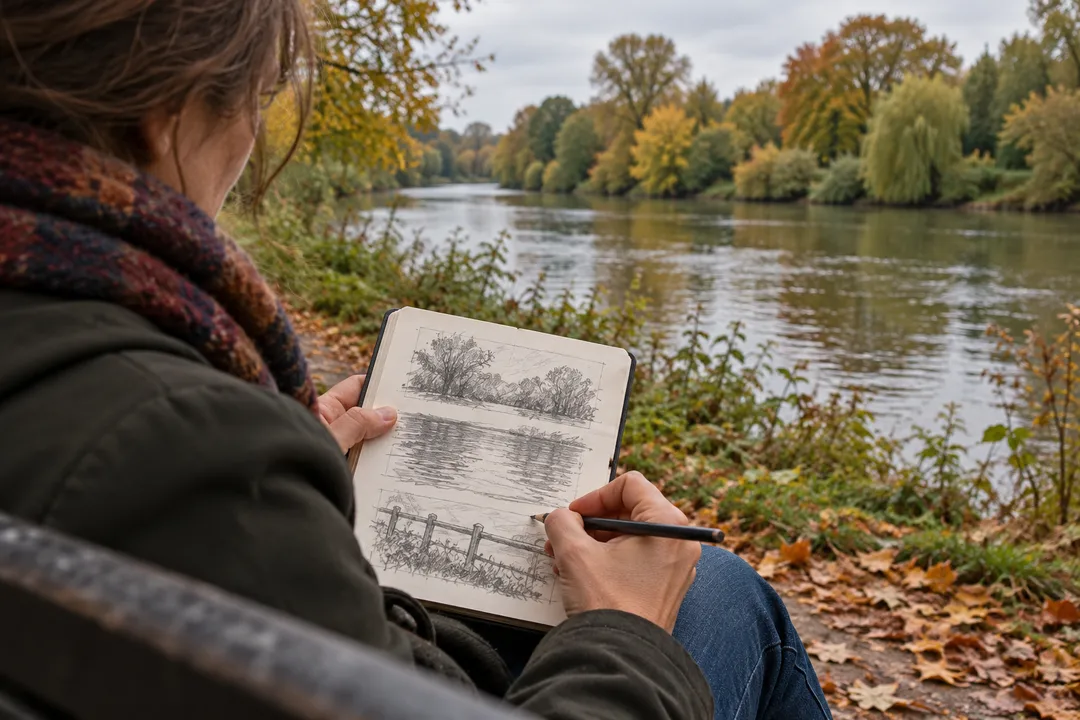
Cover illustration: an AI-generated riverside sketching activity, not a photograph of Teddington or its bridges. Teddington Lock offers a different subject for a London scenic pedestrian bridge route: the transition between a built-up river approach and the more rural character of the Ham bank. Richmond Council's conservation appraisal identifies that contrast, along with the footbridges and river structures. Make it a sketch walk rather than a race to a distant viewpoint. You need a small notebook, a drawing tool and a subject narrow enough to finish. Artistic skill is optional. The useful outcome is noticing how a bridge changes your sense of the place on either side.
A page with three small panels
Divide a notebook page into three areas while you are still on land. Label them in your own words: approach, structure and other bank. The labels organise observations, not fixed stopping positions. You can fill the page from any suitable public position that leaves the walking route clear. Keep the first drawing deliberately small. A sketch that requires a complete panorama encourages you to stay too long in one place and can turn the crossing into an exercise in finishing homework.
For the approach panel, select a relationship rather than an isolated object. A building edge meeting trees, a stretch of railing above water or the change between a street and the riverside all give you something to compare later. Leave room for a note about sound or movement. You might record a mechanical sound, voices or water, but write what you actually encounter. The plan does not promise boat movements, working machinery or a quiet bank at the moment you arrive.
Suspension and girder: look for the difference
The council's appraisal describes two footbridges: a western suspension bridge and an eastern iron girder bridge. That is enough of a starting point for an architectural observation without learning a full engineering vocabulary. Look for the visible lines that distinguish them. Which parts appear to hang, which form a solid span, and where does the deck seem to lead? Record your visual impression rather than a technical explanation you cannot support. A question mark beside an unfamiliar detail is a useful part of a sketch.
Draw the structure from the bank when possible, then cross without trying to draw while walking. You can add remembered details after reaching the other side. This separates observation from movement and gives other people space. If there is no comfortable public position for the view you wanted, choose a smaller subject from elsewhere. A sketchbook is portable enough to adapt. The point is to understand the relationship of the crossings, not to occupy the most photogenic position regardless of the people passing through it.
The Ham-bank panel should change the scale
For the third panel, make a conscious change in scale. If the first drawing concentrated on a building or a railing, let trees, open ground and the water's edge take more space here. The council describes the Ham side as having a rural character, but your drawing should still come from the scene in front of you. A conservation description gives context, not a guarantee that every view is pastoral or free of people. Draw the actual interruption as well as the expected greenery.
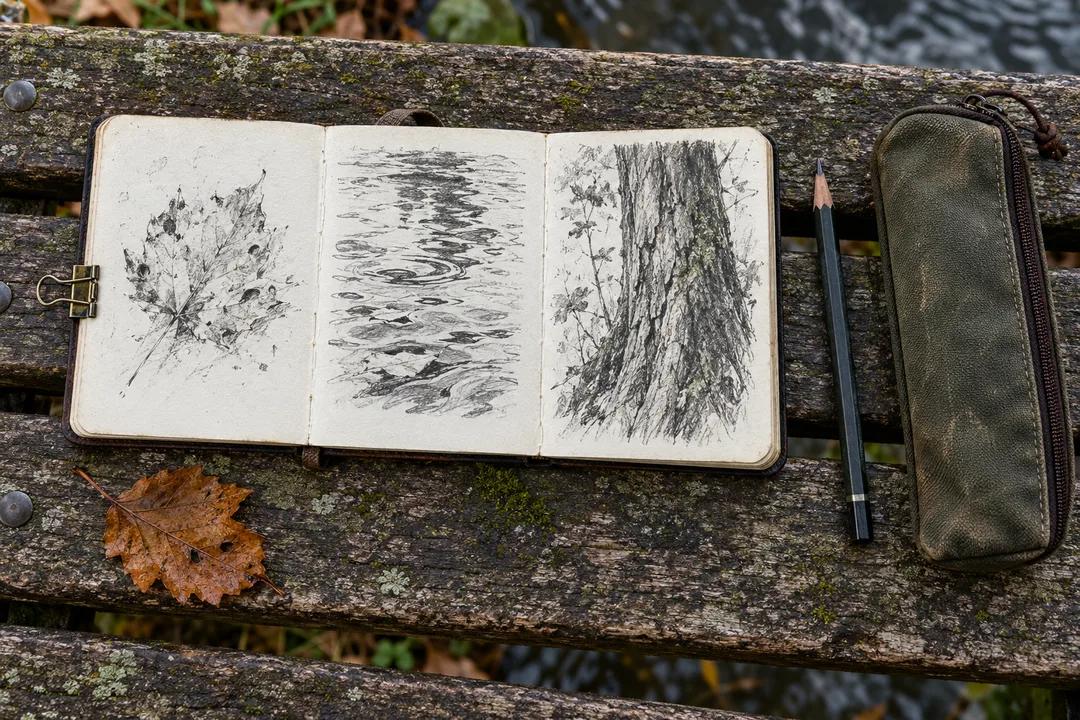
Compare the three panels before deciding whether to continue. You may discover that the most interesting transition happened on the approach rather than in the middle of the bridge. That is a good result. Write one sentence describing the change and stop the drawing exercise there. If you are with a companion, exchange descriptions without ranking whose picture is better. Someone who has barely drawn can still notice a sharp change in the width of a view or the way trees conceal the river beyond a railing. The image below is an AI-generated sketchbook exercise showing leaves, water and bark, not a depiction of the Teddington crossing.
Build a route around attention, not distance
This outing needs a start and a return decision, but it does not need a long target distance. Choose whether you intend to return across the footbridges or continue on the bank you reach. Make that choice using your arrival and departure arrangements, then keep sketching time separate from walking time. A route estimate based on uninterrupted walking will not represent a drawing outing. Avoid announcing a precise total duration when your main activity is stopping to look at things you have not yet chosen.
If one person wants to draw and another prefers to keep moving, arrange a clear land-side regrouping point before anyone separates. Do not make the person with the sketchbook responsible for noticing a companion who has wandered out of sight. A shared exercise can be simpler: both people make one observation, then walk together before discussing it. Families can use spoken descriptions instead of drawing equipment. The activity remains about attention to the river setting rather than a test of how much equipment you carried.
When the planned line is interrupted
River infrastructure is a working environment, and a conservation map is not a promise of uninterrupted access. Richmond Council's February 2026 lock-project update described temporary Thames Path diversions during works. That dated notice is a reason to build flexibility into the route, not to state that a particular diversion is operating today. Follow the route and instructions presented on site. If an intended observation position is unavailable, move the drawing task to a permitted place rather than trying to reach it around a barrier.
An interrupted route can still give you a complete page. Use a view back towards the bridge, a tree line or the relationship between public path and water. Do not move towards lock machinery, private land or the water's edge simply to recreate a picture from a website. If the crossing itself is unavailable when you arrive, make this a one-bank sketch session and describe it that way. The difference matters: you have changed the outing successfully, rather than completed a route you did not take.
Make the request about a drawing session
When using the Karpo APP, ask for help shaping a sketch-led Teddington Lock outing with a clear return choice. Explain that drawing pauses are the purpose, and that you want the route to remain compact. A useful request might specify three observation themes: the approach, the contrast between bridge structures and the character of the far bank. That is more actionable than asking for everything nearby. The planning brief should not expand into a catalogue of pubs, meals or attractions you did not ask to visit.
Keep any suggested continuation subordinate to the sketch session. Write down which element you would remove if rain, fatigue or a late arrival reduced your attention. For this outing, remove the extra riverside walking before removing the time to look. An app response is a starting point for arranging your preferences, not proof of path conditions or a booked activity. The final plan should fit on the same page as the three drawing panels, leaving the actual surroundings to supply the detail.
Practical Notes: carry less, see more
Use a notebook that can be put away quickly and a drawing tool that does not need a spread of materials across a path. Keep your belongings out of the walking line and respect any restrictions around the lock structures. No commercial opening hours, entry prices or service claims form part of this outing. The illustrations are newly generated sketching activities without bridge structures. They support the observation theme but should not be used as a precise diagram of access, engineering details or the current arrangement of the crossing.
At the end, add a final note beside the panels: where did the character of the place change most clearly? The answer might be the first view of the bridge, the moment buildings receded behind trees, or the return view towards the village side. Keep the answer tied to what you saw. You now have a record of a transition rather than a checklist of landmarks. That is enough to make a small bridge walk distinctive, even if the drawing itself consists mostly of lines, arrows and a few carefully chosen words.
Ask Karpo for more information.
Keep reading
- Richmond Park Sunset Viewing Planner: Deer Meadow Horizons
 South Bank Sunset Viewing Planner: Thames Riverside Walks
 Parliament Hill Sunset Viewing Planner: London Heath Vistas