 Richmond Park Sunset Viewing Planner: Deer Meadow Horizons
Weekend Plans
London Scenic Pedestrian Bridge Route for Three Shape Finds
Choose a London scenic pedestrian bridge route in the Olympic Park for three shape finds, with a small family game and a finish children can understand.
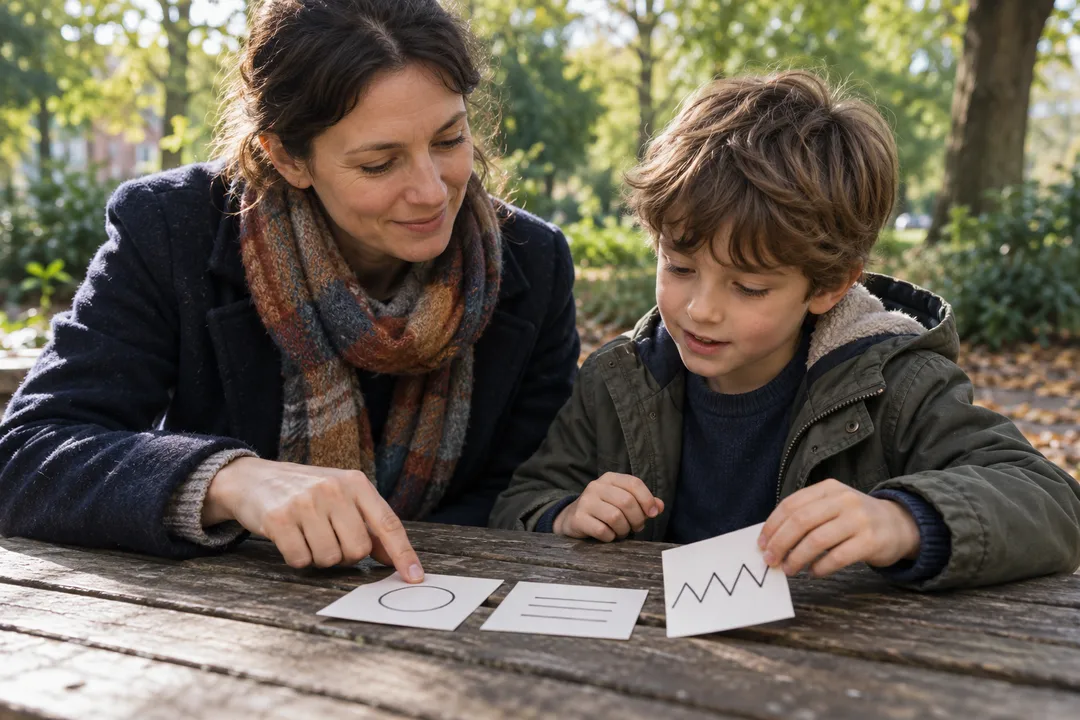
A family scenic pedestrian bridge route in London works better with a small game than a long list of crossings. In Queen Elizabeth Olympic Park, use the official park map to choose a pedestrian crossing near your chosen arrival point, then give each child three things to find: a straight line, a curve and a repeating shape. The objective is to notice how a crossing looks and works, without asking anyone to identify an engineering system. This is a suggested family activity, not an organised park trail. The photographs illustrate the activity and are AI-generated, not views of the park or its bridges.
Make the child the finder
Begin with the smallest possible brief. Draw a line, an arc and a zigzag on separate pieces of paper. A child who cannot read can still choose a card and match it to something visible. An older child can suggest a fourth shape after the first three have been found. Avoid turning the cards into a worksheet with correct answers. If a curve appears in a reflection rather than the bridge itself, that is a useful discovery. The game is about looking closely, rather than collecting a prescribed photograph.
The grown-up chooses where it is safe to stand. The child chooses what deserves attention. Keeping those jobs separate prevents the game from becoming a negotiation at every railing. Make the standing places part of the preparation: a broad path away from the crossing, a place to step aside on the approach, and a finishing space beyond the exit. Do not promise that a particular bridge has room for a group to pause. If the deck is busy or narrow, carry the cards across and do the matching from the bank instead.
Use the map as a boundary
Queen Elizabeth Olympic Park's official material describes a network of waterways and provides a park map. That gives a starting point for choosing a small part of the landscape. It does not mean a family needs to complete the official Waterways Trail. Trace the arrival, crossing and finish with a finger before leaving. Mark any tempting extension with a different colour so it stays visibly optional. A loop drawn on a page can look compact while including more walking than a child expected, especially when the route to the park is forgotten.
Let the child see the end before adding the game. Tell them the activity finishes when the three cards have been used, or when the group reaches the chosen bank, whichever comes first. This prevents a parent from adding a second crossing simply because one shape has not appeared. You can find the missing shape on the next ordinary pavement. A successful outing has an understandable ending. That is more valuable than a complete scorecard, and it makes a future short walk easier to propose.
Three discoveries, three different questions
The straight-line card asks a child to follow a direction with their eyes. Where does the line begin, and what interrupts it? A handrail, a deck edge or a reflection may offer an answer. Ask for a description before giving a label. An older child might compare two lines that appear to meet in the distance. Explain that a photograph can make parallel features seem to converge, without asking the child to work out construction details. Keep hands, pencils and cards on your side of any barrier throughout the activity.
For the curved card, look for a change of direction. It might be large enough to follow with an arm, or small enough to trace on the paper with a fingertip. Use a movement that stays within the standing space. For repetition, ask what happens more than once and what changes between the examples. Colour, spacing and shadow can all differ. These questions create three distinct observations from a single crossing. They also let siblings contribute different answers without competing to be the first person to name a bridge feature.
A game that survives disagreement
Imagine a younger child finding a curve in a cloud while an older sibling insists that only the bridge counts. Accept the cloud as the younger child's answer, then invite the older child to find a bridge curve of their own. The shared task is noticing a shape in the scene. Changing the rule midway to reward a more technical answer defeats that purpose. Give each person ownership of one card if taking turns is difficult, and compare discoveries after leaving the crossing rather than holding a debate in moving pedestrian traffic.
There is no need to make a child pose at every find. Ask whether they want a picture of the object, a drawing, or a spoken description remembered by the group. An adult can take a single detail photograph when the standing space permits. Leave other visitors out of the composition where possible. A short caption written later, such as a child's own explanation of why the railing looked like a ladder, preserves more of the activity than a sequence of rushed portraits. Keep the camera secondary to the observation.
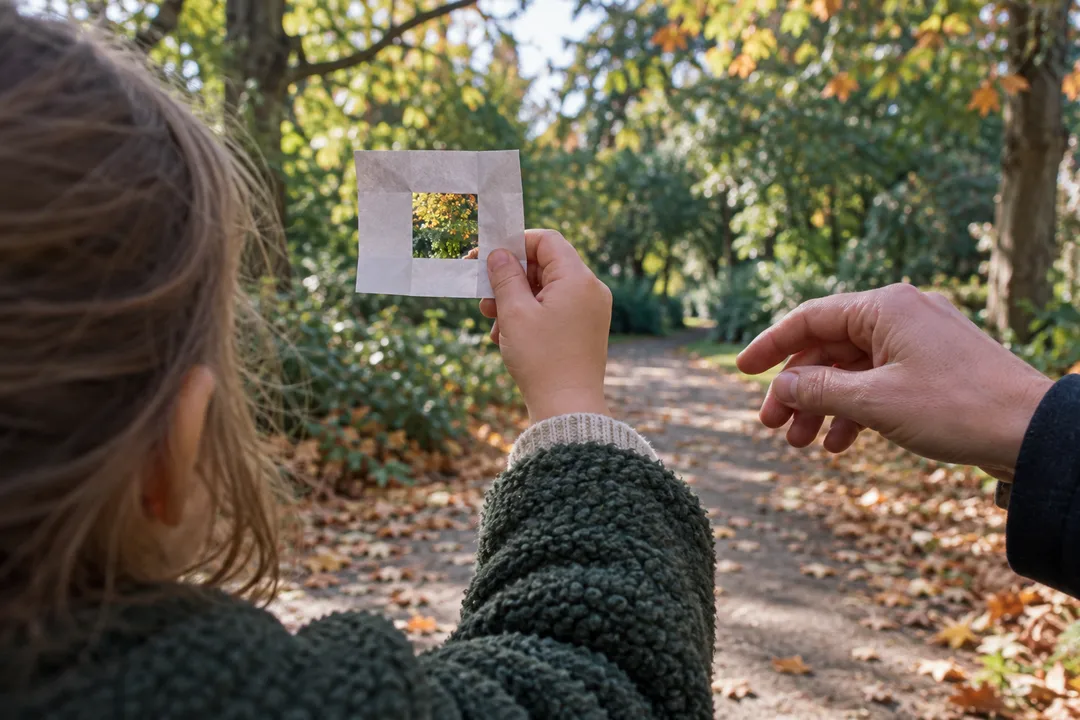
AI-generated activity illustration: a paper viewfinder on a generic park path, not an image of Queen Elizabeth Olympic Park.
Carry the shapes into the neighbourhood
The transition away from the bridge can become a final comparison. A shape found overhead may reappear in a bench, a planted border or a building outline along the route you have already chosen. Do not send children searching independently for another example. Ask them to point from the group's position, then decide together whether to move. This makes the surrounding walk part of the activity without inventing a treasure trail, directing anyone into a venue, or adding a destination that the original plan did not include.
At the finishing place, spread out the cards and let everyone explain one choice. A child may remember the sound underfoot rather than the shape they selected. That is still a useful account of the walk. Write down a question for another day instead of trying to answer everything on the spot. If the group enjoyed drawing, repeat the activity somewhere else with different shapes. If they preferred talking, leave the cards at home next time. The outcome should influence the next outing rather than becoming another obligation to repeat.
Practical Notes for the organiser
Bring a pencil, three small cards and a way to keep loose paper from blowing away. Use ordinary walking equipment suitable for your own family. Do not attach anything to a bridge or leave the cards behind. Select the approach and exit from the park's own visitor map, including the entire journey when a pushchair or mobility aid is involved. A photograph of a level deck does not establish the accessibility of its approaches. Follow signs and barriers on the ground, and replace the game with a bankside activity if crossing is unsuitable.
You can ask Karpo APP a question about ideas for a short family outing, describing the children's interests and the area you are considering. The map selection, supervision and decision to cross remain with the adults. This article does not present the cards as an app feature, promise a generated accessible route, or claim that the app sees conditions on the deck. Its useful result is a tiny activity plan you can explain aloud: one crossing, three shapes and a finish everyone understands, with permission to stop before completing the set.
Ask Karpo for more information.
Keep reading
- Richmond Park Sunset Viewing Planner: Deer Meadow Horizons
 South Bank Sunset Viewing Planner: Thames Riverside Walks
 Parliament Hill Sunset Viewing Planner: London Heath Vistas