 Clapham Bouldering Gym Finder: New in Town, Climb to Mingle
Sports Social
Hackney Roller Disco Night Planner for Adult Beginners
Use this Hackney roller disco night planner if you are an adult beginner going solo: how to practise first, fall safely, pace the session and unwind after.
Going to a roller disco alone as an adult beginner in Hackney is less brave than it sounds, as long as the first hour is planned. This roller disco night planner is written for someone who skated in a school hall decades ago, wants to try again, and does not want to spend the evening clinging to the wall while teenagers spin past. The trick is to practise in daylight, choose a calm session and decide in advance how long you will stay.
Why Hackney Is a Kind Place to Start
Hackney has a long habit of making room for people who are trying something new. The borough's parks fill with first-time runners, wobbly cyclists, outdoor table tennis and community sports clubs, and nobody stares at an adult learning. That culture carries into skating. Many of the people on an east London roller floor are adults who started late, often in their thirties or forties, and they remember exactly how the first night felt.
The area also has a strong disco and dance memory. Warehouse parties, community halls and railway arch clubs have long hosted soul, funk and house nights, and a roller disco simply adds wheels. Expect a mixed crowd: groups of friends in glitter, couples on a second date, a few serious skaters practising backwards turns, and solo learners doing slow laps with determination. You will fit in more easily than you fear.
Practise in the Park Before the Night
Two short practice sessions make a huge difference. London Fields and the wide paths around Victoria Park offer flat, smooth surfaces, especially early on a weekend morning before the cyclists and dog walkers arrive. Bring rental or borrowed skates if you can, or hire a pair for the weekend. Spend twenty minutes just standing, bending the knees and walking like a duck before you try a single glide.
Focus on three things: knees bent, weight slightly forward, eyes ahead rather than at your feet. Practise stopping with a simple T-stop or by turning into a gentle curve. Then practise falling on purpose onto grass: drop to the knees, then the wrist guards, and roll sideways. It sounds silly, but rehearsing the fall removes most of the fear, and fear is what makes beginners stiff and unsteady.

Gear That Protects Without Looking Clinical
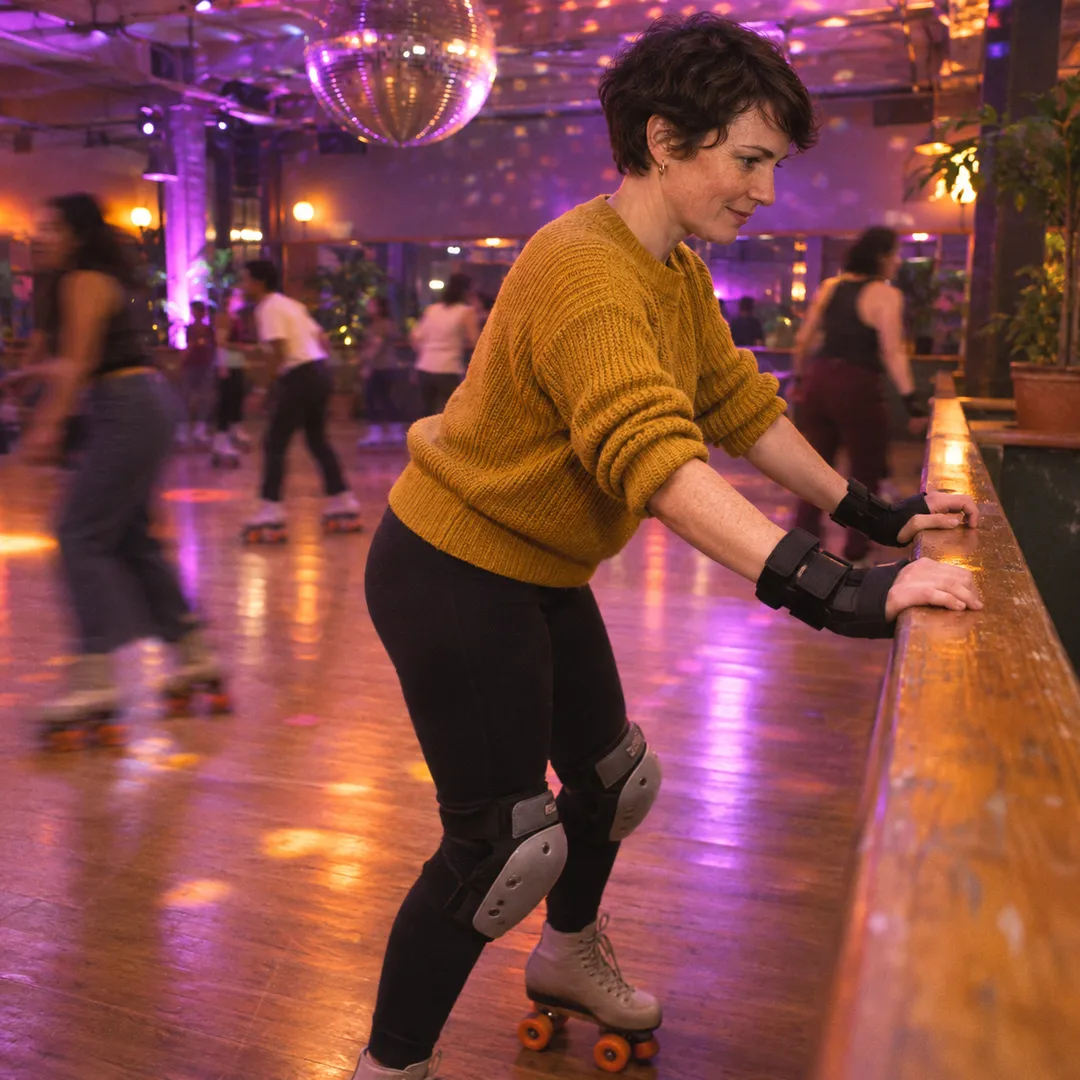
Wrist guards are the most useful thing a beginner can wear, because almost every early fall ends with hands hitting the floor. Knee pads come second, and a padded pair of cycling shorts under a skirt or loose trousers quietly protects the hips and tailbone. None of it has to look medical; plenty of skaters choose bright pads that match a disco outfit and wear them proudly.
Wear thick socks that come above the boot, because rental skates rub at the ankle. Leave dangling jewellery, long scarves and wide flares at home, or pin them back, so nothing catches on the wheels. Keep pockets light: a card, keys and phone in a zipped pocket or a small cross-body bag. A bulky backpack will throw your balance off every time you lean.
Choosing a Calm Session as a Solo Skater
Not all roller discos feel the same. Adult evenings with a party theme can be packed and fast, while early sessions, weekday nights or sessions billed as beginner friendly tend to be calmer. Read the event description for words like learn-to-skate, all abilities or warm-up session. Many organisers offer a short lesson before the main disco starts, and that is the ideal entry point for someone going alone.
If there is a lesson, take it even if you feel you remember the basics. Instructors usually teach the same skills you practised in the park, but with music and a group, which makes the transition to the busy floor smoother. You also meet other beginners, and having a familiar face on the floor makes it easier to keep going after a wobble.
The First Thirty Minutes on the Floor
Start near the rail and skate a few slow laps in the direction everyone else is going, usually anti-clockwise. Stay on the inside lane, close to the wall or the middle, and let faster skaters take the outside. When you need to stop, glide toward the edge rather than stopping in the flow. Breathe out on every stride; holding your breath makes your legs stiff and your balance worse.
Set yourself tiny goals: one lap without touching the rail, then two, then one lap with your arms swinging. Celebrate each one. If you fall, tuck your hands, get onto one knee, put one skate flat on the floor and push up with your hands on your knee. Most experienced skaters will slow down to give you space, and some will offer a hand.
Enjoying the Music Instead of Racing
A roller disco is about the soundtrack as much as the skating. Once you can manage a lap, try moving with the beat rather than trying to go faster: a small shoulder shimmy, clapping on the chorus, a slow turn at the end of a song. Disco and soul tracks have a steady rhythm that makes gliding feel natural. Speed will come later, if you want it at all.
Watch the confident skaters for ideas, but do not compare yourself to them. Some have been skating every week for years. Your goal for the first night is simply to leave wanting to come back. If you can do a full song in the middle of the floor while humming along, the night has done its job.
How Long to Stay and How to Wind Down
Decide before you go that you will skate for about an hour, take a break with water, then choose whether to return to the floor. Beginners tire faster than they expect, especially in the calves, ankles and lower back. Stopping while you still feel good protects you from the classic last-lap fall that happens when legs are shaking. There is no prize for staying until the lights come on.
Afterwards, a short walk helps. Broadway Market and the streets around Mare Street have cafes, small bars and late food, and the Regent's Canal towpath is lovely on a dry evening, though dark in places, so stay on well-lit streets if you are alone. At home, stretch the calves and hips before bed and drink plenty of water.
Plan B and Keeping the Habit Going
If the session you wanted is full, or the night turns out busier than you hoped, switch to a daytime skate in the park, a beginner class or an outdoor session in good weather. The aim is to keep practising, not to prove anything on one particular night. Many learners find that their third outing is when everything suddenly clicks.
The Karpo APP can help you keep track. Ask it for beginner-friendly roller disco nights or adult skating lessons around Hackney, compare a few options and save the ones that suit your schedule. When you feel ready to bring a friend along, share the list with them and plan a joint session. Learning alone is fine; skating together later is even better.
Ask Karpo for more information.
Keep reading
- Clapham Bouldering Gym Finder: New in Town, Climb to Mingle
 Marylebone Bouldering Gym Finder: Lunch Break Climbs
 Notting Hill Bouldering Gym Finder: Family Climbing Weekends