 Richmond Park Sunset Viewing Planner: Deer Meadow Horizons
Weekend Plans
One Tree Hill Panoramic City Lookout: London Through Trees
One Tree Hill in Honor Oak frames London through woodland, pairing a city lookout with a listening walk and close observation beyond landmark spotting.
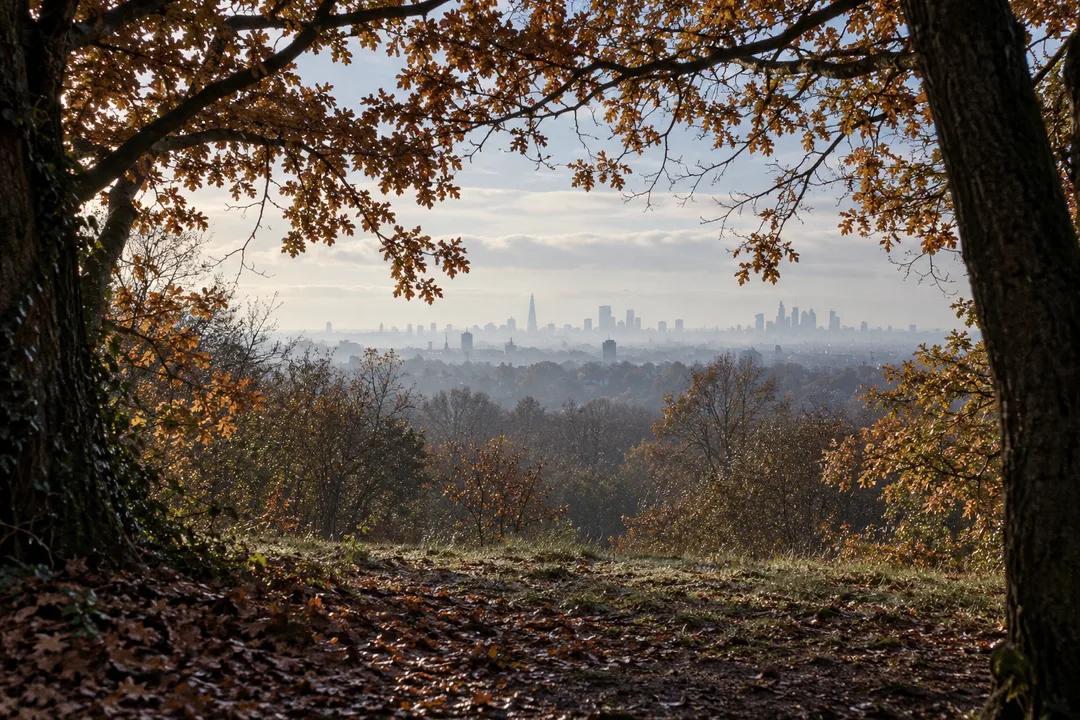
One Tree Hill in Honor Oak offers a useful change of scale: a wooded foreground with London beyond it. The appeal of this panoramic city lookout is the contrast between enclosure and distance. You can pay attention to trunks, branches and the space overhead, then let your eyes travel towards the city. Build the visit around that change. A woodland walk does not have to become a race to an exposed summit, and a view does not have to fill your whole field of vision to be absorbing.
Let the woodland set the pace
Begin with the path you are actually walking. Notice where light reaches the ground and where the canopy breaks it into smaller patches. A tree-lined route asks for a different kind of attention from a broad lawn. There is less reason to scan the entire horizon while moving, and more reason to observe what is immediately beside you. Keep your footing and other walkers in mind before looking upwards. The distant city can wait until you have somewhere suitable to stop.
Try carrying one detail from the approach into the view: the angle of a branch, a rough patch of bark, or the colour of a fallen leaf. When London becomes visible, keep that detail in your awareness rather than mentally discarding the woodland. It becomes a point of comparison. The city may have harder edges, a paler tone or a different rhythm of vertical shapes. Those differences give the outing its character. Without the nearby trees, you would be looking at a different kind of place.
A listening exercise before a lookout exercise
At a place where you can stand without blocking anyone, pause without taking a photograph. Listen for the nearest sound you can distinguish, then the most distant one. Perhaps you hear footsteps before anything else; perhaps wind or traffic is more noticeable. Do not expect a particular sound or describe a noise as birdsong merely because you are among trees. The exercise works with whatever the day provides. It makes the city feel like a lived environment rather than a silent band of buildings.
Now look towards the view and notice whether the visual distance agrees with the sounds. A city can seem far away while its noise remains present. Conversely, a nearby sound can belong to something you cannot see. There is no test to pass here. You are simply allowing the wooded hill to register through more than one sense. For someone who finds landmark-spotting tiring, that can be a more inclusive way to enjoy a lookout without having to learn a sequence of building names.

What a partial view can offer
An opening between trees does not need to imitate an observation platform. Branches divide the skyline into sections, making you choose what to attend to. Follow one opening rather than attempting to stitch every gap into a single complete picture. Look at the shape of the visible sky around a building or the way a branch interrupts a distant line. The interruption is not automatically a flaw. It records the fact that you are seeing London from within a landscape, rather than from an abstract point above it.
If the visible section is smaller than you expected, resist the urge to leave the path or push through vegetation for a wider angle. A better response is to change your expectation. Study the framed view that exists, or continue enjoying the woodland. The quality of the outing should not depend on forcing the scene to resemble an image taken in a different season or from another position. A narrow view, carefully observed, can remain more distinctive than an unobstructed panorama that looks interchangeable with several others.
Write a field note with no landmark names
Bring a small notebook if you like recording a walk. Describe the contrast in plain language before reaching for a comparison: dark bark against pale sky, a hard distant edge beside a soft foreground, or open air beyond an enclosing canopy. Limit the note to what you can see and hear. That keeps it specific without relying on an invented history or a confident identification of something you cannot distinguish. The result can be a useful memory even if the photograph is unremarkable.
Another exercise is to finish the sentence, “The city felt distant because…” without using the words big, small or beautiful. You might refer to the number of intervening roofs, the softness of a silhouette, or the way a nearby trunk occupies the frame. A companion can write a different ending. Compare them after the pause, not while either person is trying to concentrate. You will have two descriptions of the same moment, and neither needs to invalidate the other to be worth keeping.
Make room for a walk that is not silent
It would be misleading to promise a secluded retreat simply because the route includes trees. Other people may be talking, exercising or enjoying their own outing. Let them do so without treating their presence as a failure of your plan. If you want a quiet pause, choose a place where stopping is considerate and keep any audio to yourself. A listening-led visit is about noticing the soundscape, including its urban elements, rather than expecting the landscape to perform an idealised version of silence.
For a group, keep the exercise optional. Someone may prefer to talk while another person wants a brief pause; you can agree to meet again at a clearly understood point rather than asking everyone to share the same mood. Do not send a tired companion onward alone merely to preserve your own moment. The enjoyable version of this outing has space for different needs. A hill and a distant view can provide a common setting without requiring identical experiences from everyone who walks there together.
Practical Notes for a woodland-first visit
Choose shoes that suit the ground you find, keep your hands available for balance, and avoid planning the visit around a demanding photographic setup. Carry a layer that is comfortable when you stop. Anyone with concerns about slopes, uneven ground or fatigue should decide the length and shape of the walk accordingly. This is an observation exercise, not a prescribed route or a claim that a particular path will suit every visitor. Respect any barriers or directions encountered on the day.
When it is time to leave, notice how the city becomes less visible as the trees take over again. That reversal can be the strongest part of the memory. If you want ideas for a contrasting next stop, ask the Karpo APP for a London activity that changes the pace from a wooded walk. Explain whether you want somewhere sociable, a seated break or another outdoor setting. You can also finish here. A short visit with a clear sensory memory is complete without an additional destination.
Ask Karpo for more information.
Keep reading
- Richmond Park Sunset Viewing Planner: Deer Meadow Horizons
 South Bank Sunset Viewing Planner: Thames Riverside Walks
 Parliament Hill Sunset Viewing Planner: London Heath Vistas