 Bermondsey Specialty Coffee Bar Finder for London Roasteries
Coffee & Dessert
London Neighborhood Bakery Patisserie Route on Golborne Rd
Plan a Notting Hill pastry walk from Notting Hill Gate up Portobello Road to Golborne Road, with tips on market-day crowds, benches and what to carry.
Notting Hill is best treated as a long, slightly uphill line rather than a cluster, and that shape suits a neighborhood bakery patisserie route well. You start among the stucco terraces near Notting Hill Gate, follow Portobello Road north as the market stalls thicken and thin, pass beneath the Westway, and finish on Golborne Road in the shadow of Trellick Tower. Along the way you choose two or three stops on the day instead of fixing them in advance.
Starting at Notting Hill Gate
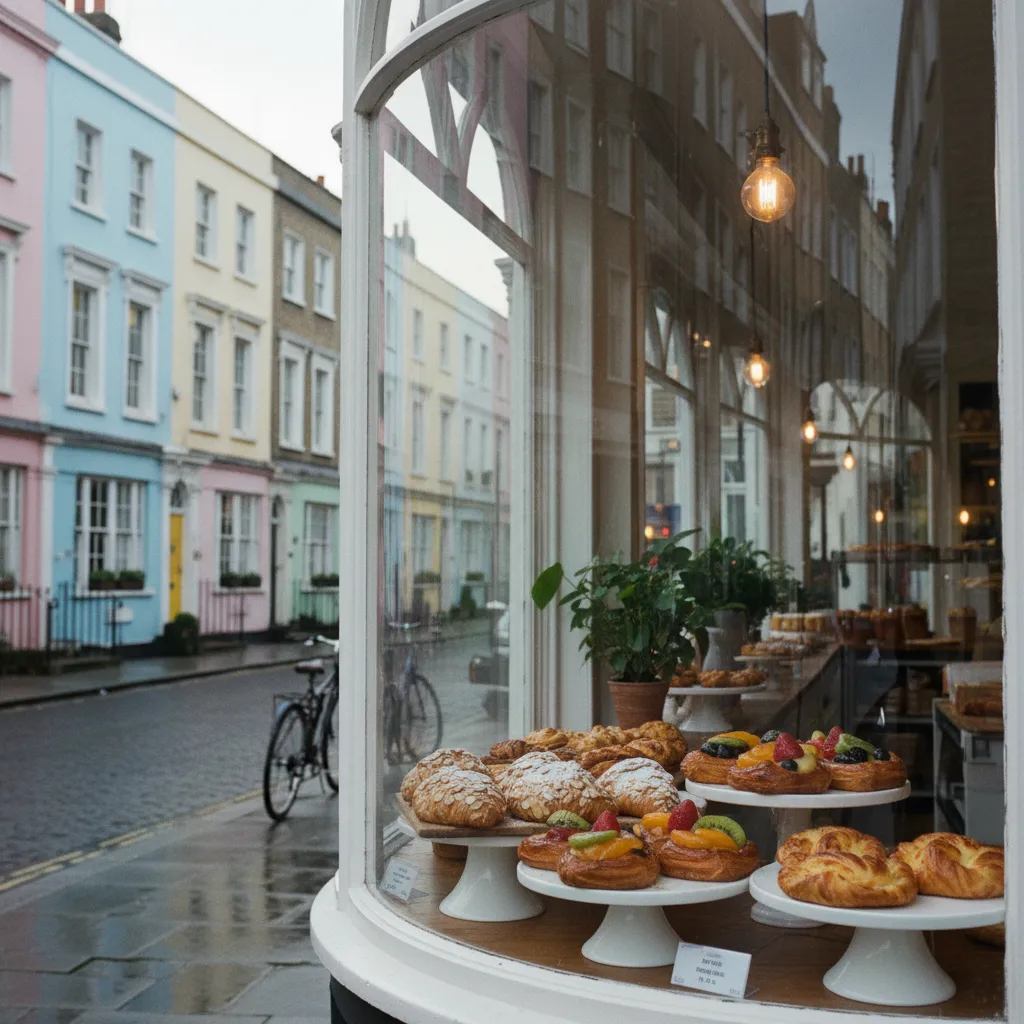
Leave the Underground at Notting Hill Gate, where the Central, Circle and District lines meet, and walk north along Pembridge Road. Within a few minutes Portobello Road begins, and the famous pastel house fronts appear on the lower stretch. This end is quieter early in the day, so it is a good place to pick up the first coffee and something small, such as a plain croissant, that you can eat standing up.
Keep the first purchase light. The route is roughly two and a half kilometres to Golborne Road, and a heavy slice of cake carried in a paper bag for half an hour rarely survives the crowds. Treat the lower end as a warm-up, look at what the windows are showing, and note anything you might want to come back for on the return leg along Ladbroke Grove.
Portobello Road on Market Days
Portobello Road changes character with the day of the week. Saturday is the day the antiques stalls and the largest crowds arrive, and the pavement can slow to a shuffle by late morning. If you want space to look into shop windows and stop without blocking anyone, a weekday or an early Saturday start is the calmer choice.
On busy days, it helps to buy on the move rather than queue at every counter you pass. Pick one stop on the middle section, between Westbourne Grove and the Westway, and let the rest of the walk be about looking. A box of small pastries is easier to carry through a market crowd than a single large tart, and it gives you something to share at the end of the route.
Under the Westway
The elevated Westway crosses above Portobello Road, and the stretch beneath it has a different feel from the stucco streets further south. The concrete canopy shelters stalls and open space, and on a wet morning it is one of the few places on the route where you can stand dry while you eat. It also marks the point where the walk turns from postcard Notting Hill toward North Kensington. Look up as you walk, too, because the upper floors of the houses along this stretch are as photogenic as the shopfronts below.
This is a sensible place to pause and decide how much further you want to go. Golborne Road is only a few minutes north, but if the crowds have been heavy you can cut west to Ladbroke Grove station here and save the northern end for another visit. Ask Karpo in the Karpo APP for current suggestions nearby if you want to swap a stop without walking back.
Golborne Road and Trellick Tower
Golborne Road runs east from the top of Portobello Road, and its skyline is dominated by Trellick Tower, the Brutalist block designed by Ernő Goldfinger and completed in 1972. The tower is Grade II* listed, and the long view of its separate service tower and bridges is one of the most recognisable sights in this part of West London. The street itself is shorter and more workaday than Portobello Road.
Because the street is compact, this end of the route rewards a slower pace. Walk its full length once before you buy anything, then double back to whatever caught your eye. Golborne Road has its own street market, but it rarely reaches the density of the Portobello antiques section. Finish here with a second coffee and the pastry you saved.
Choosing What to Buy
A good mix for this route is one laminated pastry, one custard or cream item eaten straight away, and one sturdier bake for later. Laminated pastries such as croissants and pain au chocolat are at their best within a few hours, so eat them early on the walk. Custard tarts and cream-filled choux do not travel well in a bag, so buy them close to where you intend to sit.
Sturdier bakes such as loaf cakes, cookies, cinnamon buns and sourdough keep their shape and texture through a long walk and the journey home. If you are visiting on a Saturday, it is worth buying these toward the end of the route, when you no longer need both hands free for the market. Ask for a box rather than a bag for anything delicate.
Where to Sit and Eat
Seating is the weak point of any Portobello walk, so plan it in advance. Powis Square, just east of Portobello Road near Talbot Road, is a small public garden that makes a convenient midpoint break. Further north, Emslie Horniman's Pleasance off Bosworth Road offers a larger green space with walled gardens, a short detour west of Golborne Road.
If the weather turns, the canopy under the Westway and the covered sections of the market give some shelter, and many cafés on both streets have a few indoor seats. On a dry day, however, carrying your pastries to Emslie Horniman's Pleasance and eating on a bench away from the crowds is the most relaxed way to end the walk.
Practical Notes for the Golborne Loop
Allow two to three hours for the full route with stops. The walk is mostly flat with a gentle rise northward, on pavements that are uneven in places, so comfortable shoes matter more than usual. Ladbroke Grove and Westbourne Park stations make easy exits at the northern end, and buses along Ladbroke Grove run back toward Notting Hill Gate.
Bring a tote bag with a flat base, a reusable cup if you like to carry coffee, and some cash and a card, as smaller stalls sometimes prefer one or the other. Avoid the August Bank Holiday weekend unless you want to combine the walk with Notting Hill Carnival, when the area is transformed. Before you set out, ask Karpo for a shortlist matched to the day you are going.
Ask Karpo for more information.
Keep reading
- Bermondsey Specialty Coffee Bar Finder for London Roasteries
 Covent Garden Specialty Coffee Bar Finder for London Visits
 Fitzrovia Specialty Coffee Bar Finder for London Strolls