 Brixton Vintage Thrift Shop Finder: South London Retro Gems
Hidden Gems & Odd Finds

Islington Model Shop Browsing Guide: Quiet Afternoon Picks
Browse Islington architectural model supplies, miniature timber drawers, and doll's house fittings near Upper Street. Match stripwood and walk the canal.
On a calm Thursday afternoon along the brick lanes off Upper Street and Camden Passage, architecture postgraduate Elena and her flatmate Sam arrive with a canvas portfolio case and a pocketsize vernier caliper to source materials for a canal-side Georgian terrace diorama. Following an intentional model shop browsing guide keeps their visit focused on surface texture, scale consistency, and clean cutting stock rather than mismatched craft oddments. In Islington, where design studios share pavements with antique dealers and framing workshops, the independent model and miniature rooms feel like curated material libraries stocked with fine-grain limewood, embossed styrene masonry sheets, and tiny brass sash pulleys.
Why Islington Appeals to Diorama Makers and Miniature Architects
Islington's Georgian squares, canal locks, and Victorian workshop mews inspire a very specific kind of scale modelling focused on architectural interiors, urban streetscapes, and twelfth-scale or twenty-fourth-scale domestic rooms. Rather than towering stacks of robot cartons, the counters around Angel and Camden Passage emphasise raw fabrication stock: timber stripwood racks, clear acrylic glazing sheets, and drawers of turned wooden balusters.
During a weekday afternoon you will browse alongside theatre set designers matching period wallpaper patterns, interior architecture students picking up foamboard and basswood, and doll's-house collectors restoring heirloom staircases. Counter etiquette centres on keeping delicate sheet stock pristine: always lift styrene and mountboard by two opposite corners with dry fingers so skin oils and thumb creases do not mar the matte surface.
Selecting Limewood Strip Stock and Embossed Masonry Sheets
Elena begins at the vertical timber pigeonholes where square and rectangular strips of limewood, basswood, and obechi are sorted by millimetre thickness. Unlike soft balsa, tight-grained limewood holds a crisp knife edge when mitring miniature window architraves or canal-bridge parapets. Pull two or three dowel lengths halfway out of the sleeve to check for uniform pale colour and straight grain before sliding your chosen pieces all the way free.
Next door at the flat plan-chest drawers, Sam compares vacuum-embossed styrene sheets moulded with Flemish bond brickwork, London stock courses, and corrugated iron roofing. Hold a brick sheet at a low angle toward the shop window so raking daylight reveals the mortar depth; shallow laser-scribed patterns take thin acrylic washes well, whereas deeper relief moulding suits dry-brushed lime mortar effects.
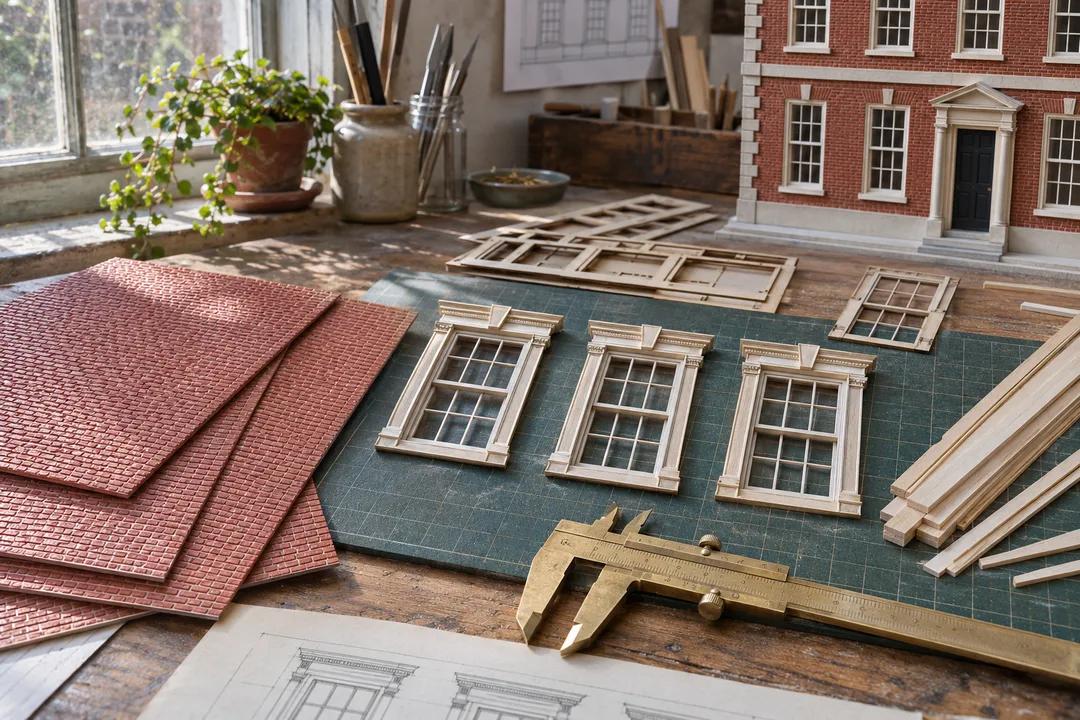
When combining timber cornices with plastic masonry facades, check the drawer of miniature mitre boxes, razor saws, and right-angle magnetic clamping squares. Clamping interior partition walls with steel corner magnets while solvent cement cures guarantees plumb Georgian chimney breasts that never twist when you slide the roof mansard into place.
Testing Micro-LED Lighting, Copper Tape, and Scale Sash Windows
A signature pleasure of browsing Islington's miniature counters is the drawer wall dedicated to architectural fittings and low-voltage room lighting. Ask the staff to demonstrate warm-white versus candle-flicker grain-of-wheat LEDs on the counter battery block before choosing bulbs for a cutaway interior. Cool bluish diodes make scale rooms look like hospital corridors, whereas warm amber micro-chips cast a convincing glow through frosted acetate window panes.
Instead of threading bulky insulated wire through thin foamboard walls, pick up a roll of self-adhesive conductive copper foil tape and a coin-cell holder switch. While you have the fittings tray open, lay laser-cut box-sash window frames directly over your chosen brick sheet to check that the sill width matches the masonry course height without awkward fractional gaps.
Browse the adjacent cabinet of twelfth-scale and twenty-fourth-scale domestic hardware for turned brass doorknobs, cast-iron coal grates, and woven stair runners. Even if you are building a strictly architectural massing study, placing a single scale streetlamp or wrought-iron boot scraper beside the entrance steps immediately anchors the human proportion of the facade.
Matching Foliage Flocks, Lime Mortar Washes, and Scale Paving
For exterior courtyard and canal-towpath bases, check the glass jars of dried seafoam armatures, fine olive-green scatter flock, and crushed ceramic York-stone paving dust. Holding foliage packets against unpainted grey card helps you judge realistic muted British greens rather than oversaturated neon turf meant for fantasy gaming boards.
Pick up a bottle of matte medium and a block of raw umber artist pastel chalk at the counter; scraping fine pastel dust into water with a drop of flow improver creates a reversible weathering wash for brick parapets and timber lock gates that never clogs delicate laser-etched wood grain.
To replicate the wet cobbles and mossy towpath walls along Regent's Canal, ask for a jar of satin acrylic gel medium along with ultra-fine olive turf powder. Dabbing a thin coat of satin medium along the water's edge of a bridge abutment gives the subtle damp stone reflection of a real north London lock without the toy-like mirror glare of heavy gloss varnish.
What to Leave Behind and How to Carry Sheet Stock Along the Canal
Skip cheap corrugated cardboard backing and high-acid wood pulp mountboard for structural diorama walls, as London dampness will warp them within a month; spend the extra moment asking for archival conservation board or dense grey modeller's millboard. Also pass on thick household PVA glues that leave yellowing strings across clear acrylic glazing, and choose canopy-safe water-clear adhesive instead.
Slide all styrene sheets, brass mesh rectangles, and veneer strips straight into a rigid A3 portfolio sleeve with a sheet of tissue between textured and clear plastics so they cannot scratch each other as you walk. Before leaving the shop doorway, open the Karpo APP to find nearby design bookshops, independent timber-frame cafes, and canal access steps across Islington so your afternoon route stays dry and unhurried.
Keep long brass rods or timber dowels taped flat against a strip of scrap mountboard inside your portfolio rather than letting them roll loose at the bottom of the gusset. Taking thirty seconds at the packing table to secure slender profiles prevents kinked window mullions before you even reach Upper Street.
Strolling Camden Passage, Islington Green, and Duncan Terrace
With their portfolio zipped flat, Elena and Sam step back into the pedestrian cobbles of Camden Passage, where antique print windows and small espresso tables offer a quiet perch for sketching elevation notes. Watching how afternoon sun hits the real brickwork and iron shopfront brackets along the passage gives immediate reference for painting miniature street facades.
From Islington Green, cut east through Duncan Terrace and Colebrooke Row, where continuous Georgian brick terraces, fanlight doorways, and cast-iron balcony railings provide a living one-to-one pattern manual for architectural modellers. Follow the footpath down to the Regent's Canal towpath at City Road Lock to watch narrowboats work through the timber gates before heading home to the cutting mat.
Pausing by the brick parapet above the lock basin lets you study how coal-tar pitch meets weathered granite coping stones and iron mooring rings—the exact textures that turn an ordinary tabletop canal bridge study into a recognisable piece of north London craft.
Ask Karpo for more information.
Keep reading
- Brixton Vintage Thrift Shop Finder: South London Retro Gems
 Notting Hill Vintage Thrift Shop Finder: Preloved Rails
 Soho Vintage Thrift Shop Finder: West End Designer Archives