 Waterloo Cozy Board Game Cafe Finder in South London
Weekend Plans
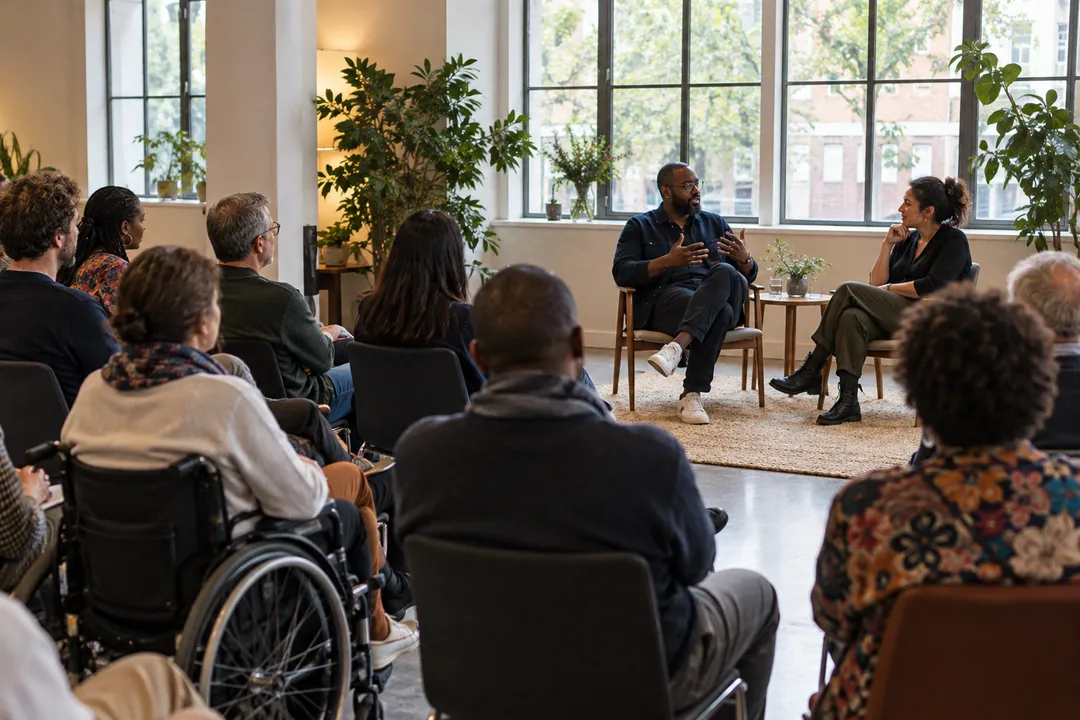
London Local Event Finder: Indoor Talks With Easier Access
Find London cultural talks in Karpo APP by topic, indoor setting and access needs, then compare published entry details and plan a manageable arrival.
Finding an indoor cultural talk starts with two equally important questions: what you want to discuss and what you need to reach a comfortable seat. In Karpo APP, describe both before asking for London suggestions. A local event finder conversation can help organise the comparison, but an “accessible” label alone cannot establish that an entrance, event room and toilet meet your needs. Give the search a specific subject and access brief so the resulting plan is useful from the first journey.
Put the subject and the access brief together
Begin with a request such as: “Find an indoor London talk about architecture on Sunday afternoon. I need a step-free route to the room, a seated format and an accessible toilet. Prefer a short approach from transport.” These are example requirements, not claims about an advertised event. Add your starting area and whether you want a lecture, a moderated discussion or a session where questions from the audience are a major part of the experience.
Use the amount of detail you are comfortable sharing. You can describe functional requirements without explaining a diagnosis. For example, “avoid stairs and long standing periods” gives more useful planning information than a broad label. If you need a companion beside you, a seat near an exit or a quiet place to pause, make those separate points. A venue can meet one requirement while leaving another unanswered, and the comparison should preserve those distinctions.
Trace the whole arrival, not only the doorway
Divide the visit into the approach from transport, the building entrance, the route to the discussion room and the route to facilities. Ask Karpo to organise any available published access information in that sequence. A level main entrance does not establish a level route to an upper-floor room. Equally, the station nearest on a map may not be the most suitable starting point for the approach you need. Treat the journey and building as connected decisions.
Avoid relying on a room photograph to judge doorway width, thresholds or turning space. If measurements are essential to you, they need explicit information from the venue rather than a visual estimate. The conversation can help you identify which detail is missing and phrase a focused question for the organiser. Keep that question next to the candidate. You should not have to remember an unresolved entrance problem while comparing the appeal of three different speakers.

Separate drop-in from an event without a ticket price
A free talk may still require registration, and a ticketed programme may have an entry process that needs time. Ask for the actual published admission arrangement for the session you are considering. “Drop-in” describes a way of attending, while “free” describes a charge. Neither word by itself establishes an allocated seat. If you need a seating arrangement agreed in advance, prioritise the organiser's stated process over the convenience suggested by a brief listing headline.
Your own arrival buffer should reflect your needs, rather than a supposed universal rule about arriving early. Tell Karpo how much time you want between reaching the building and the talk beginning. A suggested buffer belongs in the itinerary as your preference. It is different from a published door time or a requirement for latecomers. Keep those labels clear when you share the plan, especially if a companion is joining at the venue.
Decide what a good discussion sounds like
Topic interest can be narrowed without making the outing feel like homework. “Architecture” might mean how housing is designed, how neighbourhoods change or how a historic building is cared for. Give Karpo one question you would enjoy hearing people explore. Then ask it to compare advertised subject descriptions. A talk that answers your curiosity is often more rewarding than a more prominent event whose programme only loosely overlaps with what you wanted to learn.
Also describe the format you find easiest to follow. You might prefer one speaker, a moderated panel, a smaller conversation or a session with a clearly described question period. If hearing support, captions or a hearing loop matters, list that requirement explicitly. Step-free access does not answer an audio-access question. A detailed comparison should keep the subject, format and access information visible together so you can decide which candidate deserves the next step.
Use a decision order that protects your essentials
Sort the requirements into essentials and preferences before selecting a favourite. The essential list might include a usable route, appropriate facilities and a seated event. Preferences could include a particular neighbourhood, a shorter journey or a more informal discussion. Ask for suggestions to be assessed in that order. That prevents an appealing speaker or an attractive interior from displacing an access requirement that would make the outing impractical for you.
For two promising candidates, ask Karpo for a plain comparison: what is described, what matches your brief and what remains unresolved. An option with incomplete access information can stay under consideration without being called suitable. A specific question to the organiser is useful here, such as whether the published route applies to the exact event room. If an essential requirement remains unanswered, choose another candidate or another date rather than letting enthusiasm fill in the gap.
Keep the nearby walk optional
A cultural talk can be the whole outing. If you want a little time outdoors, ask for a short route near the chosen venue with the surface, distance and places to pause that suit you. A public square or broad pavement may be a better fit than a scenic shortcut. Do not assume a historic passage, waterside path or park entrance is suitable merely because it appears nearby. The route needs its own assessment, separate from the building's access description.
Give the walk a gentle purpose: discussing one idea from the talk, spending time with a companion or enjoying a change of setting. Plan it after the session if concentrating on the journey beforehand would make arrival harder. It should be easy to shorten or remove without affecting the main event. Ask for an itinerary that still works if you go directly home, so the optional walk never becomes another obligation to complete.
A fallback can preserve the subject
If no event meets the access brief on the first date, keep your topic and explore a different day, a smaller travel area or another discussion format. A later talk with clear arrangements may be more worthwhile than a superficially convenient session with too many unanswered practical questions. Explain which variable you are willing to change. You do not have to widen every part of the search at once or settle for an unrelated attraction.
Save the selected event information and a concise access note together. Include the event room where known, agreed entrance instructions if provided, meeting arrangement and the questions already answered. Share only the personal access details you want your companion to have. A saved plan should distinguish published venue information from your own preferences. That makes the note useful beyond the conversation and avoids asking someone to reconstruct which parts were essential when you discussed the shortlist.
Practical Notes for a thoughtful afternoon
Allow space in the plan for a pause, assistance if you use it and a journey home that suits your energy. Any essential unanswered access question belongs with the organiser or venue, using a specific request about the feature you need. Karpo APP can help frame that request and compare the information you bring back. It does not certify access conditions, measure a doorway or establish that a lift is operating through a conversational recommendation.
Finish with one chosen discussion and a clearly described next action: following the organiser's registration process, asking a precise room-access question or exploring another date. Keep a companion's role explicit if they are helping with the journey. The point of the search is an afternoon where you can pay attention to an idea that interests you. A careful brief makes the practical parts visible early, leaving the conversation at the event room for the subject itself.
Ask Karpo for more information.
Keep reading
- Waterloo Cozy Board Game Cafe Finder in South London
 Shoreditch Cozy Board Game Cafe Finder in East London
 Brixton Cozy Board Game Cafe Finder for Warm London Days