 Richmond Park Sunset Viewing Planner: Deer Meadow Horizons
Weekend Plans
Bow Historic Canal Towpath Walk: Three Locks, One Shortcut
A historic canal towpath walk beside Victoria Park traces Hertford Union’s three locks and bridges, with a structure-focused plan during low-water restrictions.
Hertford Union gives a historic canal towpath walk beside Victoria Park, following a short connection opened in 1830 between the Regent's Canal and Lee Navigation. Its three locks and cast-iron bridges provide the heritage interest. This is a walk to read the structures, not a promise of boats passing through them: the Canal & River Trust lists a navigation closure between Top and Bottom Lock because of low water levels. Boat navigation and pedestrian access are separate matters, and any barrier on the public route still takes priority over a suggested itinerary.
Begin where two canal companies met
Start the historical story at the junction with the Regent's Canal. Stop Lock Bridge carries the older canal's towpath across the entrance to the Hertford Union. Historic England lists the bridge for its cast-iron construction and its place at a late Georgian canal junction. That gives you something concrete to examine before following the newer waterway: the span and brick abutments explain how an existing route had to accommodate another canal arriving at its side.
The bridge dates from 1830, the same year the Hertford Union opened. Rather than treating it as an ornamental entrance, look at what it makes possible. People could keep moving along one canal while boats entered the other beneath them. A small crossing therefore records a larger relationship between transport routes. From a place where you can stand clear of passing walkers, compare the curve of the ironwork with the straight line of the canal beyond it.
A commercial shortcut with a difficult beginning
The Hertford Union is also known as Duckett's Canal after its promoter, Sir George Duckett. Canal & River Trust's history describes an enterprise that failed to become a great commercial success. The canal later came under the Regent's Canal proprietors. Keep the first part of that story in mind as you walk: an apparently obvious shortcut on a map was not automatically a successful business. The surviving structures tell you what was built, while the history complicates any simple story of inevitable progress.
You do not need every change of ownership to enjoy the route. The important relationship is visible: a short eastward line connects two larger waterways. Think about why a boat operator might want that connection, then consider how the cost and reliability of a route could affect its usefulness. This gives the walk a question that carries from bridge to lock, rather than turning each feature into an isolated photograph with a date attached to it.
Keep the park on one side of the story
The Trust's walking leaflet follows the canal eastwards beside Victoria Park and finishes at Carpenters Road Bridge. It gives a distance of two kilometres and a suggested walking time of thirty-five to forty minutes. Those figures describe its published walk, rather than a guaranteed pace for every visitor. If you want to spend time looking at the bridges and locks, allow more room in the afternoon. Add the approach and the journey from the finish when considering the total outing.

Victoria Park makes this a different experience from a canal enclosed by buildings on both banks. The green edge provides a place to turn your attention away from the water for a moment. Keep any park visit separate from the canal route in your plan, however. A search result for a large park can hide how much walking is involved inside it. Decide whether you want a canal study with a brief green-space pause or an afternoon mainly spent in the park.
Look for the change from bridge to lock
The official leaflet identifies Gunmakers Lane, also called Three Colts Bridge, as a listed bridge dating from the canal's opening. Historic England's canal survey also draws attention to listed locks, bridges and an adjacent cottage. Taken together, these are enough for an outing with a strong architectural subject. Choose a few features to compare, such as how iron meets brick at a crossing and how a lock chamber changes the water's level, instead of trying to identify every fitting from a distance.
Approach the lock area as a place with equipment and edges, not as an outdoor climbing structure. Gates, beams and railings may look like convenient supports for a photograph, but the public path is the appropriate viewing position. Keep bags and companions away from the sweep of moving equipment wherever it is in use. Even when a lock is quiet, avoid treating the operating space as a picnic platform or a shortcut between the two banks.
What the low-water notice changes
The Trust's notice identifies the affected section as Top Lock to Bottom Lock and classifies the restriction as a navigation closure caused by low water levels. That means an article should not invite you to arrive expecting regular boat passages through the three locks. The heritage visit can instead focus on their construction and relationship to the canal. The absence of a boat is not a disappointing interruption to a promised show, because a show is not what this outing offers.
Do not read a navigation notice as blanket permission to walk anywhere along the bank. Equally, a boat restriction alone does not establish that the entire pedestrian route is closed. Follow the public route and any on-site directions, stopping or leaving it where access is restricted. If your main interest is watching boats work through locks, choose another outing. This particular walk is better framed around the structures, the junction and the history of a canal whose usefulness has always depended on more than its short length.
Let the eastern junction be the finish
As the Hertford Union meets the Lee Navigation, the setting widens and the Olympic Park enters the wider view. The Trust's leaflet uses Carpenters Road Bridge as its finish, which gives the route a definite endpoint. Pause there to look back at the small connection you have followed. It is a useful moment to distinguish the canal's own story from the much larger network continuing beyond it. You do not have to follow every branch to understand this one.
A return walk offers the junctions in the opposite order, but it also doubles the canal section. Make that choice deliberately, particularly if you have already spent time in Victoria Park. For a linear afternoon, plan your onward journey from the eastern end before committing to the walk. Avoid making a companion who wanted a compact heritage visit continue into an extensive Olympic Park tour simply because the next path is available and the afternoon still has daylight.
Practical Notes for a structure-focused visit
Use the Canal & River Trust's Hertford Union walking leaflet for its start, finish and feature sequence. Wear shoes suited to an outdoor route and leave space for commuters, cyclists and other walkers when stopping. The canal's short length does not turn every access point into a step-free entrance. This article makes no promise about the accessibility of a particular approach. Choose a route that suits your group, keeping the canal and any park extension as separate decisions.
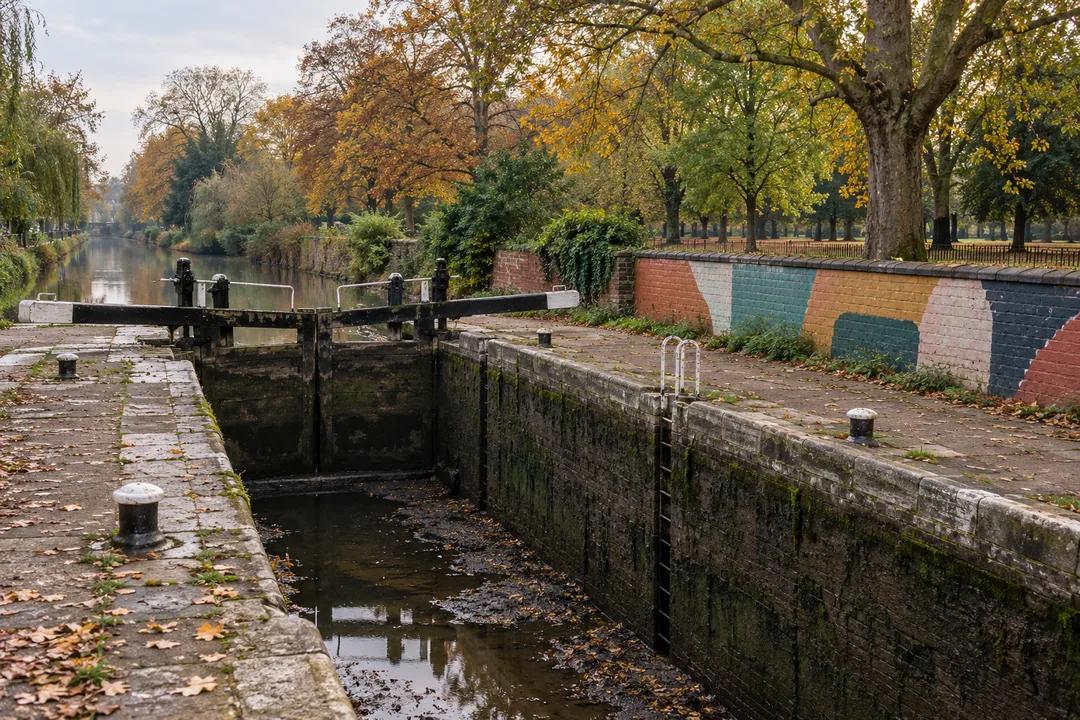
The accompanying images are AI-generated editorial illustrations of canal architecture, including a low-water lock setting, rather than records of present-day conditions. In the Karpo APP, ask for a short east London canal walk focused on bridges and industrial history, with a linear finish or an agreed return. That makes the intended outing clear without inventing live information about boats, water levels or route conditions. The reward is seeing how a small piece of infrastructure connects a much larger city.
Ask Karpo for more information.
Keep reading
- Richmond Park Sunset Viewing Planner: Deer Meadow Horizons
 South Bank Sunset Viewing Planner: Thames Riverside Walks
 Parliament Hill Sunset Viewing Planner: London Heath Vistas