 Richmond Park Sunset Viewing Planner: Deer Meadow Horizons
Weekend Plans
London Hidden Courtyard Garden: Museum Leaves After Labels
The Museum of Brands pairs its collection with an enclosed London garden. Shift from printed labels to living textures on a hidden courtyard garden visit.
The Museum of Brands gives a London hidden courtyard garden outing an unusual companion: a collection built around the visual language of everyday packaging. Its garden offers a different kind of looking after the printed labels indoors. Make the contrast the purpose of your visit. Move from objects designed to catch attention to plants whose details become apparent when you stop searching for a message, a familiar name or something to buy.
Leave one remembered colour at the door
Choose a colour you remember from the collection and carry it mentally into the garden. You might look for an approximate match in a leaf, a flower if one is visible, or a patch of reflected light. The exercise works even when there is no match. A manufactured colour and a living surface behave differently. One may be flat and repeatable, while the other changes with light, shadow and the angle from which you look. Let that mismatch be the discovery.
This gives two visitors with different interests a way to share the stop. A person drawn to design can describe the balance of shapes, while a garden enthusiast can follow the planting. Neither needs to borrow the other's vocabulary. Try describing the same view in one sentence each, without using the words beautiful or peaceful. The answers might focus on density, contrast, softness or the boundary of the courtyard. Those descriptions are more personal than a general verdict about whether it is a hidden gem.
A planted enclosure beyond the Time Tunnel
The museum's own garden material describes herbaceous plants, climbers and subtropical planting within a courtyard. That combination suggests a layered view rather than a single central specimen to tick off. Its visitor information also includes the garden as part of the museum experience. Keep the two together in your planning: this is a museum garden, with a collection as its context, rather than an unrelated public park discovered behind an unmarked door.
Look first at where growth meets the enclosing surfaces. A climbing plant makes a different sort of line from a printed border. It can branch, double back and leave irregular spaces between stems. Without touching or moving it, follow one visible stem until it disappears from view. Then step back to the whole planted area. Changing between those scales gives the garden a rhythm that does not depend on a dramatic photograph or a flower being at its peak.
Do not turn the planting description into a seasonal promise. The pleasure of this exercise can lie in the arrangement of leaves even when there are few visible flowers. Compare a broad surface with a smaller repeated one, and look at how much darkness remains between them. You are reading depth rather than naming every species. A close view can feel almost abstract, but leaving some of the courtyard boundary in the picture keeps its human scale apparent.
What a label tells you, and what a leaf cannot
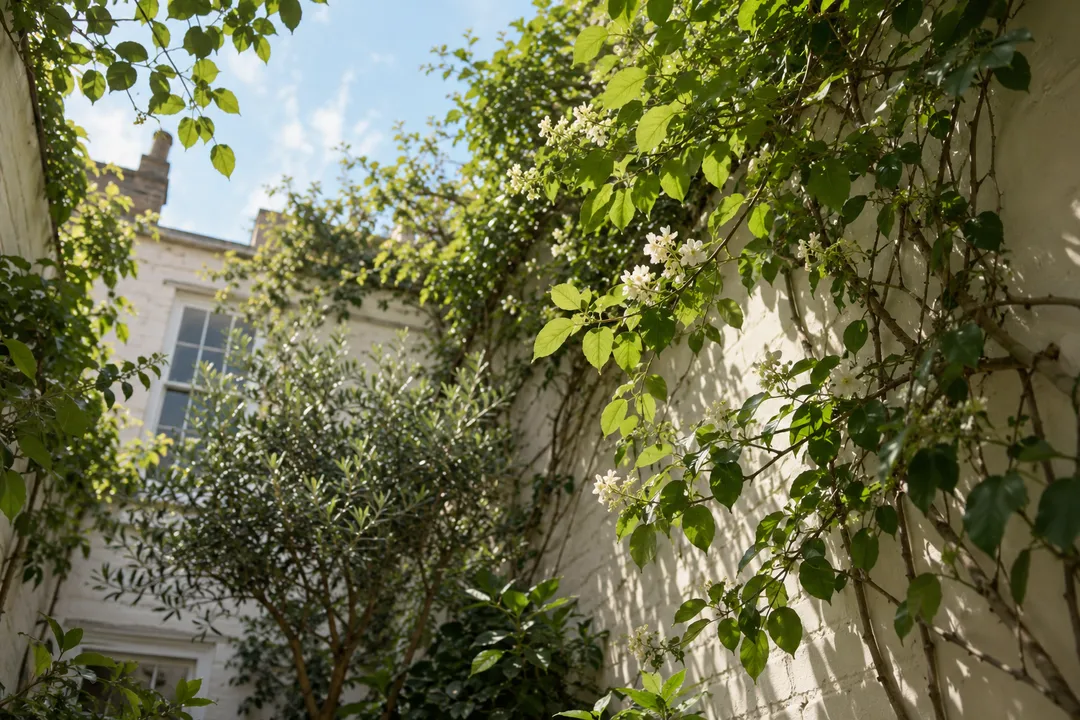
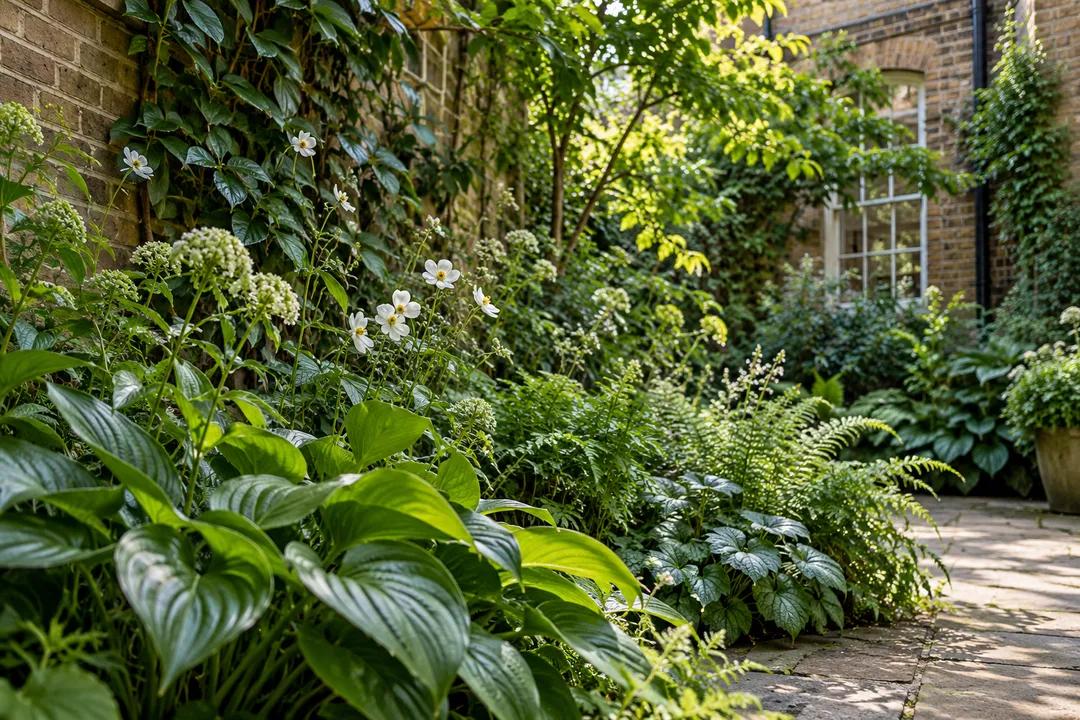
The accompanying pictures are newly generated photographic illustrations of courtyard textures, rather than records of this museum garden.
Packaging often asks for an immediate response: recognition, appetite or loyalty. In the garden, try looking without deciding whether you like what you see. A damaged edge, a bent stem or an uneven shadow can hold attention without becoming an attractive souvenir. This is an editorial exercise, not a statement about the museum's interpretation programme. It is particularly useful after an exhibition, when the habit of reading labels can make every new view feel like another piece of information to collect.
For a sketch, divide a notebook page into two small rectangles. In the first, draw a remembered printed shape from the collection. In the second, draw the outline of a plant without identifying it. Limit each drawing to a few lines. The resulting pair can show how your hand moves differently when copying a controlled graphic and an irregular living form. Keep the notebook close, and avoid spreading materials across a surface somebody else might need.
Make room for an unrecorded moment
A camera is helpful for comparing textures, but it can also make the garden another catalogue. Try composing one image and then putting the camera away. Notice what sits just outside the frame: the edge that made the scene feel enclosed, or the leaf that seemed too untidy to include. You do not need to rescue every excluded detail in a second photograph. Let some part of the experience remain something you looked at without recording.
If you are visiting with a child, ask for a colour description that does not use a brand name. A shade might become pea green, rain-cloud grey or the colour of a familiar coat. Allow the answer to be approximate. The game connects the collection and garden without turning plants into props or requiring a flower to be picked. Adults can join in too, particularly if a day of reading display text has made another formal explanation feel like work.
Take the comparison into Notting Hill
An onward walk through Notting Hill can continue the contrast between deliberate display and incidental growth. Look at the boundary between a shop window and the pavement, or at a planted container against a facade. Keep your attention on what can be seen from public space. A residential front garden is somebody's home environment, and an interesting doorway is not an invitation to step through it. The museum's enclosed garden gives you a subject to carry, without making private spaces part of the itinerary.
Choose a walking companion's pace over the ambition to cover every nearby attraction. One person might want to talk about a familiar package seen in the collection, while another wants a quieter stretch of pavement. Agree on a simple next action: continue walking, find somewhere to sit, or finish the outing. Skip adding another museum solely because it is nearby. This pairing is strongest when the garden gives the collection some breathing room, rather than becoming a brief pause in an overfilled day.
Practical Notes for the transition outdoors
Use the museum's visitor route and its own guidance for the garden. An enclosed planted space should not be assumed to offer the same room for running, picnicking or equipment as a large park. Carry compact belongings and keep exits and passages clear. If another visitor is resting, make your photograph around the space they are using rather than waiting pointedly for them to move. Ordinary courtesy matters more than achieving an empty frame.
In wet weather, allow the comparison to become a short look rather than a prolonged outdoor activity. The collection remains the reason for the museum visit, and the garden need not carry the entire day. Later, use the Karpo APP to ask for an onward Notting Hill idea that suits your interests. Describe whether you want more design, a walk or a change of pace. The useful outcome is a plan that respects how the visit actually felt, rather than another list of sights to complete.
Ask Karpo for more information.
Keep reading
- Richmond Park Sunset Viewing Planner: Deer Meadow Horizons
 South Bank Sunset Viewing Planner: Thames Riverside Walks
 Parliament Hill Sunset Viewing Planner: London Heath Vistas