 Brixton Vintage Thrift Shop Finder: South London Retro Gems
Hidden Gems & Odd Finds

Walthamstow Haberdashery Shop Picker for Curtain Sewing
Plan a Walthamstow haberdashery shop picker run along the High Street market for curtain header tape, heavy zips and trimmings, then walk into Lloyd Park.
A haberdashery shop picker in Walthamstow operates on a completely different scale from the tiny button rooms of the West End. Along Walthamstow High Street, where street stalls stretch for block after block toward St James Street, the fabric and trimmings shops cater to people furnishing whole houses: bay-window curtains for Victorian terraces, zipped cushion covers, Roman blind cords and sturdy school-uniform repairs. When Dev Patel and his partner, Hannah, moved into a draughty two-bedroom flat near Forest Road, they decided to sew their own lined winter curtains for the front bay rather than live with bare sashes. This guide traces their Saturday morning down the market for curtain tape, weighted hem cord and brass rings, then loops up to Lloyd Park and Walthamstow Village.
Why Walthamstow High Street Suits Home-Furnishing Makers
East London's long street market has served working families and home dressmakers for generations, and the shops lining both sides of the High Street still reflect that practical domestic appetite. While central London counters focus on couture silk or stage costume, Walthamstow's shelves are stacked for bulk and durability: wide rolls of thermal blackout lining, triple-pleat heading tape, upholstery webbing, continuous zip chains sold off the reel, and boxes of curtain hooks you scoop by the handful.
Because outdoor stallholders and indoor shopkeepers work side by side, you can compare textures in open daylight without feeling like you are holding up a formal tailoring counter. Dev and Hannah quickly realised that shopping here rewards a clear separation between what you buy from the pavement barrows and what you step inside a permanent haberdashery to ask for.
Outdoor Market Stalls Versus Indoor Trimmings Counters
The open-air stalls down the middle of the High Street are ideal for broad rolls of cotton drill, ticking stripe, velvet remnants, calico for test panels and wide lengths of wadding. Stallholders work fast, unrolling cloth across wooden trestles and calling out lengths while shoppers wheel folding trolleys past the fruit and household goods stands.
For the mechanical parts that make a curtain hang straight or a sofa cushion survive daily use, step off the cobbles into the brick-and-mortar haberdasheries behind the stalls. Inside, the wall racks hold rust-proof curtain gliders, corded track runners, eyelet presses, heavy-duty denim and leather machine needles, and spools of bonded nylon thread that will not snap when you pull up a three-metre pleat. Dev kept the outer cloth on their trolley outside while Hannah took their folded sheet of window measurements straight to the indoor counter.
Measuring Bay Windows Before You Ask for Header Tape
Nothing slows down a High Street counter like trying to calculate curtain fullness in your head while three customers behind you are waiting for zip sliders. Before catching the Victoria line or walking down from Hoe Street, measure the full length of your curtain pole or track, not the glass frame, and decide what kind of heading you want.
Pencil pleat tape generally asks for double the track width in fabric, whereas deep pinch pleats or wave headings often need more generous fullness so the folds do not flatten when drawn shut. Hannah wrote two numbers on the back of an envelope: the finished drop from just below the pole ring to the sill, and the total width of all joined fabric widths. When she handed that envelope across the counter, the assistant immediately pulled the right width of woven pocket tape and counted out matching hooks without a minute of hesitation.
Buying Continuous Zip Chain, Piping Cord and Lead Weight
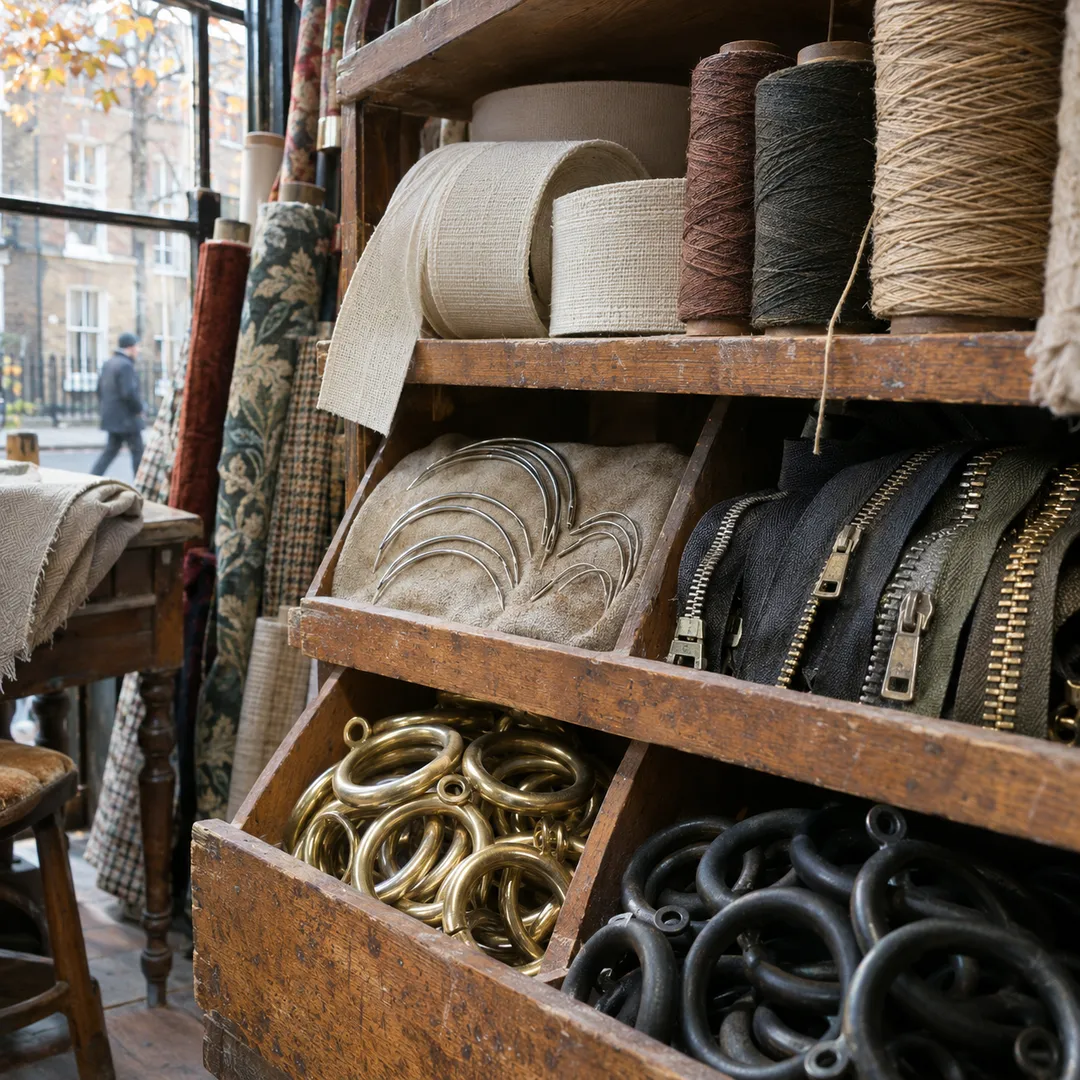
One of the quiet pleasures of a neighbourhood haberdashery is buying components off the continuous roll rather than in wasteful plastic blister packs. For the matching box cushions on their bay window seat, Dev asked for continuous upholstery zip chain, where the shop cuts the exact metreage you need and slides on as many metal pulls as your cushion covers require.
They also picked up washable cotton piping cord wound from a tall wooden cone and a length of braided lead-free hem weight tape to sew into the bottom corners of the curtains so draughts from the sash windows would not make the edges flare. Before leaving the counter, check that your home sewing machine has a zipper foot and a piping foot wide enough for the cord diameter you chose; if not, the counter tray next to the till is the place to pick up a snap-on foot and a fresh pack of heavy-gauge needles.
From the High Street to William Morris Gallery and Lloyd Park
Carrying two rolls of lining and a bag of brass rings across Walthamstow builds an appetite for quieter surroundings, and the neighbourhood offers a fitting second act for anyone who cares about textiles. Walk north across Forest Road into Lloyd Park, where the eighteenth-century brick house at the entrance holds the William Morris Gallery, the former childhood home of the nineteenth-century designer and Arts and Crafts pioneer.
After spending an hour in the High Street sorting humble cotton tapes and workaday cords, looking closely at Morris's woodblock chintzes, Indigo discharge prints and Hammersmith carpet samples gives your own home project a fresh sense of proportion. Even if you only walk the moat path and the grassy lawns of Lloyd Park behind the house, the open green space lets you rest your arms and check your bags before heading home to clear the dining table for cutting.
Winding Back Through Walthamstow Village
If you have energy left in the afternoon, cut east from Hoe Street toward Orford Road and the quiet lanes of Walthamstow Village. Where the High Street is loud, linear and workaday, the village cluster around St Mary's churchyard feels almost country-like, with timber-framed almshouses, ancient yew trees and independent bakeries where you can sit with a pot of tea and sketch out your cutting layout.
Dev and Hannah used a corner table along Orford Road to label each paper packet of hooks, cord and thread with a marker pen so nothing got muddled once they unpacked at home. When they realised they had forgotten a seam ripper and a brush-off tailor's chalk pencil for dark velvet, they opened the Karpo app to check whether another small sewing or craft counter sat along their walk back toward Walthamstow Central.
Practical Habits for an East London Haberdashery Run
Start your Walthamstow trip before midday on a weekday or Saturday, when the full sweep of High Street stalls is set up and indoor counters still have time to help you calculate heading tape and cord lengths. Bring a sturdy canvas bag or a wheeled shopping trolley if you are buying thermal interlining or upholstery webbing, because dense cotton rolls grow heavy ten minutes into the walk.
Use the Karpo app to map out which textile and haberdashery stops sit closer to St James Street versus Walthamstow Central so you can walk the market in one straight line rather than doubling back against the crowd. Carry your window and cushion dimensions on paper, buy an extra metre of piping cord for corner joins, and finish under the trees of Lloyd Park where England's most famous textile obsessive once walked.
Ask Karpo for more information.
Keep reading
- Brixton Vintage Thrift Shop Finder: South London Retro Gems
 Notting Hill Vintage Thrift Shop Finder: Preloved Rails
 Soho Vintage Thrift Shop Finder: West End Designer Archives