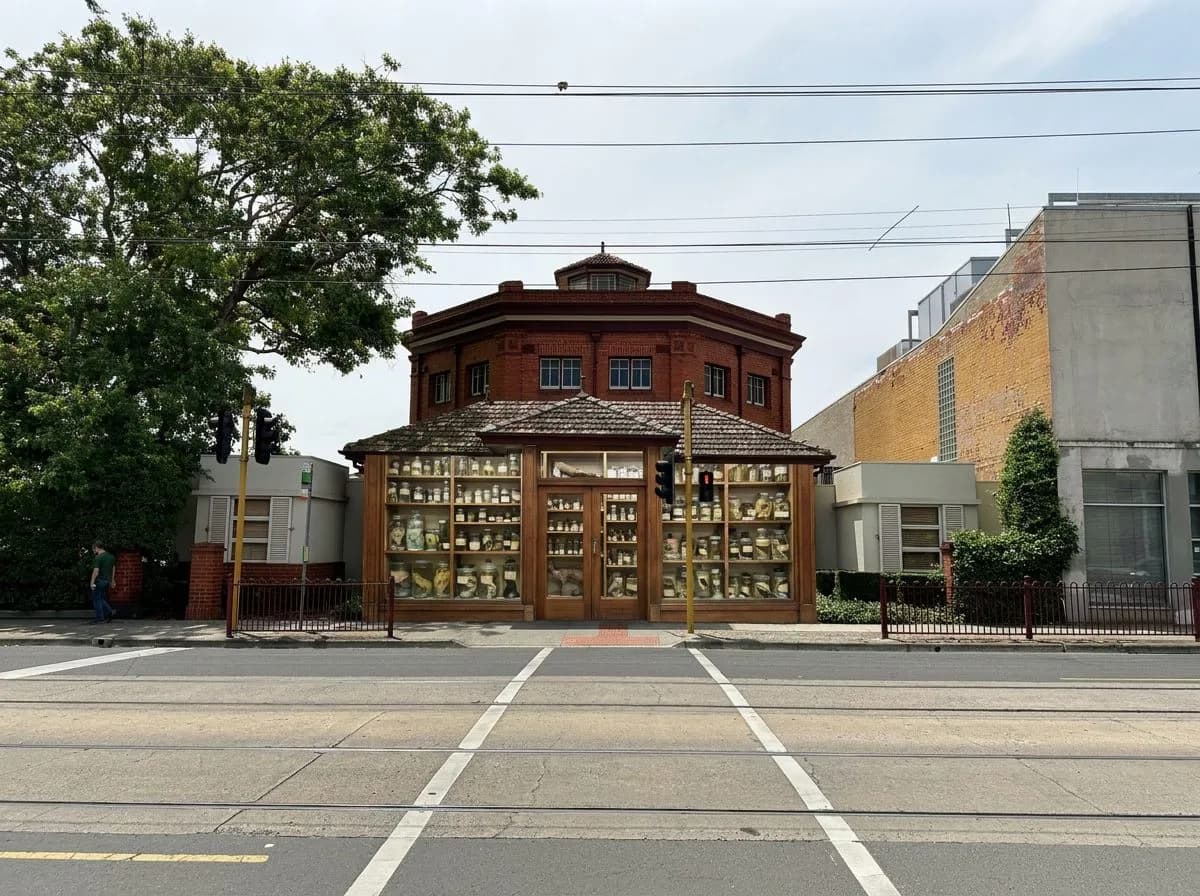
London keeps its strangest treasures behind the public galleries. On Gower Street, past the Grant Museum of Zoology's main displays of articulated skeletons and taxidermy, a locked door opens once monthly to reveal floor-to-ceiling jar storage—a working archive of 19th-century preservation where light refracts through ethanol and glass, illuminating specimens suspended in perpetual stillness. This is not the polished face of natural history; it is the storage room, the back office, the place where Victorian collectors' ambitions translate into three thousand glass vessels lining metal shelving. And for those who book ahead, it is briefly, carefully accessible.
The monthly access window
Jar store tours run on selected dates by advance booking, a rhythm as regular as tides. Online booking opens two weeks in advance, and group size is capped at fifteen participants—a constraint imposed by the narrow aisles between shelving units and the intimacy required when a guide is explaining formaldehyde concentrations and the ethics of Victorian acquisition. Miss the booking window and you wait another four weeks. The museum does not bend its schedule; this is institutional access granted on institutional terms.
The limitation is practical but also experiential. Fifteen people can cluster around a jar containing a preserved octopus hatchling, can hear the guide's commentary on how specimen labels encoded collector rivalries, can ask questions without shouting over a crowd. It transforms the tour from spectacle into seminar, a measured encounter with objects that deserve scrutiny rather than a glancing Instagram scroll. Fall 2026 bookings are already filling; set a calendar reminder now or resign yourself to peering through the gallery glass at the specimens visible from the public side.
Inside the jar store
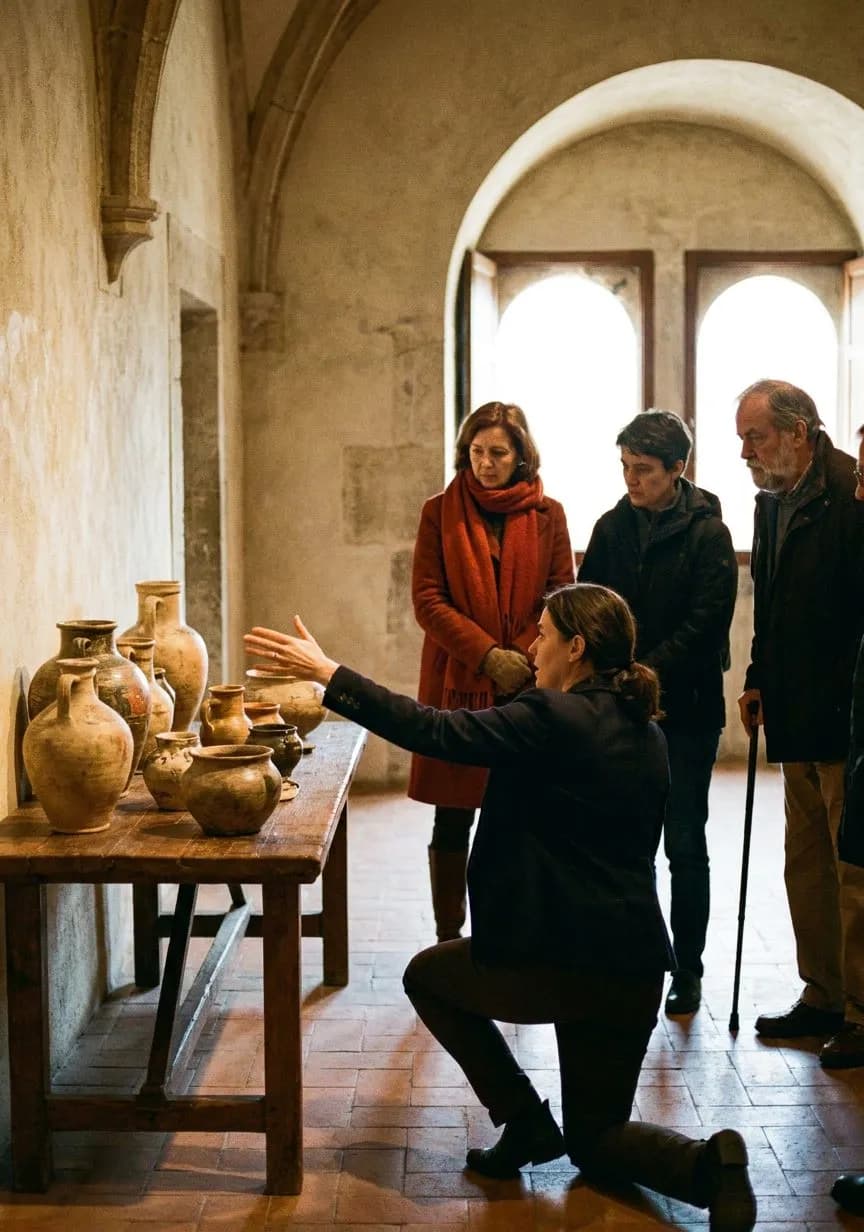
The door opens and the temperature drops. Wet specimen storage demands climate control—steady cool, low humidity, minimal light exposure when not in use. The shelving rises from floor to ceiling, industrial metal painted institutional beige, each shelf crowded with jars of amber liquid. Some vessels are fist-sized; others require two hands to lift. Labels curl at the edges, inked in cursive or typed on ribbons of fabric tape, recording Latin binomials and acquisition dates that predate the museum's 1828 founding as part of University College London's original teaching collection.
Tours last forty-five minutes and include access to storage areas invisible from the main gallery, where the density of the collection becomes legible. The Grant Museum holds sixty-eight thousand specimens in total, with more than three thousand wet preparations housed in this jar store. Many date to the earliest days of UCL's natural history teaching, when professors sent students and collectors across empire trade routes to return with biological samples preserved in spirits. The guide explains Victorian techniques—how ethanol concentrations varied by tissue type, why some jars were topped with pig bladders before screw lids became standard, the way light degrades pigment over decades until brilliant tropical fish fade to sepia ghosts.
The sensory experience is peculiar. Glass mutes color but magnifies form; you notice the curve of a spine, the flare of a fin ray, the delicate webbing of an amphibian's foot. The jars do not smell unless opened, but the room carries a faint chemical sweetness, not unpleasant, a reminder that preservation is an active process. Sound is muffled by the density of glass and liquid; voices lower instinctively, as if in a library or a church. This is a place where curiosity and mortality meet on equal terms.
The Micrarium viewing
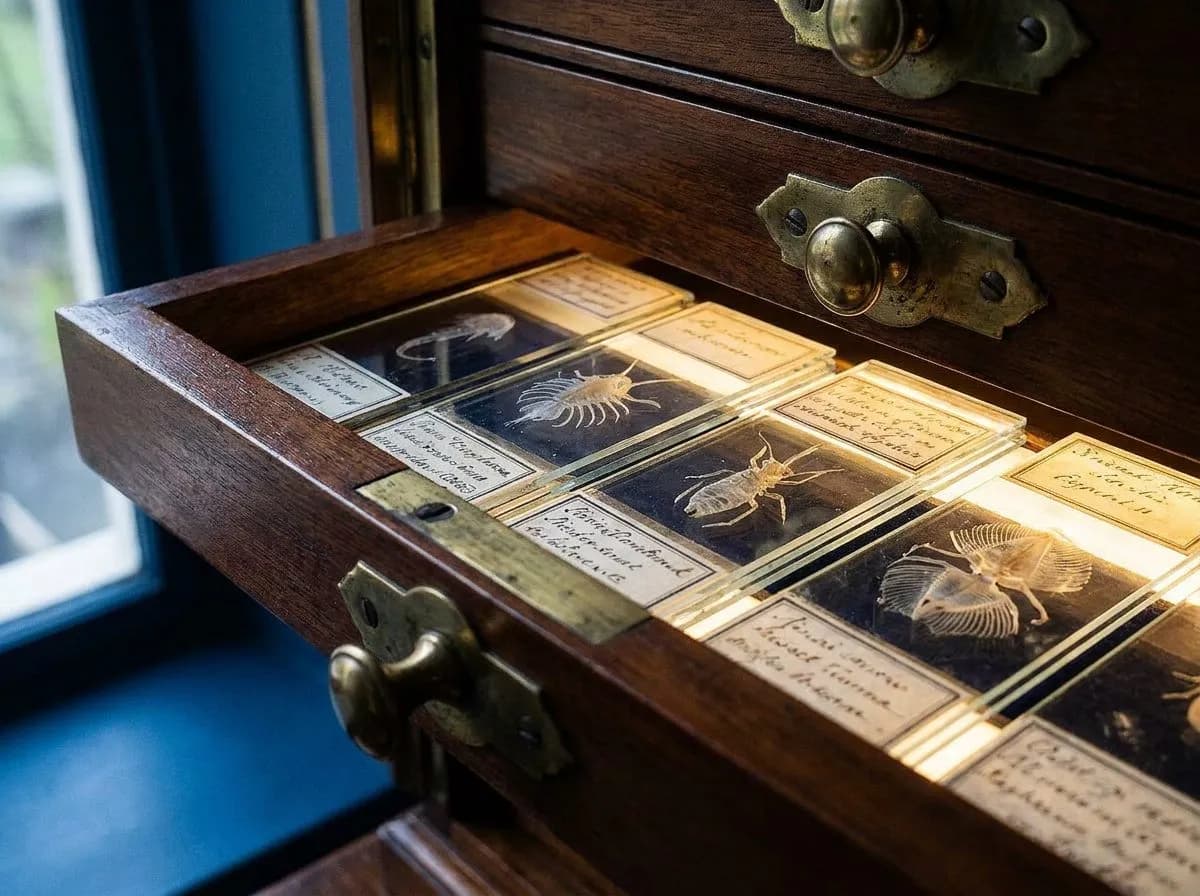
After the jar store, the tour extends—if you opt in—to the Micrarium, a custom cabinet designed to display microscope slides as art objects. Micrarium viewing adds fifteen minutes to the tour, and it is worth every second. The cabinet is a wall-mounted unit of backlit drawers, each containing rows of mounted specimens: cross-sections of bone, slices of tissue, whole insects pinned between glass. Twenty-three hundred slides in total, arranged by taxonomy and technique, glowing amber and rose and crystalline white under LED lighting calibrated to mimic daylight without the UV damage.
The Micrarium invites a different kind of looking. Where the jars reward attention to three-dimensional form, the slides reveal pattern and structure at magnifications invisible to the naked eye. A mouse femur sliced transversely becomes a mandala of concentric rings. A fly wing, backlit, shows venation as intricate as lace. These are teaching specimens, prepared by students and technicians over a century and a half, but under controlled light they transcend pedagogy and become something closer to stained glass—biological data rendered as visual poetry.
The guide here shifts register, less lecturer and more enthusiast, pointing out personal favorites: a dragonfly larva in such fine section that individual muscle fibers are visible, a bat ear preserved to show the capillary network that regulates temperature. You lean close, your breath fogging the glass for a moment before the ventilation clears it. It is tempting to photograph everything, but the light and the scale conspire against phone cameras; better to simply look, to let the patterns settle into memory as texture and color rather than pixel.
Context and collection
The Grant Museum opened in 1828 as a teaching resource for UCL's medical and zoology students, one of the few university natural history collections in London to remain active in its original pedagogical role. It is named for Robert Edmond Grant, the first professor of zoology and comparative anatomy at UCL, a figure who mentored a young Charles Darwin and whose evolutionary ideas prefigured—and were later overshadowed by—*On the Origin of Species*. The collection's Victorian-era specimens carry that intellectual lineage, objects gathered in the service of questions about morphology, adaptation, and the mutability of species.
By late 2026, the museum will have completed climate-control upgrades to the jar store, extending the lifespan of its wet preparations and allowing slightly expanded tour access without risking specimen degradation. The timing is fortunate; public appetite for behind-the-scenes museum experiences has grown as city guide coverage highlights the contrast between polished exhibitions and working archives. The Grant offers both: the main gallery is free and open to walk-ins, but the jar store and Micrarium remain gated, available only to those who plan ahead and commit to the schedule.
Practical notes
The Grant Museum of Zoology is located at Rockefeller Building, 21 University Street, London WC1E 6DE. Nearest Tube stations are Euston Square (Circle, Hammersmith & City, Metropolitan lines) and Warren Street (Northern, Victoria lines), each about a five-minute walk. Street parking in Bloomsbury is restricted; use public transport or a nearby car park. The museum’s accessibility and entrance arrangements should be confirmed in advance; inquire in advance about jar store tour accessibility, as the storage aisles are narrow. Tours run year-round regardless of weather. Bring a notebook if you are detail-oriented; the guides share more information than you will retain by memory alone. Book tours at ucl.ac.uk/museums. Admission to the main gallery is free; check the museum’s booking page for current tour pricing
Tags: #GrantMuseum #LondonMuseums #Bloomsbury #UCL #NaturalHistory #WetSpecimens #Micrarium #TheOddEdit #MuseumTours #VictorianScience #ZoologyCollection #BehindTheScenes #LondonFall2026 #CityGuide #HiddenLondon
Sources consulted: Grant Museum of Zoology · UCL Grant Museum official site · Natural History Museums · UCL Museums Events
All trademarks are the property of their respective owners.