 Shoreditch Comic Shop Crawl Planner: Murals to Manga
Hidden Gems & Odd Finds
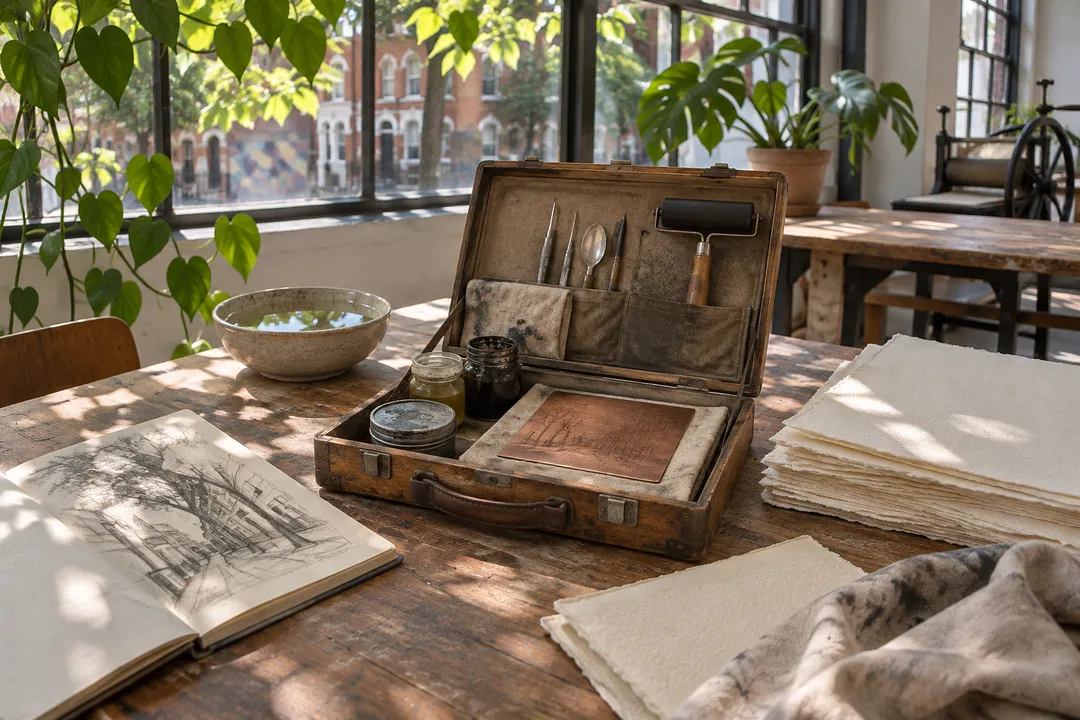
Camberwell Etching Paper Supply Picker: Make 3 Trials
Build a Camberwell etching paper trial around a curious plate, clear sample notes and useful comparisons, then choose nearby material places yourself.
The most useful sheet may be the one that makes you want to try the plate again. A Camberwell etching paper supply picker can start with that curiosity instead of a fixed idea of the perfect material. Bring a small experimental image, decide what you want to learn and keep the purchase proportionate to the test. The neighbourhood provides a creative setting for your own outing, while a short trial brief gives the browsing enough direction to lead somewhere practical.
Name the question before the material
An experimental plate often contains several ideas at once: a scratched line, an open patch and a rough area that behaves unexpectedly. Choose the uncertainty that matters most now. Perhaps you want the lightest mark to survive, or the rough passage to feel less busy. Write that as a question in your notebook. A clear question makes a modest test meaningful and prevents a visit from becoming a hunt for a paper that somehow solves every difficulty in the image.
Separate curiosity from correction. You might enjoy a paper's unusual texture even when it is unlikely to resolve the current issue. Give that curiosity a place on a later-project list rather than forcing it into the immediate purchase. The distinction preserves the pleasure of browsing and protects the experiment from becoming too complicated. When you return to the plate, you should still remember what you intended to learn before the new material caught your attention.
Build a small comparison with different roles
Think of three trials as three questions, not three attempts to prove the same favourite right. One candidate can explore a calmer surface, another a more tactile one, and a third a different handling feel. The exact choices depend on the materials you actually encounter and the guidance available to you. You need no claim about what a Camberwell supplier stocks. Your brief remains useful even if the visit simply helps you identify a future trial more precisely.
Before committing to larger sheets, consider the size of the test image and the space you can use at home or in your workspace. Small experiments are easier to keep together, but they still need enough blank area to judge the relationship between plate and paper. Resist cutting everything down until the image nearly touches the edge. A comparison should preserve the qualities you care about, including a comfortable border and enough surface to understand the sheet as an object.
Borrow a colour from Camberwell
A walk you choose through Camberwell can provide a visual reset between material decisions. Look for a muted colour beside a strong one: a painted doorway against brick, a leaf against a pale wall, or a shadow crossing a pavement. Note what makes the pairing hold together. This is a way to refresh your eye when several white papers begin to seem identical. You are studying relationships rather than collecting a catalogue of picturesque subjects.
If you pause near a green space, leave the paper protected and make a quick drawing in a separate notebook. Try the same simple shape with a sharp outline and a softer edge. Which version feels closer to the print you want? A small exercise can make your preference more legible. The outing then has a rhythm of looking and deciding, with room for ordinary pleasure instead of continuous scrutiny of fibre, shade and surface.

Handle samples as working evidence
Ask before touching, and use the edge or support provided rather than repeatedly rubbing a sheet. The desire to understand texture is reasonable, but the paper does not need to endure a stress test during browsing. Read the identifying information that is actually present and write it down accurately. A remembered impression of softness is difficult to use later without knowing which sample created it. Clear notes give the next printing session something concrete to work with.
Keep a distinction between a material description and your own response. A label may describe composition or manufacture; your notebook may say that the sheet feels springy or that its colour makes a grey drawing feel warmer. Both can be useful when kept separate. Avoid treating a personal impression as a promise of performance. The next trial is there to find out how the sheet behaves with your plate, ink and way of working.
Give every trial a fair chance
At a suitable printing workspace, decide which parts of the process you can keep consistent and record the parts you cannot. If you change both paper and wiping, the difference in the result becomes harder to interpret. Follow the relevant guidance for each material, especially where preparation differs. A fair comparison does not require pretending every sheet is identical. It requires enough attention that you can explain why the results might differ once the proof is dry.
Place the dried trials together and return to the original question. Look at the faint mark, the rough passage or whatever feature you selected before browsing. Then step back and consider the whole image. A paper may improve one detail while making the composition less comfortable overall. Record that tradeoff in a sentence. The most useful result is sometimes discovering that a technically interesting surface belongs with another plate rather than the one currently on the table.
Let nearby recommendations support the afternoon
Use Karpo APP to discover nearby art material places around Camberwell. Describe the kind of place you would like recommendations for, then decide which suggestions suit your interests. You select any visits and arrange your own route and transport. The app's role can stay simple while your own notebook carries the experiment: a question, a few contrasting candidates and the reasons each one might help you learn something from the next proof.
If a friend comes along, invite them to choose the image detail they notice first. Their answer can reveal whether your technical concern is also the visual centre of the print. Compare their response with yours during a pause you choose. You do not have to agree. A useful companion may see a lively irregularity where you see a problem, and that difference can turn a paper trial into an experiment with how the work communicates.
Practical notes for a repeatable habit
Pack protective support, a pencil and enough clear space in your bag to keep paper flat. Keep the trial notes short enough that you will actually complete them after printing. A simple record of material, process changes and observed result is more useful than an elaborate form left blank. Retain one labelled offcut when appropriate so you can recognise the surface again without relying on the memory of a long browsing afternoon.
Choose the next action while the question is still fresh: prepare one comparison, examine the dry results and decide whether another trial is justified. A material outing does not need to end in certainty to be successful. Camberwell can give the afternoon its energy, and a carefully chosen sheet can give the plate another possibility. What matters is that the experiment remains small enough to finish and interesting enough to make you want to return to the work.
Ask Karpo for more information.
Keep reading
- Shoreditch Comic Shop Crawl Planner: Murals to Manga
 Bermondsey Comic Shop Crawl Planner: Zines Under the Arches
 Clapham Comic Shop Crawl Planner: Charity Shelves and Common