 Clapham Bouldering Gym Finder: New in Town, Climb to Mingle
Sports Social

Shoreditch Cycling Trail Planner: Quiet East London Routes
Navigate protected bike lanes through Shoreditch along Cycleway 1 and Leonard Street docks to connect quiet warehouse passages with Regent's Canal routes.
Shoreditch features one of London's most cycling-dense road networks, yet traveling through the district without a deliberate corridor plan frequently strands riders in congested freight delivery bottlenecks along Great Eastern Street or trapped behind slow-moving weekend pedestrian crowds on Brick Lane. The primary challenge in East London stems from the collision of Victorian street geometry with heavy commercial transport, as lorries serving converted warehouse studios vie for space against commuter bicycles. A well-constructed cycling trail planner near me search in Shoreditch focuses on utilizing Hackney and Islington's interconnected secondary grid, anchored by the spine of Cycleway 1 (C1) and the re-engineered protected junctions at Old Street. By routing along parallel backstreets like Paul Street and Tabernacle Street, cyclists preserve a continuous forward cadence while avoiding the noisy arterial exhaust of Shoreditch High Street.
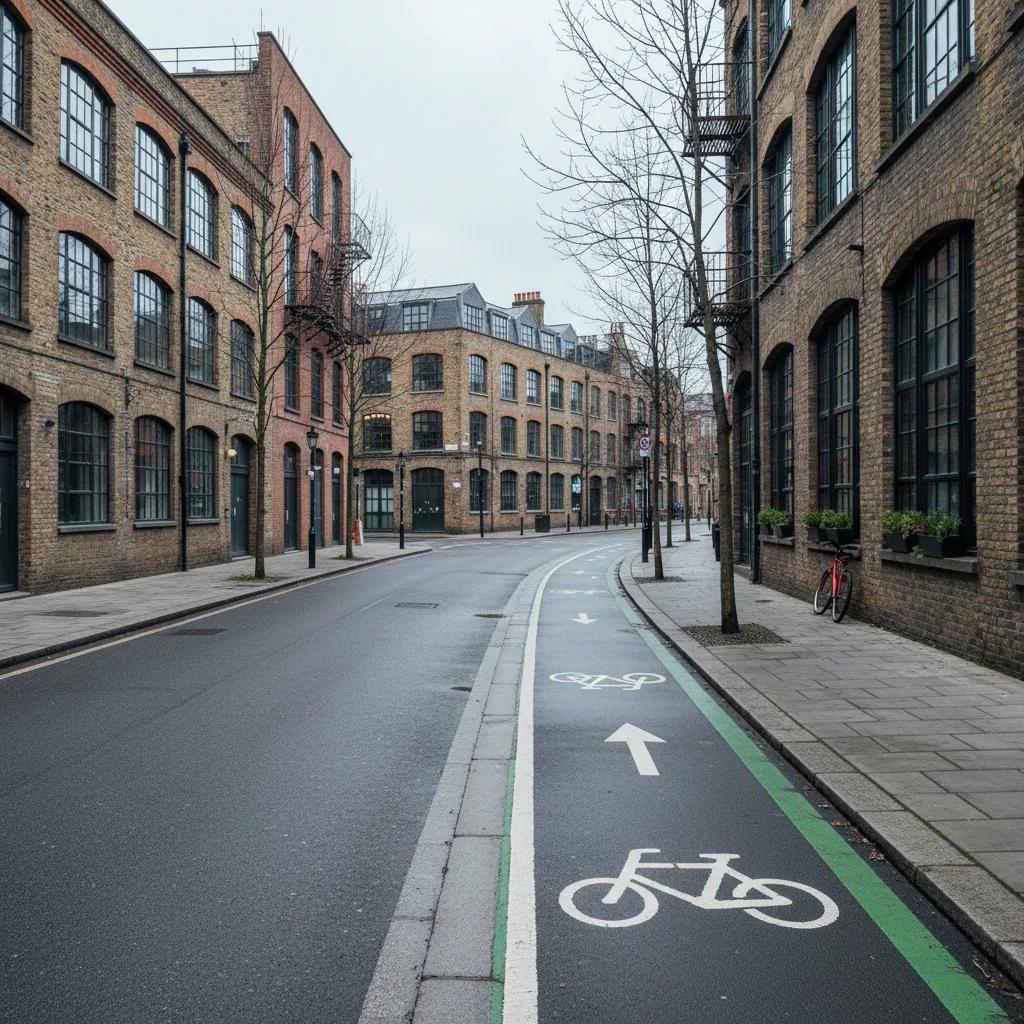
The North-South Spine via Cycleway 1 and Paul Street
Cycleway 1 represents the critical cycling expressway through East London, running southward from Tottenham down through Dalston and De Beauvoir before entering Shoreditch along Pitfield Street. As riders cross Old Street heading south into the City, the route transitions into Paul Street and Wilson Street, which are protected by modal filters that prohibit through motor traffic while permitting continuous bicycle transit. This creates a calm, low-stress corridor where cyclists travel unhindered alongside tech offices and design studios.
Maintaining momentum along Paul Street requires simple vigilance around side alleys where couriers on cargo bikes frequently emerge from delivery docks. Because vehicle volumes are restricted by council bollards, cyclists can ride side by side or occupy the center of the lane comfortably without feeling tailgated by private automobiles. At the southern terminus, Wilson Street deposits riders directly onto the northern edge of the City near Finsbury Square.
Navigating the Redesigned Old Street Crossroads
For decades, the Old Street roundabout stood as one of the most hazardous junctions for vulnerable road users in central London. Transport for London's multi-year modernization project permanently removed the intimidating gyratory system, replacing it with a modernized, signal-controlled peninsula featuring segregated two-way cycle tracks and dedicated bicycle traffic lights. Cyclists crossing east-west between Clerkenwell and Shoreditch now proceed through protected lanes separated from vehicular turns by physical concrete kerbs.
When approaching the junction from the west along Old Street, observe the low-level cycle signals that illuminate green several seconds before vehicular lights, granting bicycles safe clearance across pedestrian crossings. Signage around the subterranean station concourse directs eastbound riders either south toward Moorgate or east along the segregated track flanking Shoreditch Town Hall, eliminating the dangerous lane-weaving of past years.
Santander Cycles Docking Around the Creative Quarter
Shared bicycle users in Shoreditch enjoy a dense distribution of docking terminals, though high commuter demand creates distinct tidal flows: docks fill up early in the morning with City workers and empty rapidly during late afternoon departures. The docking installation on Leonard Street near Paul Street provides 26 bays located centrally within the gallery and agency district, offering an ideal drop-off point for visits to local studios.
Alternative docking banks operate along Shoreditch High Street near the Overground station and on Clifton Street just north of Worship Street. If arriving in Shoreditch during the evening rush when Leonard Street docks are occupied, proceed three blocks eastward to the docking station on Shoreditch Church (St Leonard's), which offers higher bay turnaround due to its position near key bus interchange stops.
Connecting to Regent's Canal and Victoria Park
Heading northeast out of Shoreditch unlocks some of London's most celebrated leisure cycling corridors. Following Pitfield Street north past Shoreditch Park connects directly with the Regent's Canal towpath at Whitmore Road Bridge. From this entry ramp, cyclists can follow the historic waterway eastward toward Broadway Market and Victoria Park, trading city traffic for tree-lined waterside paths.
Riders joining the towpath must respect the Canal & River Trust's "Share the Space" code of conduct, which gives pedestrians absolute priority. Because towpath widths narrow under historic brick bridges, courteous cyclists slow their speed to a walking pace, ring their bells gently when approaching blind corners, and prepare to dismount when weekend family crowds gather around lock gates near London Fields.
Configuring Routes with Karpo APP
Shoreditch's dense grid of one-way streets, bollards, and low-traffic neighborhood filters makes static map applications frustrating for cyclists unfamiliar with local rat-run closures. Utilizing Karpo APP allows riders to configure bespoke cycling routes that automatically prioritize quiet backstreet segments over fume-heavy main roads like Commercial Street. The platform enables cyclists to balance ride speed against road smoothness, helping you avoid cobblestone alleys when traveling on fragile road wheels.
Keep in mind the practical reality of the software: Karpo APP organizes your strategic waypoint chain and surface choices, but it does not supply live bike-share dock telemetry or voice-guided real-time navigation. Cyclists still confirm dock vacancies via the TfL Santander Cycles app and keep their eyes on the road, using Karpo APP as the pre-ride blueprint for discovering calm, low-traffic transit lines.
Industrial Cobblestones and Railway Bridge Hazards
Historic industrial character across Shoreditch means riders regularly encounter weathered granite setts and uneven stone tracks, particularly along Redchurch Street, Boundary Street, and Rivington Street. These textured surfaces present little issue in bone-dry conditions, but morning fog or winter rain transforms them into slippery tracks where sudden turns can destabilize narrow tires. Cyclists should keep wrists relaxed and let their elbows absorb road vibrations.
Railway bridges carrying the London Overground along Shoreditch High Street and Brick Lane present secondary blind spots. Roadways frequently pinch inward underneath these Victorian brick spans, where shadows reduce visibility during late afternoon hours. Maintain bright daytime running lights even in cloudy weather to ensure that turning delivery vans and rideshare drivers identify you through bridge underpasses.
Practical Notes
Cycle security in Shoreditch requires stringent precautions because Hackney and Tower Hamlets experience high rates of opportunistic bicycle theft. Avoid leaving expensive commuter bicycles locked with cheap wire cables. Instead, secure your frame and rear wheel to an official council hoop using a heavy hardened-steel D-lock, and take removable accessories like rechargeable lights, GPS computers, and quick-release saddle packs with you.
Remember that bus lanes along Great Eastern Street and Bishopsgate permit cycling, but keep a respectful distance behind London buses to ensure you stay outside their blind zones. When signaling turns across complex junctions, extend a clear, deliberate arm signal early and check over your right shoulder twice before altering lane position.
Ask Karpo for more information.
Keep reading
- Clapham Bouldering Gym Finder: New in Town, Climb to Mingle
 Marylebone Bouldering Gym Finder: Lunch Break Climbs
 Notting Hill Bouldering Gym Finder: Family Climbing Weekends