 Clapham Board Game Night Finder: New to London Meetups
Weekend Plans
Botanical Garden Near Me in Forest Hill: Horniman's Free Sixteen Acres
The Horniman Museum and Gardens at 100 London Road, Forest Hill, opens 16 acres of themed gardens free from 7.15am Monday to Saturday and 8am on Sundays, with a medicinal garden, a prairie-style Grasslands Garden, a Victorian conservatory and a hilltop bandstand.
The Horniman Gardens cost nothing to enter and open at 7.15am Monday to Saturday, 8am on Sundays, which makes them one of the earliest botanical garden near me options in south-east London. The 16 acres wrap around the Horniman Museum at 100 London Road, Forest Hill, London SE23 3PQ, a five to ten minute uphill walk from Forest Hill station. Plan around one date: on Saturday 31 October 2026 the whole garden closes to anyone without a ticket for the museum's Day of the Dead family festival.
A Tea Trader's Gift to South London
Frederick Horniman, a Victorian tea merchant and compulsive collector, opened his house and its grounds to visitors before building a purpose-made museum, completed in 1901 and given to Londoners along with the land. His architect, Charles Harrison Townsend, designed the clocktower in Doulting stone, the same shelly limestone used at Wells Cathedral, and later the bandstand. The gardens grew in layers after that: Arts and Crafts beds in the 1930s, then planting tied to the museum's anthropology, music and natural history collections.
The Sunken Garden and Its Useful Plants
Head first to the Sunken and Display Gardens, built in 1936 and overlooked by a terrace with benches that catch the sun. The beds are now planted with perennials rather than changing bedding, and the pond was deepened in 2023 for wildlife. Around them run three teaching gardens: a Medicinal Garden split into ten body-part sections, a Dye Garden where plants are grouped by the colour they produce, and a Materials Garden showing species used for building, textiles and musical instruments.
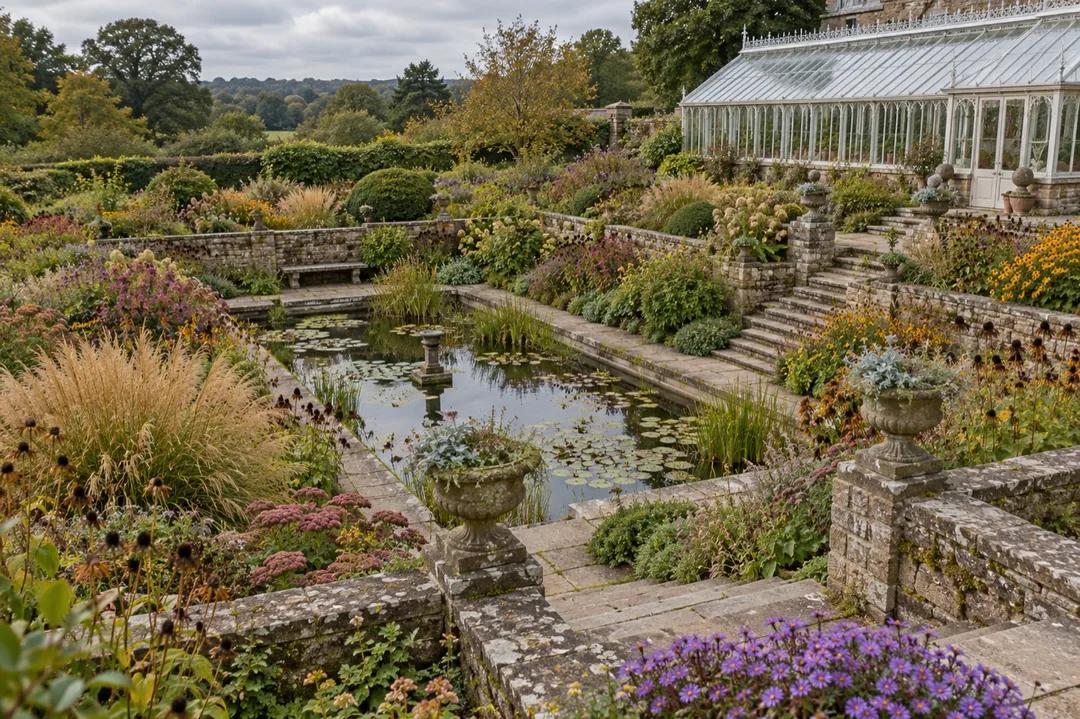
The Grasslands Garden is the most photographed part in autumn. It recreates critically threatened wild landscapes, mixing North American prairie plants with South African grassland species, and in October the seedheads and bleached stems catch low light beautifully. Nearby, the Prehistoric Garden in front of the museum gathers so-called living fossils: a ginkgo, tree ferns, cycads, a monkey puzzle and a Wollemi pine, a tree known only from fossils until it was found growing in Australia in 1994. Look out for the life-size velociraptor model hiding among them.
A Conservatory That Moved From Croydon
The Grade II listed glass Conservatory was first built in 1894 at Coombe Cliffe in Croydon, the home of Horniman's parents, and was ordered from the catalogue of Walter Macfarlane's Saracen Foundry in Glasgow. By 1982 it had fallen apart; it was dismantled, moved here, restored with English Heritage, and reopened in 1989. Today it is used for performances and events rather than as a plant house, and the museum lists refurbishment works on it, so treat it as architecture to admire from the path.
The Bandstand View and Who Is Up There
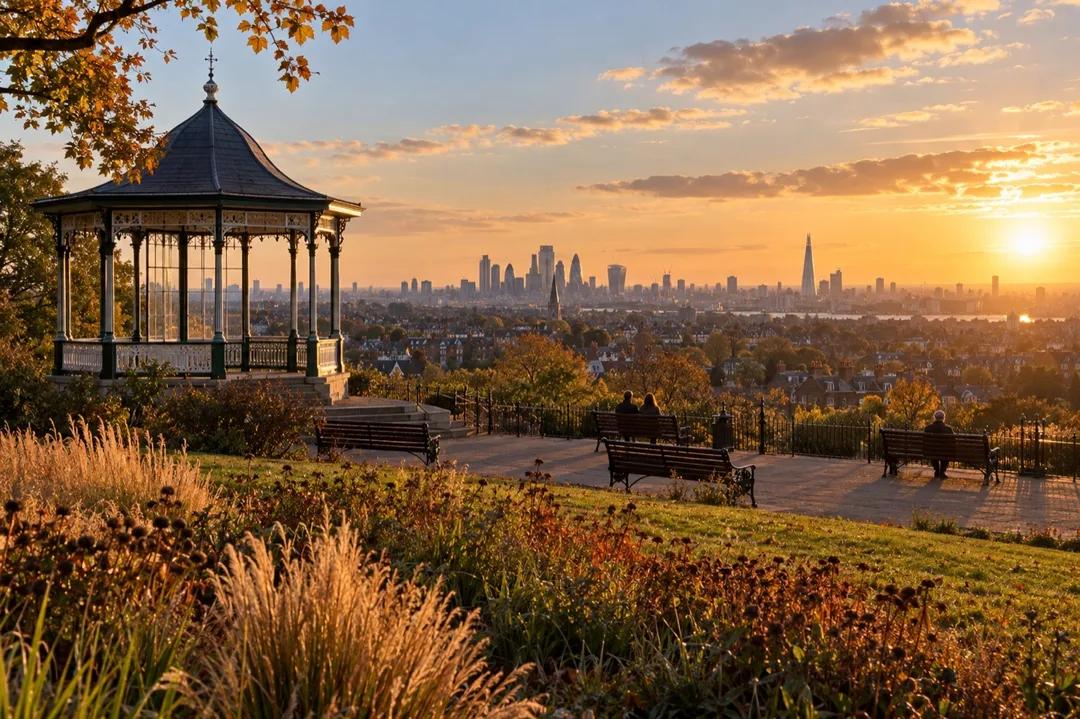
Climb to the Bandstand, built in 1903 to Townsend's design and renovated in 2012 with new oak floorboards and glass replacing decades-old screens. The terrace looks north across the city, and on clear evenings the towers of the City and the Shard stand out on the horizon. It is the garden's social hub: picnicking families spread across the terrace, and dog walkers head down to the Meadow Field below, the only area where dogs may run off the lead. The Bandstand Kiosk serves drinks on Sundays and holidays, 10am to 4pm, weather permitting.
Two smaller stops are easy to miss. Facing London Road stands London's first Alaskan totem pole, carved in red cedar by the Tlingit artist Nathan Jackson in 1985 and topped by an eagle, his clan crest. Elsewhere in the gardens, the Sound Garden turns instruments from the music collection into giant playable versions, so expect children drumming on it at any hour. Both are free and take five minutes, and they explain why this garden feels so tied to the collections indoors.
Paid Extras Worth Adding
The gardens and museum are free, but the Butterfly House, the Aquarium and the Voyage to the Deep exhibition need timed tickets. The Butterfly House runs 10.30am to 4pm with last entry at 3.30pm, and prices on the Horniman's ticket page start from £2 to £28.60 depending on ticket type, with family discounts applied automatically at checkout. The free Animal Walk, with alpacas, goats and rabbits, opens at 12.30pm and closes at 4pm, so time your loop to pass it in the early afternoon.
Autumn Hours and When Not to Come
From Sunday 25 October 2026 to 7 February 2027 the main Horniman Drive gates close at 4.20pm, and the Nature Trail, a woodland strip along an old railway line, shuts at 3pm. Do not come on 31 October or 25 December, when the gardens are fully closed. In high winds staff may close the gardens at short notice, and the museum suggests phoning ahead on very windy days. The Gardens Café opens at 9am and closes at 4pm from 25 October.
Getting Here While the Bus Stops Are Closed
Forest Hill station is on the London Overground Windrush line between Highbury and Islington and the south, and the museum is signposted from the platform 1 exit toward London Road. The walk is short but uphill. Right now the Horniman's site warns that both bus stops outside the museum are closed because of burst water mains, so if you planned on the bus to the door, get off at Forest Hill station instead. Buggy parking is in Gallery Square, and most garden paths are tarmac or concrete.
If the Gate Is Shut, Walk to the Woods
If you arrive on a closure day or after 4.20pm, Sydenham Hill Wood, a London Wildlife Trust reserve of old woodland and Victorian garden remnants, is about a fifteen-minute walk west through residential streets and makes a good substitute. In the other direction, the high street around Forest Hill station has independent cafés and a weekend crowd of young families. The Horniman is also on the Green Chain Walk, a signed route linking open spaces across south-east London if you want a longer hike.
Practical Notes
The museum is open 10am to 5.30pm daily and its café 9am to 5pm, which makes it a dry fallback if rain sets in. Children under three are free for the paid attractions, and Universal Credit holders can buy up to four £2 tickets per attraction, though not online from 24 October to 1 November. Foxes live in the gardens; do not feed them. Allow two hours for the gardens alone and a full day with the museum.
Ask Karpo for more information.
Keep reading
- Clapham Board Game Night Finder: New to London Meetups
 Marylebone Board Game Night Finder: Baker Street Mysteries
 Notting Hill Board Game Night Finder: Two-Player Rainy Dates