 Brixton Christmas Light Up Walk Planner: Rainy Arcades
Free Things to Do
Barbican Botanical Conservatory: See It Free Before 2027
Yes, the Barbican Conservatory on Silk Street is free, but it opens only on set dates and closes for restoration in January 2027. Book December's plant ballot.
The Barbican Conservatory is free, sits on Level 3 of the Barbican Centre on Silk Street, London EC2Y 8DS, and has only weeks of public life left in its current form. The Barbican says the multi-storey glasshouse will be emptied for a three-year restoration starting January 2027. If you want a botanical conservatory in the City of London that looks like nowhere else on earth, the remaining open dates this autumn and winter are the ones to grab.

Why This Glasshouse Looks Like a Jungle Ate a Car Park
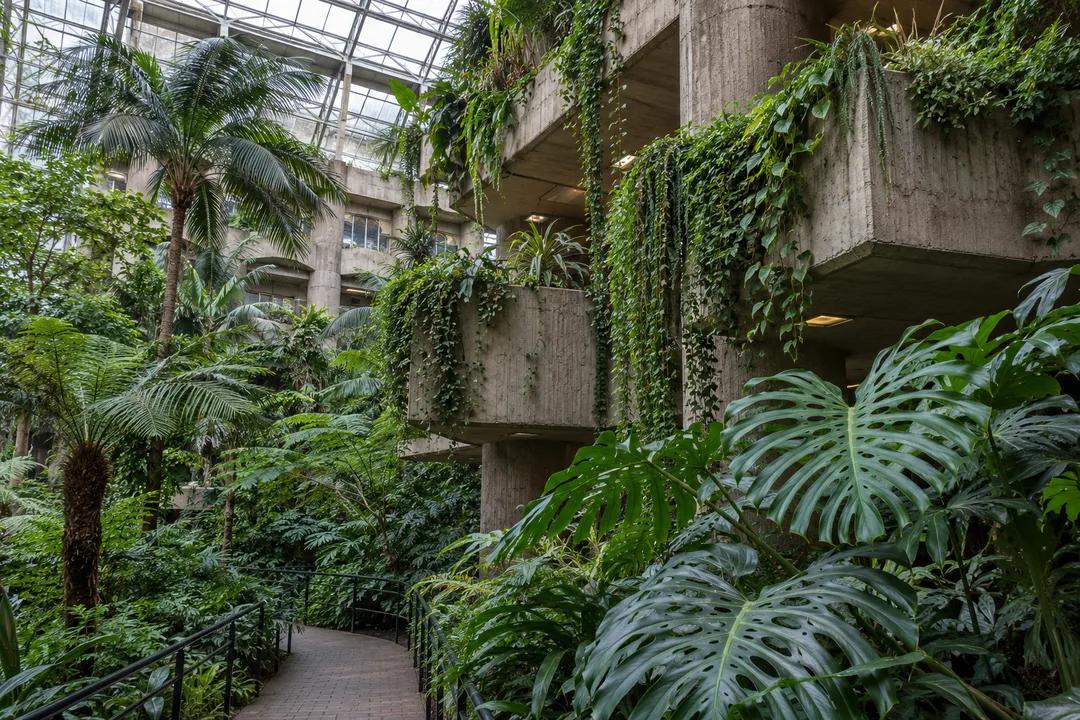
The planting went in during the 1980s, on the roof of the Barbican Theatre and wrapped around its 100-foot flytower, the tall box that hides the stage machinery. That is why the paths climb and twist around raw concrete columns instead of running in neat glasshouse aisles. The Barbican itself calls it London's best loved, possibly only, eco-Brutalist space, and standing under the glass roof with board-marked concrete on every side, the label is fair.
The Barbican's own Visit the Conservatory page says the beds were planted between 1980 and 1981, the space opened in 1984, and it now holds around 1,500 species of plants and trees, some of them rare and endangered in their native habitat. Head Gardener Marta Lowcewicz has worked here for sixteen years and raised many of the plants from seedlings. The big-leaf monstera, glossy ficus and trailing tradescantia over the balconies are exactly the species now being cut and potted up for the public.
The December Plant Adoption Ballot
The best reason to go before the closure is the final plant adoption event on 2 December, run with Wayward Plants, the plant reuse group that held its first London adoption here in 2009 during the Radical Nature exhibition. Tickets are free but allocated by ballot, and the ballot closes on Thursday 19 November. Winners get an email and 48 hours to claim a free ticket before the slot passes to someone else.
The rules are strict and worth knowing before you enter. There are 40 tickets per time slot, one ticket per person, and the name on the booking has to be the person attending. There are no walk-ins, under-16s are not admitted, and bags are checked at the door. Each ticket holder leaves with one cutting, sized according to its host plant, so expect a rooted sprig rather than a floor-standing monstera.
Visitors are encouraged, not required, to make a donation toward the restoration when they book. More than 2,000 cuttings have been propagated at the Wayward Plants Reuse Centre across the adoption programme, and the Barbican has said further free openings, special tours and artistic events will be announced. Members of Young Barbican, the centre's free scheme for under-30s, had a separate adoption date on 29 November.
What to Look For Once You Are Inside
Go slowly and look up. The best views are from the upper walkways, where the vines hang past you into the void and you can see how the glass roof sits over the theatre's flytower. The collection is described by the Barbican as temperate and arid plants, so alongside the jungle look there is a drier corner of cacti and succulents in concrete planters that photographs beautifully in flat winter light.
Ask the gardeners which host plant your cutting came from. The adoption page says visitors can see the parent plants, and staff are usually happy to point out the specimens that have survived since the original planting. For many regulars the real draw is simply the contrast of soft green against hard grey concrete, which is the image that made the conservatory a fixture of London photography feeds.
Getting There and Finding the Door
The conservatory is easy to miss because it has no street entrance. From Barbican tube station, take the steps signed Art Gallery up to the Sculpture Court, where a sign points you to the conservatory. Coming along the highwalks, follow signs to Barbican Centre. From inside the building, the main lifts take you to Level 3, the gallery floor, and the glasshouse entrance is through double doors on the right.
Accessibility is limited and the Barbican is candid about it. Only around 30% of the conservatory is fully step-free today, because the narrow paths and stairs were never designed for wheelchairs. The automatic doors from the gallery floor are 120cm wide and lead to a 1:12 ramp, and assistance dogs are welcome. If steps are a problem, the restored space will add widened paths and a new lift.
An Honest Verdict on Timing
Skip the idea of turning up on a random weekday afternoon. The Barbican's Visit the Conservatory listing runs its final public openings from Friday 13 November 2026 to Sunday 3 January 2027, and the page states plainly that the conservatory is closed for public visits on any date not listed. Admission is free but ticketed, and a limited batch of day tickets is released online from 9:30am on each opening day, so the morning release is your best shot if the waiting list has not come through.
If you do strike out, two free alternatives sit within a short ride. Sky Garden, up in the City's walkie-talkie tower, has a landscaped garden under glass at the top, bookable for free up to three weeks ahead. Crossrail Place Roof Garden in Canary Wharf is a timber-latticed garden over the Elizabeth line station. Neither has the concrete-jungle drama, but both scratch the greenhouse itch.
What Changes After 2027
The restoration is a full rebuild of the systems behind the greenery. Ageing waterproofing, heating, glazing and irrigation will be replaced by architects Allies and Morrison with engineers Buro Happold, while landscape practice Harris Bugg Studio works with the Barbican team on a new planting scheme mixing returning plants with new specimens. Some plants will be stored and replanted and others donated to community projects.
The payoff is that from 2030 the Barbican plans to open the conservatory daily and keep it free, instead of a few times a month. That is good news for London, but it also means the slightly wild, overgrown version visitors know now will not come back in the same form. Seeing it before the plants come out is the point of a visit this season.
A Short Walk Around the Barbican Estate
Build in time for the estate itself. The Barbican lakeside terrace, a level below the Sculpture Court, faces St Giles Cripplegate, a medieval church that survived the Blitz and now sits marooned among the towers. Walk the highwalks south toward Postman's Park, with its wall of tiles remembering everyday heroes, then on to St Paul's Cathedral, about fifteen minutes on foot.
Practical Notes
Address: Barbican Centre, Silk Street, London EC2Y 8DS, conservatory entrance on Level 3. Entry is free and ticketed. Public opening dates run Friday 13 November 2026 to Sunday 3 January 2027, closed on unlisted dates. The final plant adoption event is 2 December, booked by ballot only, closing Thursday 19 November, one ticket per person and no under-16s. Large bags, luggage, prams and buggies are not allowed inside, and only guide dogs are admitted. Save the Barbican's Conservatory page in the Karpo APP so new ticket releases do not slip past.
Ask Karpo for more information.
Keep reading
- Brixton Christmas Light Up Walk Planner: Rainy Arcades
 Hackney Christmas Light Up Walk Planner: Canal Boats
 Islington Christmas Light Up Walk Planner: Square Dates