 Clapham Board Game Night Finder: New to London Meetups
Weekend Plans
London Art Museum Guide to South Kensington's Victoria and Albert Museum
Explore the Victoria and Albert Museum in South Kensington, featuring world-renowned decorative arts, the Cast Courts, Raphael Cartoons, and Victorian architecture.
For travelers and cultural enthusiasts searching for an extraordinary art museum near me in London, the Victoria and Albert Museum stands as the world's premier treasury of decorative art, fashion, sculpture, and design. Anchoring the historic cultural precinct of South Kensington at Cromwell Rd, South Kensington, London SW7 2RL, this monumental institution houses over 2.8 million cataloged objects that span five thousand years of human ingenuity. From monumental Italian Renaissance plaster casts and gilded Islamic glass to royal couture gowns and post-war modernist furniture, the museum provides an unhurried journey through the visual and material cultures of Europe, Asia, and the Americas.
Victorian Origins, Royal Patronage, and Aston Webb Architecture
The origins of the institution trace back directly to the Great Exhibition of 1851 in Hyde Park, organized by Prince Albert and royal civic reformer Henry Cole to celebrate international industrial progress and craftsmanship. Following the triumph of the exhibition, Cole established the Museum of Manufactures in Marlborough House in 1852, utilizing exhibition surplus profits to assemble exemplary historic and contemporary manufacturing models. In 1857 the burgeoning collection transferred to its permanent South Kensington site as the South Kensington Museum, becoming an innovative educational laboratory that pioneered evening opening hours illuminated by gas lighting so working-class craftspeople could study historical masterworks after labor shifts.
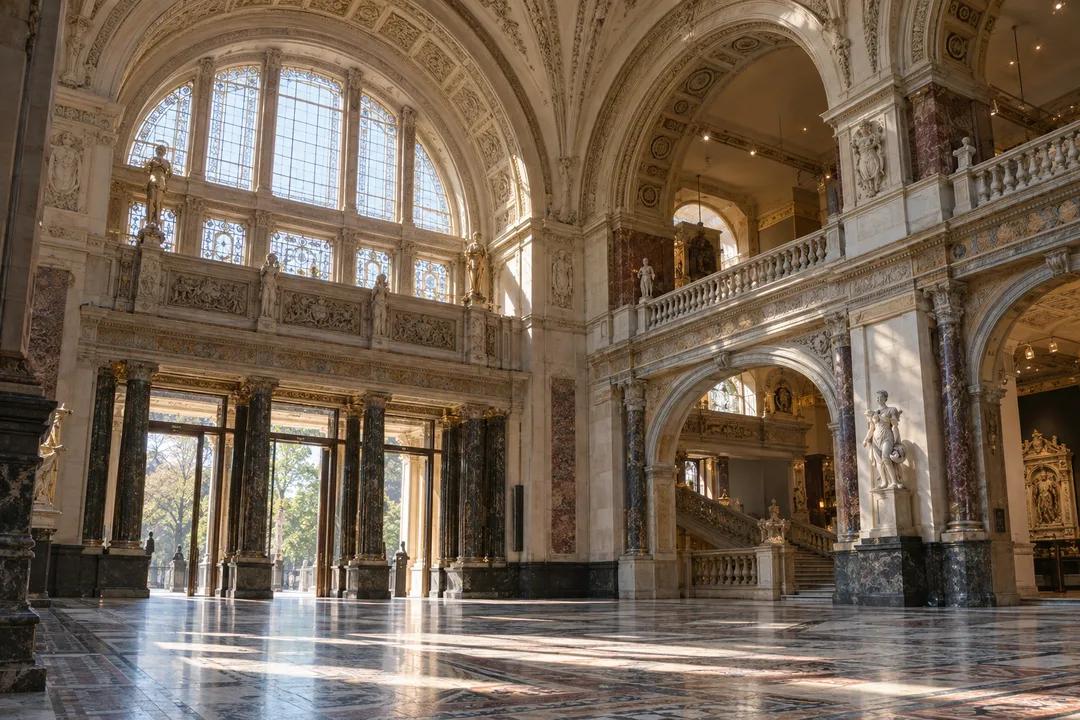
The landmark complex was renamed the Victoria and Albert Museum on 17 May 1899, when Queen Victoria laid the foundation stone for the magnificent Aston Webb front façade in her final public ceremonial appearance. Aston Webb's design fused striking red brick and Portland stone with grand Renaissance arches and an imposing three-hundred-foot octagonal lantern tower inspired by Saint Mary of the Flower in Florence. Crossing the threshold reveals soaring vaulted halls, classical mosaic pavements, and the tranquil John Madejski Garden, an open-air central courtyard where contemporary visitors gather around a stepped elliptical reflecting pool framed by red-brick Italianate colonnades.
The Cast Courts, Raphael Cartoons, and British Galleries
Among the most beloved architectural marvels within the museum are the magnificent Cast Courts in Galleries 46a and 46b, originally opened in 1873 to display full-scale architectural replicas for Victorian scholars unable to undertake European Grand Tours. Dominating the soaring skylit gallery is a plaster replica of Rome's Trajan's Column, standing over one hundred feet tall and cast in two colossal vertical sections to accommodate the gallery ceiling. Surrounding the column are breathtaking life-size casts of Michelangelo's David, Ghiberti's Gates of Paradise from Florence Baptistery, and the Portico de la Gloria from Santiago de Compostela Cathedral, meticulously restored to highlight nineteenth-century mould-making wizardry.
A few galleries away in Room 48 hangs one of the greatest artistic treasures in the British Royal Collection: the Raphael Cartoons, painted in 1515 by Italian master Raphael Sanzio as preparatory full-scale tapestry designs for the Sistine Chapel in Rome. Depicting the acts of the Apostles Peter and Paul in vibrant distemper paint on mounted paper sheets, these monumental artworks were brought to London by King Charles I in 1623 and loaned to the South Kensington Museum by Queen Victoria in 1865. The gallery's subtle fiber-optic illumination and deep acoustic dampening offer a contemplative environment to study Raphael's peerless compositional balance and dramatic human gestures.
Visitors venturing into the British Galleries discover four centuries of British decorative arts spanning from 1500 to 1900 across two sweeping floors. Celebrated highlights include the Great Bed of Ware, a massive carved oak four-poster bed mentioned in Shakespeare's Twelfth Night, alongside delicate Elizabethan miniatures by Nicholas Hilliard and the hand-embroidered textile panels of William Morris and the Arts and Crafts movement. The museum's Asian departments in the Nehru Gallery and Toshiba Gallery present priceless Mughal emerald daggers, imperial Chinese jade carvings, and the exquisite Ardabil Carpet, the world's oldest dated Persian carpet, woven in 1539.
Historic Morris Refreshment Rooms and Madejski Courtyard
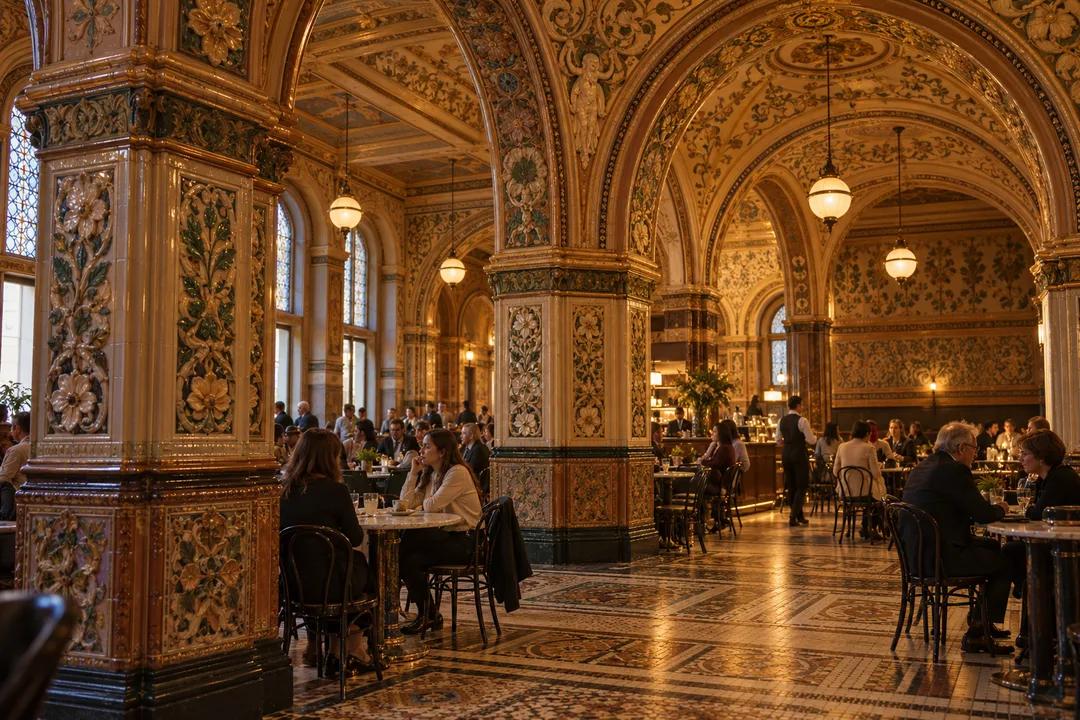
A visit to the Victoria and Albert Museum is inextricably tied to the history of public hospitality, as this institution created the world's first dedicated museum restaurant during the 1860s. Today, guests can enjoy lunch, loose-leaf teas, and artisanal cakes inside the historic V&A Café, situated across three lavishly preserved Victorian dining chambers. The Gamble Room dazzles with molded ceramic relief tiles, enameled mottos, and a central Victorian fireplace, while the Poynter Room features hand-painted blue-and-white Delft tiles illustrating the months and seasons of the agricultural year.
The crown jewel of the dining suite is the Green Dining Room, commissioned in 1866 from the pioneering decorative firm Morris, Marshall, Faulkner & Co. and designed by William Morris and Pre-Raphaelite painter Sir Edward Burne-Jones. Enclosed by olive-green wainscoting, gilded plaster leaves, stained-glass zodiac medallions, and delicate floral relief friezes, the room represents an enduring manifesto of handcrafted design. The café serves fresh seasonal British fare, including sourdough sandwiches, warm vegetable quiches, traditional Cornish cream teas with clotted cream and strawberry jam, and fair-trade organic coffee.
Practical Admission Details, Hours, and Transit Access
General admission to the Victoria and Albert Museum's permanent galleries and collections is completely free of charge, with no advance booking required for standard entry. The museum is open daily Monday through Sunday from 10:00 am to 5:45 pm, with extended evening hours every Friday until 10:00 pm, when the galleries come alive with live acoustic music performances, curatorial lectures, and late-night drinks. Major temporary exhibitions focusing on haute couture fashion, retrospective photography, or global design are ticketed, with standard adult admission typically ranging from £20 to £25, while museum members and patrons enter free.
The museum is fully wheelchair accessible, providing level step-free access via the Exhibition Road entrance, spacious elevators serving all gallery levels, complimentary manual wheelchair loans, and accessible restrooms throughout the building. Lockers are available in the subterranean Sackler Courtyard for luggage and coats, though large suitcases exceeding cabin dimensions are not permitted on site.
Traveling to the Victoria and Albert Museum is straightforward thanks to excellent public transit connections. South Kensington Underground station, served by the District, Circle, and Piccadilly lines, is located just three minutes away on foot and connects directly to the museum basement level through a tiled pedestrian subway tunnel. Numerous Transport for London bus routes, including the 14, 74, 414, and C1, stop directly outside along Cromwell Road. Nearby cultural attractions within a five-minute stroll include the Natural History Museum, the Science Museum, and the majestic concert hall of the Royal Albert Hall.
To discover more historic museums, royal galleries, and cultural itineraries across London, turn to the Karpo APP. Whether you are mapping out afternoon museum strolls in South Kensington or seeking recommendations for nearby historic pubs, the platform provides tailored neighborhood suggestions for every cultural explorer.
Ask Karpo for more information.
Keep reading
- Clapham Board Game Night Finder: New to London Meetups
 Marylebone Board Game Night Finder: Baker Street Mysteries
 Notting Hill Board Game Night Finder: Two-Player Rainy Dates