 Clapham Board Game Night Finder: New to London Meetups
Weekend Plans
London Art Museum Visit to The National Gallery on Trafalgar Square
Discover The National Gallery on London's Trafalgar Square, housing over 2,300 Western European masterpieces from Van Eyck and Da Vinci to Turner and Van Gogh.
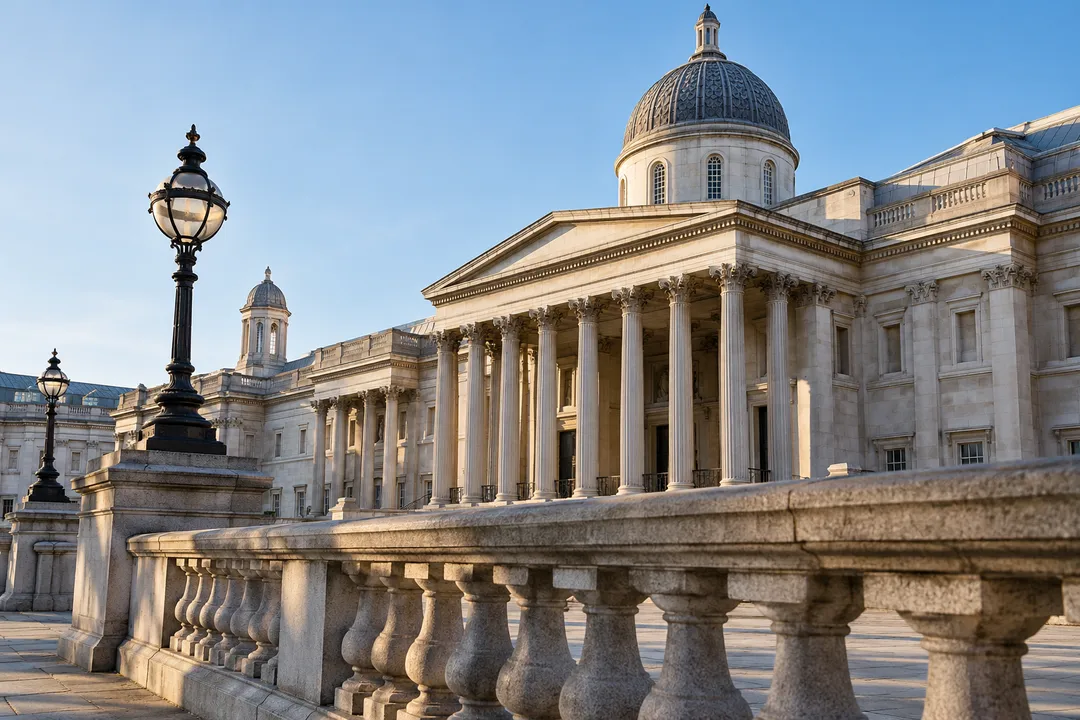
When seeking an iconic, historically magnificent art museum near me in London, The National Gallery on Trafalgar Square, London WC2N 5DN represents the crown jewel of British civic culture. Founded by Parliament in April 1824 through the acquisition of thirty-eight masterworks from banker John Julius Angerstein, the collection moved to its current neoclassical home designed by architect William Wilkins in 1838. Standing prominently along the northern terrace of Trafalgar Square, its grand Corinthian portico and central dome command one of the capital's most recognizable public plazas.

Two Centuries of Western European Painting Masterpieces
The National Gallery holds an extraordinary, encyclopedic collection of more than 2,300 paintings tracing the evolution of Western European art from approximately 1250 through to the early twentieth century. Unlike royal dynastic collections assembled through aristocratic inheritance, Britain's national collection was built consciously on behalf of the public, designed to foster aesthetic education and cultural enrichment for every citizen regardless of social background.
The gallery complex expanded over successive generations, culminating in the 1991 addition of the Sainsbury Wing, masterminded by postmodern architects Robert Venturi and Denise Scott Brown. Recently refreshed for the gallery's 2024 bicentenary celebrations, this luminous wing provides purpose-built display suites for the museum's earliest Italian, Netherlandish, and Flemish panel paintings, with serene limestone pilasters and natural overhead skylights.
Entering through the grand vestibule and ascending the imperial marble staircases reveals magnificent vaulted rooms paneled in crushed silk damask and polished hardwood parquet. Soft ambient daylight pours through ceiling lanterns, illuminating gilded frames and centuries of brushwork in an atmosphere of enduring scholarly prestige and aesthetic wonder.
Highlights from the Italian Renaissance to Impressionism
Navigating the collection rooms takes guests on an unforgettable journey through the monumental turning points of European painting. In the early Renaissance galleries, visitors encounter Jan van Eyck's peerless 1434 Arnolfini Portrait, celebrated for its convex mirror reflection, microscopic domestic realism, and delicate depiction of Northern European marriage rituals. Nearby hangs Leonardo da Vinci's mystical Virgin of the Rocks, displaying the Italian master's revolutionary sfumato technique and rocky cavern atmosphere.
The sixteenth-century Italian rooms feature monumental altarpieces and mythological canvases by Raphael, Michelangelo, Titian, and Paolo Veronese. A crowd gathers consistently before Hans Holbein the Younger's 1533 portrait The Ambassadors, an astonishing monument of Tudor diplomacy featuring meticulously painted celestial globes, lutes with broken strings, and a celebrated anamorphic skull visible only from an acute side angle.
Seventeenth-century masterworks include Caravaggio's dramatic Supper at Emmaus, famous for its theatrical chiaroscuro lighting and raw emotional realism, alongside extensive gallery suites dedicated to Rembrandt van Rijn, Peter Paul Rubens, and Anthony van Dyck. Diego Velázquez's sensual Rokeby Venus, the only surviving female nude painted by the Spanish court master, commands Room 30 with its subtle reflection of beauty and mortality.
Moving into the nineteenth-century galleries introduces guests to British landscape masters and French Impressionists. J.M.W. Turner's poetic 1839 canvas The Fighting Temeraire depicts an aging warship being towed down the Thames to the breaker's yard, while John Constable's The Hay Wain captures Suffolk agrarian tranquility. In the Impressionist wing, Vincent van Gogh's vibrant 1888 Sunflowers and Claude Monet's shimmering The Water-Lily Pond draw art enthusiasts from around the world.
Opening Hours, Free Entry Rules, and Cloakroom Guidelines
Admission to The National Gallery's permanent collection is completely free of charge, upholding two hundred years of unconditional public access. Visitors can enter without booking advance tickets, although reserved entry slots can be booked online during peak summer tourism periods to bypass queue lines at the main entrance. Highly anticipated temporary loan exhibitions require separate paid tickets, generally costing between £16 and £24 for adult attendees.
The gallery is open seven days a week from 10 am to 6 pm, with late Friday evening openings extending until 9 pm. Visiting on a Friday evening is highly recommended, as the galleries transition into a relaxed, atmospheric sanctuary complemented by live chamber music performances, curator-led talks, and evening dining in the museum cafes. The institution closes annually on December 24 through 26 and on January 1.
Full accessibility is provided throughout the building, with step-free street entrances located at the Sainsbury Wing entrance and the Getty entrance on Charing Cross Road. Lifts serve every floor, accessible restrooms and baby care rooms are clearly signposted, and sensory maps are available for neurodivergent visitors. Wheelchairs are available free of charge from the information desks.
Bulky travel luggage and backpacks larger than 56 x 45 x 25 cm are not permitted inside the galleries, but small daypacks can be stored in the self-service cloakroom lockers located in the Sainsbury Wing basement for a minor charge. The gallery operates cashlessly across all retail shops and dining outlets.
Trafalgar Square Views, Bookshops, and West End Walks
Reaching The National Gallery is remarkably simple given its central location in the heart of London. Charing Cross station, served by both National Rail and the London Underground's Northern and Bakerloo lines, is situated just two minutes away on the Strand. Leicester Square station, served by the Piccadilly and Northern lines, is a four-minute stroll north, while dozens of iconic red double-decker bus routes terminate at Trafalgar Square.
Take time to browse the National Gallery Bookshop on the ground floor, renowned as one of Europe's finest specialized art bookstores, stocked with scholarly exhibition catalogues, fine art prints, and artisan British gifts. For lunch, Ochre restaurant inside the gallery serves contemporary British dishes using seasonal produce, alongside classic afternoon tea served in a velvet-lined dining room.
Exiting onto Trafalgar Square places visitors beside landmark fountains, the bronze Landseer lions, and Nelson's Column rising above the historic streetscape. Directly behind the gallery on St Martin's Place stands the National Portrait Gallery, offering an inspiring continuation of your museum day. Stroll five minutes eastward along William IV Street into the cobblestone alleys of Covent Garden, filled with street performers, heritage market stalls, and independent cafes.
Walking northward brings guests immediately into the bustling West End theater district, Chinatown's culinary enclave, and the leafy quiet of Soho's historic squares. This premier central location enables visitors to combine world-class art viewing with fine dining and London theater. To uncover curated museum trails, historic West End walks, and cultural dining suggestions across London, consult the Karpo APP.
Ask Karpo for more information.
Keep reading
- Clapham Board Game Night Finder: New to London Meetups
 Marylebone Board Game Night Finder: Baker Street Mysteries
 Notting Hill Board Game Night Finder: Two-Player Rainy Dates