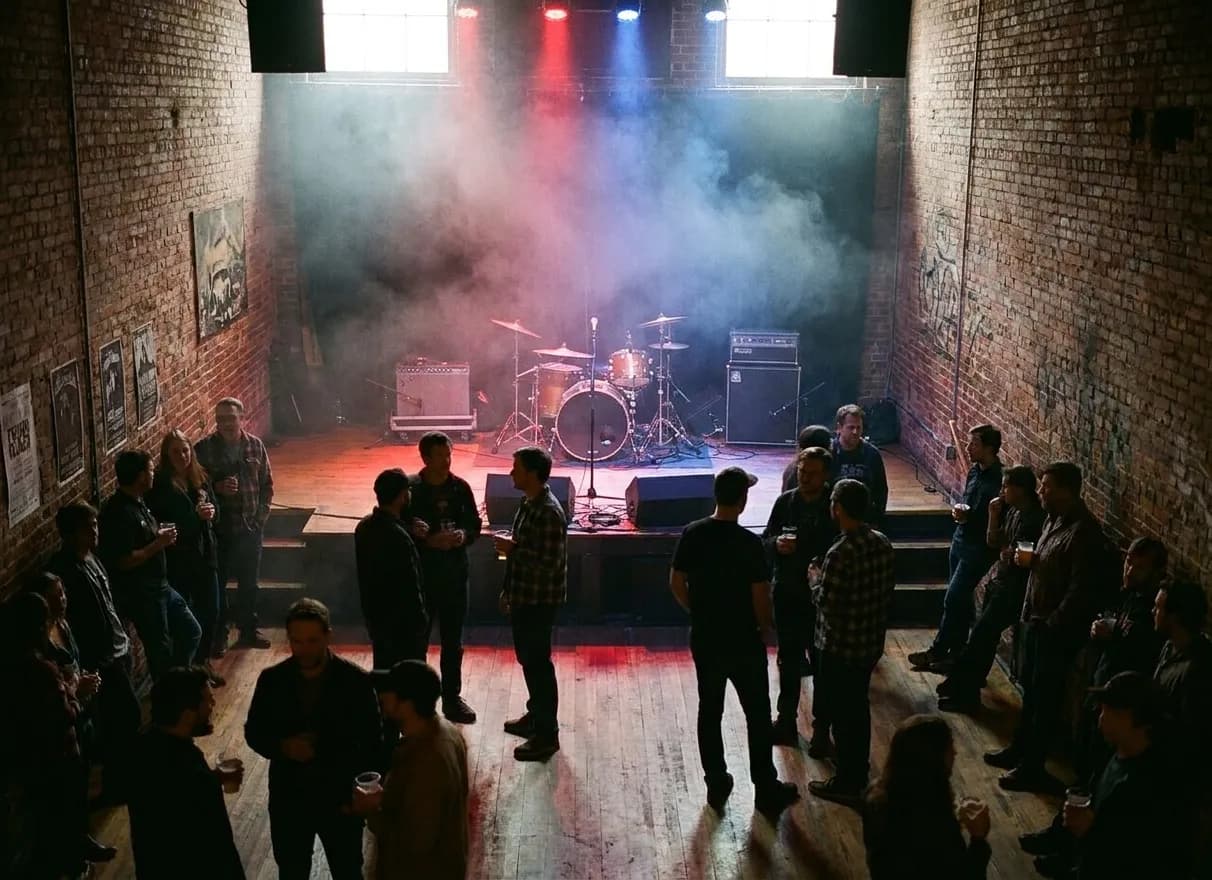
The most interesting live music in San Francisco on any given Tuesday is being played by people you have not heard of, to about forty people, for somewhere between nothing and fifteen dollars. This is the local circuit, and it is where a genuinely large share of the city's music actually happens — not at the ticketed shows that sell out in minutes, but in small rooms on weeknights with three or four local acts on a bill. It is cheap, it requires no planning, and it is almost entirely invisible unless you know the handful of rooms that run it. Understanding how a local bill is put together is most of what you need to use it well.
Karpo can find San Francisco weeknight local bills happening tonight, tell you when each act is on, and what the door is charging.
How a local bill is structured
A typical weeknight bill has three or four acts. The first is usually the newest or the one that asked most recently. The middle slots are working local bands. The last slot is the headliner, which on a local bill means whoever is drawing the most people rather than whoever is best-known nationally.
Doors are commonly an hour before the first act, and each set runs roughly thirty to forty minutes with fifteen to twenty minutes of changeover between. So a bill with doors at eight and four acts finishes close to midnight, and the headliner goes on somewhere around eleven. Working backwards from that is how you decide when to arrive.
Arrive early anyway, at least sometimes
The obvious move is to turn up for the headliner, and it is usually the right one. The less obvious move — going for the whole bill occasionally — is how the circuit actually rewards you, because the opener on a Tuesday is where you find something before anyone else does.
It also matters to the bands. A room of six people during the first set is a demoralising thing to play to, and the local scene runs on bands supporting each other's shows. Being one of the people who came early is a small thing that the room notices, and it is how you end up in conversations with the people who know where everything else is happening.
Sliding scale, suggested donation and free doors
The pricing here is more varied than at ticketed venues. Some rooms charge a low fixed door. Some run a sliding scale, where you pay what you can within a stated range, no questions asked. Some are free with a bucket. All three are common and none carries any stigma attached to paying the lower end.
Where a sliding scale exists, the convention is to pay toward the top if you can and the bottom if you cannot, and nobody at the door is monitoring which you chose. The money goes to the bands rather than the venue in most of these arrangements, which is worth knowing when you decide.
Merchandise is the other half of the economics and it is worth understanding. Bands typically keep a much larger share of a record or shirt sale than of a door split, so buying something at the merch table is a considerably more effective way to support a group you liked than anything else available to you on the night. It is also how you remember who they were.
Open mics and the entry point
Open mics are the base layer of the circuit and they run somewhere in this city almost every night. The quality is genuinely variable within a single evening, which is the format working as intended rather than failing. They are free or nearly so, they are welcoming, and they are the fastest way to work out who is playing around you.
For anyone who plays, they are also the way in. The convention is to turn up early, put your name on the list, watch the whole thing rather than leaving after your slot, and come back. That last part is the entire mechanism by which a local scene forms.
All-ages spaces, and why they matter
San Francisco has a small number of all-ages venues and community spaces that run gigs, and they are disproportionately important. A scene where every room is twenty-one-plus loses its next generation, and the spaces that manage all-ages shows do it on thin margins and volunteer labour.
If you have a choice between two similar shows, going to the all-ages one is a defensible use of an evening. They also tend to be cheaper, earlier, and better attended by people who are there entirely for the music, which makes for a better room than a bar where half the crowd is there because it is a bar.
Where to look
The rooms cluster in the Mission, SoMa, the Tenderloin edge and out along the Divisadero corridor, with a scattering elsewhere. The reliable method for finding what is on is not a listings site — those lag badly on weeknight local bills — but the venues' own calendars and, better still, the bands' own accounts.
The most effective habit is to pick one room and go repeatedly regardless of who is playing. Weeknight bills at a well-programmed small venue are curated by someone with taste, and trusting that taste is a far better use of an evening than researching four different rooms and going to none of them. After a month you will know the promoters, the regulars and roughly half the bands, which is when the circuit stops being a listing and starts being a scene.
The last thing to say is that this circuit rewards showing up more than it rewards choosing correctly. Nobody who is deeply embedded in a local scene got there by researching which show to attend; they got there by going to the same room repeatedly until they knew everyone. Pick a venue, go four times, and the entire thing opens up in a way no amount of listings-reading will achieve.
Tags: #SFMusic #LiveMusicNearMe #LocalBands #WeeknightGigs #SanFrancisco #MissionDistrict #SoMa #OpenMic #AllAges #SlidingScale #FreeThingsToDo #MusicScene #ThingsToDo #BayArea
Please drink responsibly. Must be of legal drinking age.
All trademarks are the property of their respective owners.
Ask Karpo first
Want to know which San Francisco rooms have a local bill tonight, when the headliner is on, and what the door costs? Ask Karpo before you head out.