 Los Feliz Nail Salon Walk In Finder for Broken Nail Repair
Neighborhood Guides

LA Transit Station Pitstop Finder: Three-Minute Snack Plan
Build a three-minute snack shortlist near 7th Street/Metro Center with Karpo APP, separating fast pickup from walking risk and keeping a fallback ready.
A three-minute walking limit near 7th Street/Metro Center is useful only when it describes the right part of the journey. It cannot also promise a three-minute meal. Use a transit station pitstop finder in the Karpo APP to separate the walk from the time needed to choose, order, collect food, and return toward the subway. During a rush-hour transition, the helpful result is a short list of easy-to-carry formats near your intended exit, with a clear decision to skip anything that adds friction.
Define what three minutes means
Start by distinguishing a three-minute radius from a three-minute total break. If your entire interval lasts three minutes, leaving a familiar transit route to search for food is unlikely to fit comfortably. A walking ceiling, however, can help narrow a longer personal window. State both figures: how far you are willing to walk away from an identified exit and how long you have before you need to resume the trip. Karpo can then compare suggestions against two separate constraints.
An exit name is more actionable than a broad downtown location. Tell the app which side of the station you can identify and where you intend to go after collecting food. If you do not know the exit, ask for help organizing that first decision before adding restaurants. An apparently nearby counter may be convenient from one approach and awkward from another. Do not treat the station name as proof that every option will sit along your route.
Use the order format to shrink the shortlist
For a tight transfer, the food's preparation steps matter. A wrapped item that is ready to collect has a different planning burden from a customized bowl or a hot sandwich that needs cooking. Ask for candidate formats based on your appetite and restrictions. You do not need to pretend that one cuisine is always fast. The relevant question is whether the particular order is simple enough for the time and hands you have available.
A practical message is: “I am using 7th Street/Metro Center during a busy commute. Limit food suggestions to an easy walk from the exit I name, ideally no more than my personal three-minute walking allowance. I need a filling snack that travels in one bag, cannot eat nuts, and have twelve minutes total before I continue.” Replace twelve with your actual window. Ask for no more than two candidates and a packaged-food alternative rather than a general dining roundup.
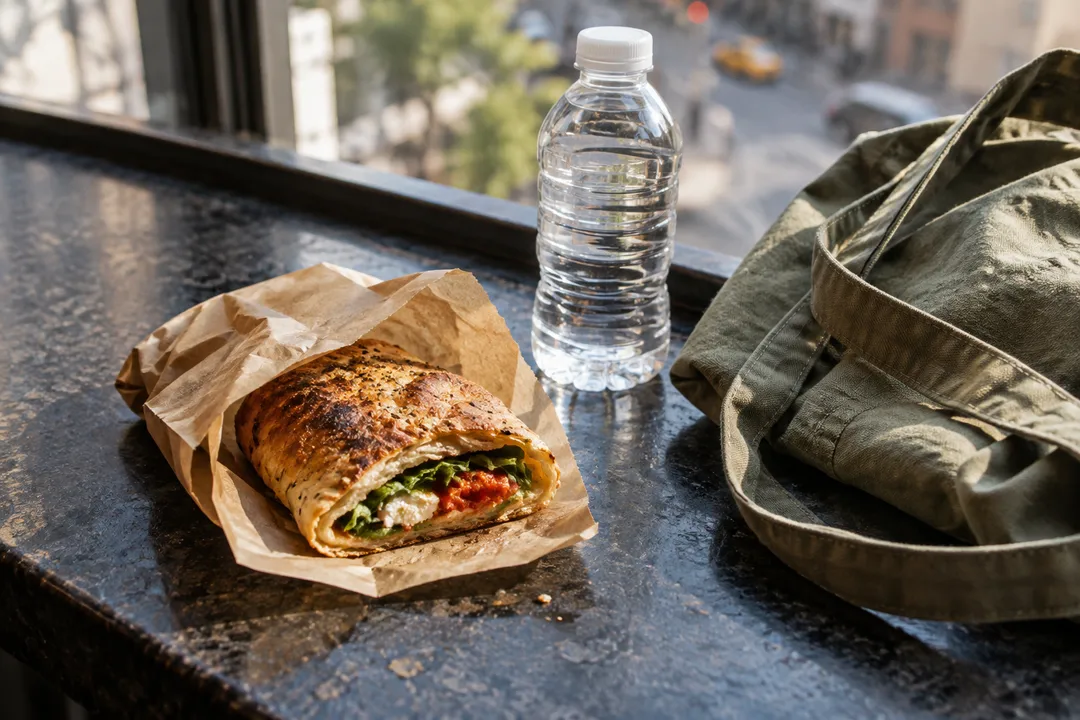
AI-generated wrapped-snack still life showing a portable food format, without depicting an identified downtown counter.
Keep comparisons on the same terms
Request the same few attributes for each suggestion: the intended exit relationship, likely order format, carrying requirements, and any access detail that remains unestablished. This makes it easier to reject an option that sounds appealing but requires extra decisions. A concise comparison is more useful than a list of ratings when you are trying to keep moving. Ask Karpo to explain why one proposal better fits your particular route and which constraint makes the runner-up less convenient.
Do not rank by walking distance alone. A tiny physical detour can become a long pause if you cannot find the doorway, understand the ordering process, or identify where collection happens. Include those uncertainties in your decision. You may prefer a slightly less interesting snack from a counter whose approach you understand. That is a valid preference for this task, and it helps the app avoid recommending a destination that turns the transfer into an exploration project.
Make a line decision without predicting the line
Rush hour is a context you provide, not a live queue feed. The tool cannot see the people waiting or calculate a guaranteed collection time. Decide what you will do when you reach a candidate: proceed if the ordering method is obvious and the purchase fits the remaining allowance, or leave if the process is unclear. A short line can still conceal several complex orders. Keep attention on your clock and the work your own order requires.
Choose the abandonment point before you become invested in the food. You might leave when you cannot tell whether a line is for ordering or collection, when a payment step is failing, or when preparation would use the return reserve. Those rules keep sunk effort from driving the next choice. If you abandon a candidate, the backup should simplify the purchase rather than offer another ambitious counter in a different direction.
Buy something that fits the subway leg
Describe how you will carry the food after the pause. A hand-held snack in a closed bag can leave room for a work tote, a handrail, or a companion's needs. An open container, several drinks, or a meal needing utensils changes the route's practicality. Tell Karpo whether you intend to eat before entering the station or later at your destination. Consumption rules remain a matter for the transport operator and location, not an assumption attached to a food recommendation.
A dietary requirement should not disappear because the interval is short. Separate a strict restriction from a flavor preference, and let the app reduce the list if necessary. If no suitable option fits, the right result can be to continue and eat at the next stage of your day. Buying the wrong food quickly is not a successful shortcut. You can carry a familiar backup on later commutes if this transfer repeatedly proves too tight for a comfortable purchase.
Work with the direction of the crowd
A busy sidewalk can make a familiar approach feel different. Keep the proposed route legible: one exit, one candidate, and one return or onward cue. Avoid adding a second crossing just to improve the menu. The app can help compare the pattern, but you decide whether the path is comfortable when you see it. If you need a step-free approach or more space for bags, make that a core requirement instead of a small note at the end.
When the situation changes, supply the new constraint directly. “I have reached the street, but the food option is across a crossing I do not want to make” is more useful than asking for another list of nearby cafes. Request a replacement on your current side or a route that continues toward the next commitment. This maintains continuity and prevents a series of individually small detours from consuming the whole interval.
The fallback should remove a step
For this downtown snack task, a good fallback might be a ready-to-carry purchase along the same exit path, food without a drink, or no purchase at all. Explain which step you are willing to lose first. If eating matters more than coffee, drop the beverage search. If getting to work on time matters most, end the stop before ordering. A backup is useful because it is easier, not because it recreates the original meal elsewhere.
Finish your Karpo APP request by asking for a compact action plan you can remember without repeatedly looking at a screen. Keep the walking ceiling, whole-break limit, order requirement, and leave-by cue visible. The app can organize those facts and compare options; it cannot verify stock, reserve pickup, monitor crowds, or ensure a counter is open at that instant. The value is a disciplined food decision at 7th Street/Metro Center that leaves your commute understandable.
Ask Karpo for more information.
Keep reading
- Los Feliz Nail Salon Walk In Finder for Broken Nail Repair
 Highland Park Nail Salon Walk In Finder for Retro Manicures
 Koreatown Nail Salon Walk In Finder for K-Beauty Nail Looks