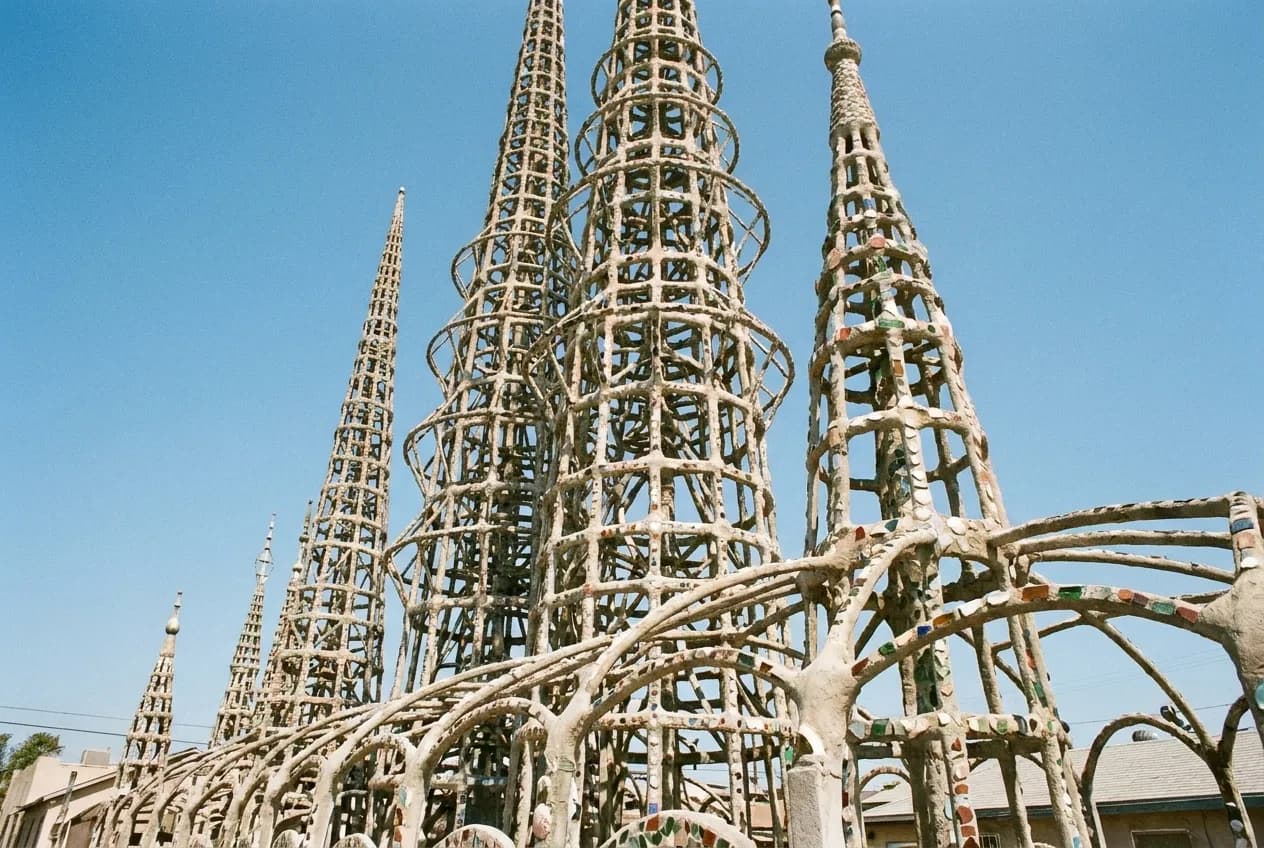
A things to do near me search in Los Angeles will eventually surface the Watts Towers and will not explain the two things that determine whether the visit works: you cannot get inside the gates without a guided tour, and the tours run in short afternoon windows on four days a week. What is behind those gates is seventeen interconnected structures, the tallest of them just under a hundred feet, built by one man in his own backyard over thirty-three years without a single bolt, weld or piece of scaffolding.
Ask Karpo when the tour windows fall this week, how early to arrive for a ticket, and what else in Watts and South LA is worth the same trip.
Thirty-three years, one pair of hands
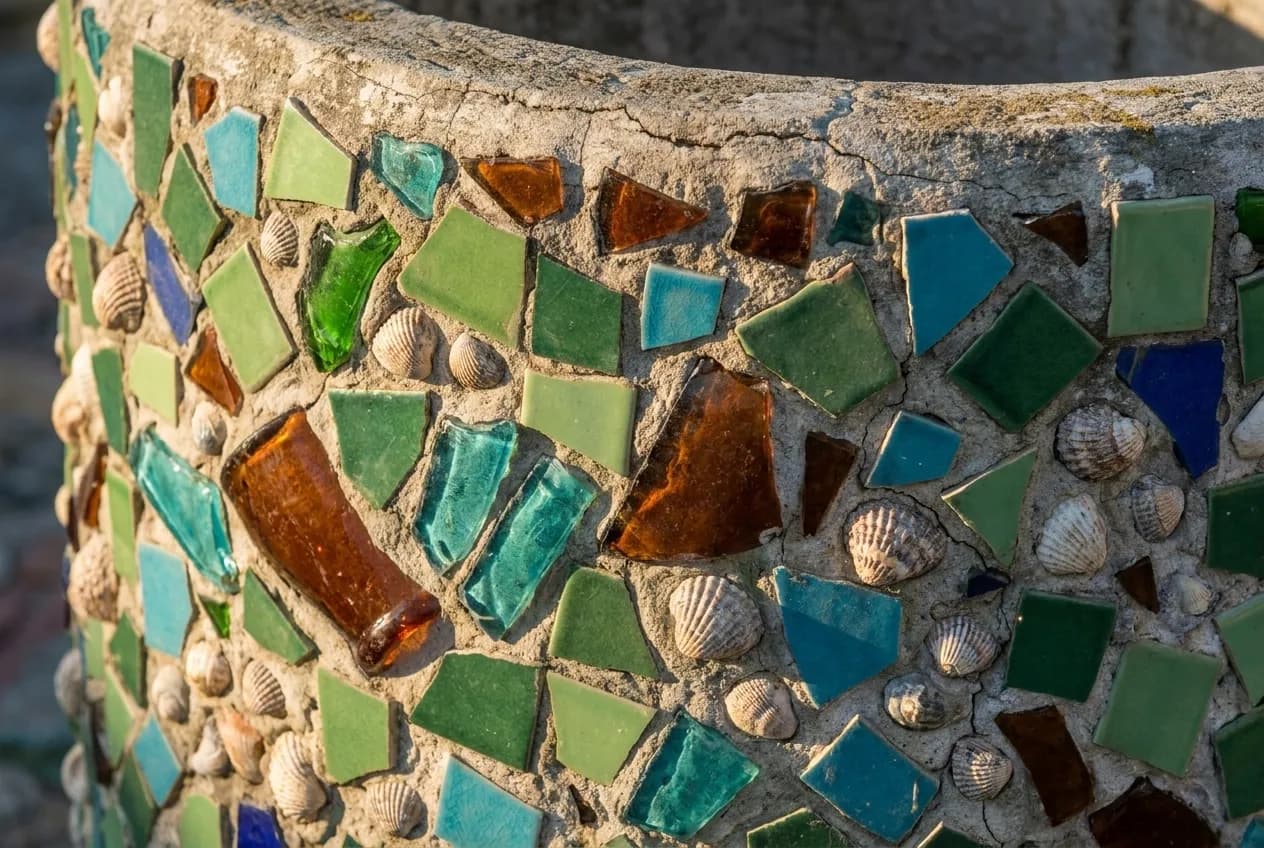
Sabato Rodia, known as Simon, was an Italian immigrant labourer who began building on his triangular lot in 1921 and stopped in 1954. He worked alone, without machine equipment, without a construction crew and without any drawings. The method was steel rods and pipe wrapped in wire mesh, coated in mortar, and studded while wet with whatever he could gather: broken bottles, pottery, tile offcuts, seashells.
Then, in 1955, he gave the property away and left, and as far as anyone knows he never came back to see it. That ending is as remarkable as the building. Thirty-three years of daily work, given up without ceremony, and the structures survived largely because the neighbourhood and later a committee of admirers refused to let the city take them down.
The engineering is the surprise
Because it looks handmade and improvised, people assume it is fragile. In 1959 the city, having decided the towers were unsafe, arranged a load test designed to pull the tallest structure over. The test failed. The steel and mortar construction held against a force that would have destroyed a conventional masonry structure, and the demolition order was dropped.
Standing underneath, that outcome makes sense. The forms are open lattices rather than solid masses, which means wind passes through rather than pushing against them, and the conical geometry distributes load downward and outward. Rodia had no formal engineering training and arrived at a structurally literate solution by building, looking and adjusting for three decades.
The tour window is the constraint
Access to the interior is by guided tour only. Tours run Thursday through Saturday from 10:30am to 3:30pm and on Sunday from 12:30pm to 3:30pm, they last about half an hour, and each one takes a maximum of twenty people. Tickets are sold first come, first served at the adjacent Watts Towers Arts Center rather than in advance.
That combination means arriving with margin. A weekend afternoon can sell through the remaining slots, and turning up at 3:20 on a Sunday is arriving after the last tour has gone. Go earlier in the window, take the ticket for whatever time is available, and use the gap to look at the exterior from the street and the arts centre next door.
Watts, and why the towers are here at all
Watts sits in South Los Angeles, and it is a neighbourhood that most of the city's visitors never see and many of its residents have opinions about without having visited. The towers were built here because this is where a working-class Italian immigrant could buy a narrow lot in the 1920s, on a block backing onto the rail line, and the fact that they are here rather than in a museum district is the point rather than an inconvenience.
The Watts Towers Arts Center sits immediately next door and runs exhibitions and programmes for the community rather than for tourists, which makes it the right second stop. Between the two you get the object and the context, and the context is what keeps this from being a curiosity.
One more thing worth carrying in: this is an object that does not photograph well and looks extraordinary in person. Photographs flatten the lattice work into a silhouette and lose the surface entirely, which is where nearly all of the detail lives. Up close you can read the tools Rodia used, the imprints of hands and corn cobs pressed into wet mortar, the maker's marks on the backs of broken plates, the labels still legible on bottle glass. Half an hour of looking at the surface is a better use of a tour slot than any number of pictures of the spires.
Getting there
The Metro A line stops at 103rd Street/Watts Towers, effectively at the door, which makes this one of the rare Los Angeles destinations where the train is the obvious choice rather than a compromise. From downtown it is a short ride, and the walk from the platform is a few minutes.
If you drive, there is street parking, and the sensible plan is to combine the visit with something else in the area rather than driving forty minutes for a thirty-minute tour. The towers reward more attention than the tour length suggests, and the exterior view from the sidewalk is available whether or not you get a ticket.
Practical notes
The Watts Towers stand on East 107th Street in Watts, South Los Angeles, built by Sabato Rodia between 1921 and 1954. There are seventeen structures, the tallest just under a hundred feet. Interior access is by guided tour only: Thursday to Saturday 10:30am to 3:30pm, Sunday 12:30pm to 3:30pm, about thirty minutes, maximum twenty people, tickets first come at the Watts Towers Arts Center. The Metro A line stops at 103rd Street/Watts Towers.
Tags: #ThingsToDoNearMe #Watts #WattsTowers #SimonRodia #SouthLA #LosAngelesArt #FreeThingsToDoLA #LANeighborhoods #WhatToDoInLA #LAHistory #FolkArt #PublicArt #LAWalks #MetroALine
All trademarks are the property of their respective owners.
Ask Karpo first
Want to know when the tour windows fall this week, how early to arrive for a ticket, and what else in Watts is worth the same trip? Ask Karpo for current tour times, a plan that uses the arts centre while you wait, and a second stop that makes the journey worth it.