 Sawtelle Bowling Group Night Planner for a College Reunion
Sports Social
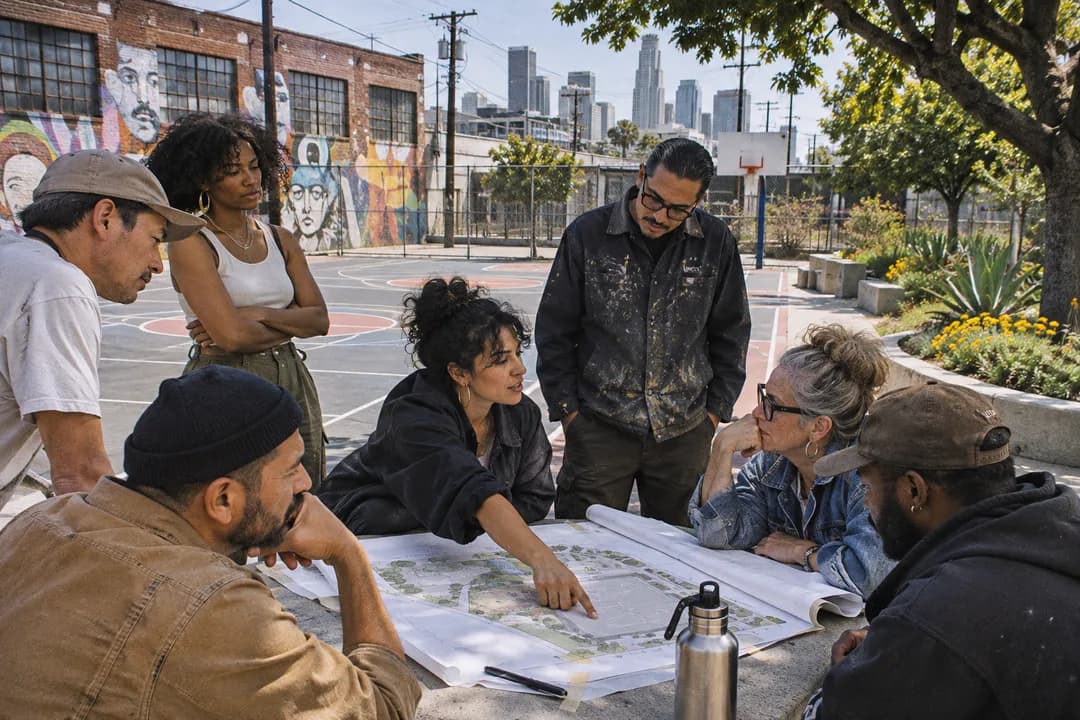
Arts District Public Basketball Court Finder: DTLA Runs
Arts District hoopers connect Little Tokyo, Pecan Recreation Center across the LA River, and Alpine Recreation Center. Compare Metro A and E Line stops.
Converted rail yards and brick cold-storage warehouses between Alameda Street and the Los Angeles River—originally built in the early 1900s to serve the Santa Fe Railway—leave almost zero grassy parkland inside the Arts District itself. Using a public basketball court finder from the Arts District means knowing which bridge or Metro stop connects your loft block to Pecan Recreation Center across the Sixth Street Viaduct, Little Tokyo's Terasaki Budokan court corridor, and Alpine Recreation Center on Yale Street. Outdoor municipal LA Recreation and Parks rims along this loop are free for drop-in shooting.

Why Warehouse Blocks Require a Five-Minute Bridge or Rail Pivot
Walk around Mateo Street, Traction Avenue, and Palmetto Street and you will see former industrial loading docks, coffee roasters, and galleries rather than traditional municipal playgrounds. While the small Arts District Park at 4th and Hewitt Streets offers a neighborhood pocket green and dog run, full-court basketball players branch just beyond the Alameda Street or Los Angeles River boundary.
Crossing the Sixth Street Viaduct—rebuilt as a landmark ribbon-arch bridge in 2022—puts you directly at Pecan Recreation Center near Pecan and First Streets on the Eastside, where outdoor municipal hoops welcome morning shooters and afternoon pickup squads.
Pivoting North to Alpine Rec Center or West to Little Tokyo
If the Pecan Street blacktop is hosting a youth league or stacked with Eastside five-on-five teams, head ten minutes north through Little Tokyo and Chinatown to Alpine Recreation Center at Alpine and Yale Streets. Situated on a terraced hillside just west of North Broadway, Alpine features multiple outdoor basketball rims that draw regular Downtown LA and Chinatown hoopers.
Players staying closer to 1st and Central Avenue in Little Tokyo also monitor community open-gym and court schedules around the Terasaki Budokan sports pavilion on South Los Angeles Street, or head up toward Los Angeles State Historic Park for pre-game warmup runs.
Riding the Metro A and E Lines From Little Tokyo/Arts District
The Regional Connector transit tunnel opened in 2023 made the Little Tokyo/Arts District Station at 1st and Alameda Streets one of the best-connected rail hubs in Los Angeles County. Both the Metro A Line (heading north to Chinatown's station near Alpine Recreation Center) and the Metro E Line (heading east across the river to Soto and Indiana Streets) stop at 1st and Alameda. Every LA Metro rail or bus tap costs $1.75 with a TAP card and includes two hours of free transfers.
Coordinate your group meetup at the 1st and Alameda station plaza before deciding whether to ride one stop east across the river or two stops north to Chinatown.
Downtown After-Work Waves Versus Morning Solo Shooting
Court turnover around the Downtown LA perimeter shifts sharply between creative studio hours and after-work commuter waves. Weekday mornings between 7:30 AM and 10:30 AM at Pecan or Alpine Recreation Center are ideal for solo ball-handling, free-throw sets, and two-man shooting games.
Between 5:00 PM and 8:00 PM on weekdays, loft residents, downtown office workers, and neighborhood guards converge for full-court five-on-five runs played to eleven or fifteen. Walk inside the fence, check who holds last next on the bench, and call your squad's spot right away.
Concrete Heat Islands and LA River Viaduct Breezes
Surrounded by dark asphalt parking lots, concrete river channels, and brick warehouse walls, the Arts District and Boyle Heights corridor absorbs intense solar heat between May and October. Afternoon court surfaces regularly feel ten degrees hotter than coastal Venice or Santa Monica blacktop.
Late-afternoon breezes funneling north up the concrete channel of the Los Angeles River bring welcome cooling after 4:30 PM, though they can push high-arc outdoor three-pointers slightly off line. Wear light-colored breathable mesh gear and pack a dry shirt for the Metro ride back.
Abrasive Urban Concrete and Durable Outdoor Footwear
Industrial grit from Alameda Street trucks and sun-baked municipal concrete wear down soft indoor basketball shoes in a matter of weeks. Lace up outdoor-specific basketball sneakers with high-density carbon rubber outsoles and firm midsole torsional plates.
Carry a rugged outdoor composite basketball that keeps its pebble grain against rough concrete aprons, and mark your initials clearly with permanent ink before stepping onto a multi-hoop court.
Hydration Prep on Traction Avenue and 1st Street
Never cross the Sixth Street Viaduct or walk uphill to Yale Street without at least two liters of cold water already in your bag. Pick up bottled water and fruit at a market in Little Tokyo along 1st Street or a corner shop off Traction Avenue before heading to the court.
Inside the basketball enclosure, clip your backpack to the chain-link fence near midcourt so it stays off the dusty concrete apron and within sight during full-court transitions.
Winter Storm Drainage and Viaduct Shadow Lines
During Southern California's winter rain season between January and March, flat municipal courts near the Los Angeles River collect shallow puddles along painted key lines and baseline corners. Tall warehouse walls and bridge superstructures also cast sharp afternoon shadows that slow evaporation on the western end of the floor.
Test your stopping traction along the free-throw line before sprinting into a contested layup, and keep early drills confined to the sun-dried half of the court after a morning shower.
Post-Game Cooldown Walk Across the Sixth Street Viaduct
After wrapping up two hours of pickup basketball, take a fifteen-minute cooldown walk across the pedestrian pathway of the Sixth Street Viaduct or stroll through the historic pedestrian plaza of Japanese Village Plaza in Little Tokyo. Walking at an easy pace lets your heart rate settle and prevents lower-back stiffness.
Use the wide bridge overlook or plaza benches to stretch your calves and hamstrings before heading back toward Mateo Street.
When to Skip Industrial Pockets for Multi-Court Rec Centers
Do not waste an afternoon wandering industrial cul-de-sacs between 6th and 7th Streets hoping to stumble across an unlisted full-court playground inside a private loft courtyard. The Arts District's historic rail-yard zoning means public athletic space sits on the neighborhood perimeter.
Go directly to Alpine Recreation Center on Yale Street or Pecan Recreation Center across the river when you want reliable public backboards, and use the Arts District proper as your pre-game meetup and post-game recovery base.
Structuring Your DTLA Hoop Route in Karpo APP
Save your Arts District basketball route inside the Karpo APP with the Little Tokyo/Arts District Metro station at 1st and Alameda as your transit hub, Pecan Recreation Center as stop one, and Alpine Recreation Center as stop two. Include a fifteen-minute sideline wait limit so your crew pivots cleanly.
Logging a quick post-run note on afternoon heat, evening court lights, and stack depth turns your Karpo APP plan into a repeatable Downtown LA basketball guide.
Ask Karpo for more information.
Keep reading
- Sawtelle Bowling Group Night Planner for a College Reunion
 Larchmont Bowling Group Night Planner for Carpool Parents
 Boyle Heights Bowling Group Night Planner for a Quince Court