 Los Feliz Nail Salon Walk In Finder for Broken Nail Repair
Neighborhood Guides
Silver Lake Neighborhood Historical Walking Tour: Film Steps
Walk Silver Lake's film past for free: the Laurel and Hardy Music Box Steps, the Hyperion Disney studio site, Neutra homes and the 1967 Black Cat corner.
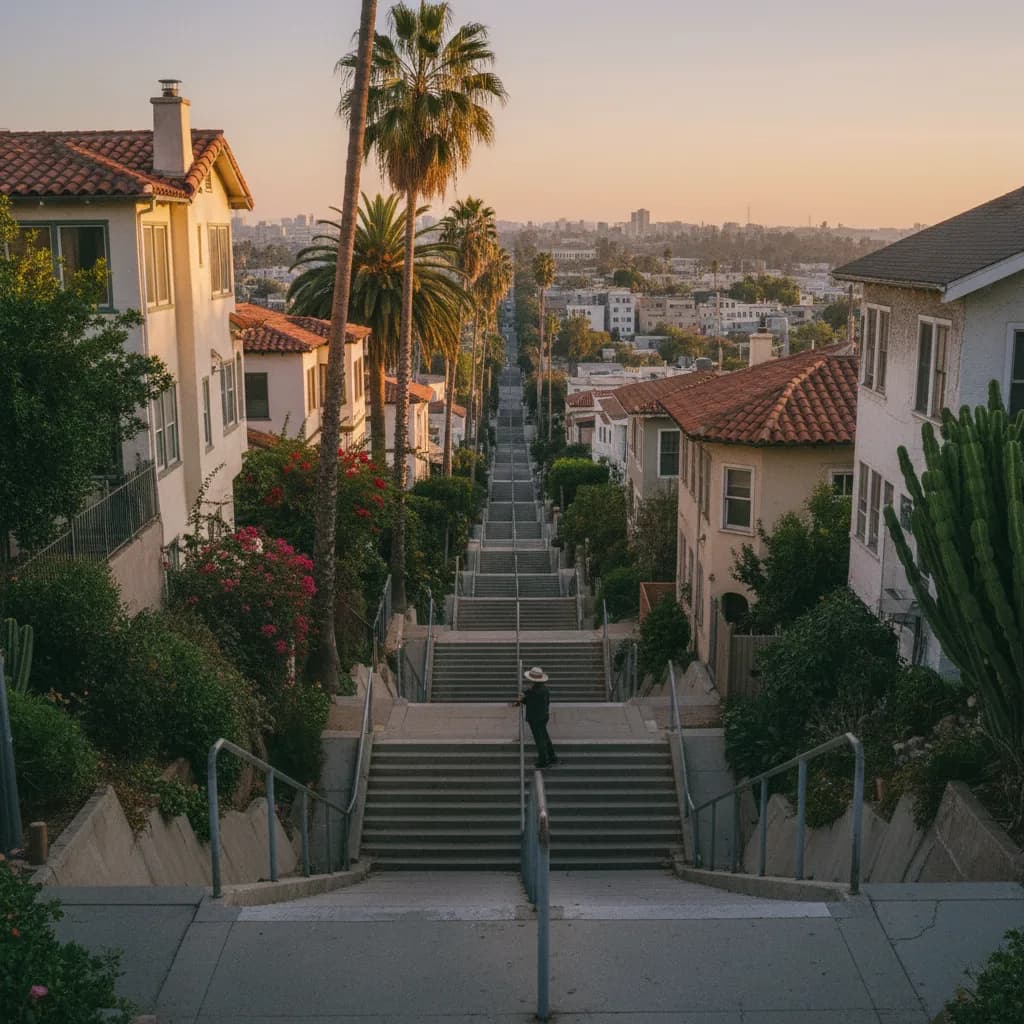
Laurel and Hardy hauled a crated piano up 133 concrete steps on Vendome Street for The Music Box, the 1932 short that won the Academy Award for best comedy short subject. Those steps still climb the hill today, and they anchor this neighborhood historical walking tour of Silver Lake, a district that was called Edendale when silent film crews first arrived. The route is free, self-guided and roughly three and a half miles with real hills.
Edendale, Before Hollywood Was Hollywood
Start on Glendale Boulevard near Effie Street, in the flats that early filmmakers knew as Edendale. In the 1910s this strip held some of the first permanent studios in Los Angeles, including the lot where Mack Sennett produced his Keystone Cops comedies. One of Sennett's original sound stages survives on Bates Avenue and is a city Historic-Cultural Monument, though it is a working private facility, so admire it from the sidewalk.
Edendale's studios left for larger lots in Hollywood and Culver City within a decade, which is why most visitors never hear the name. The hills they left behind filled with bungalows, and later with artists, leftists and gay residents who found the rents low and the neighbors tolerant. That mix explains almost every stop on this route, from the stairways to the modernist houses to the bar on Sunset Boulevard.
The Music Box Steps on Vendome Street
Walk south and west to Vendome Street, where a plaque at the base of the stairs between Vendome and Descanso Drive marks the Music Box Steps. Climb all 133 risers and you will understand the joke: the stairway is steep, narrow and hemmed in by houses, and the piano would have had nowhere to go. Neighbors still use the stairs as a daily shortcut, so let residents pass and keep voices low near the windows.
Bring a small bottle of water for this section. There are no shops on the residential stairways, and the walk from Vendome to Hyperion stays on quiet streets lined with Spanish Revival duplexes, jacaranda trees and garages cut into the slope. Look for the house numbers painted on curbs and the narrow footpaths between lots; many are the same pedestrian rights-of-way the streetcar commuters used a century ago.
The steps are part of a larger network of public stairways that predate the car in Silver Lake, built so residents could walk down to the streetcar lines along Sunset and Glendale. Several more climb the ridges nearby, and local walkers string them together for a hard morning workout. Honest advice: skip the stair-chaining on hot afternoons; there is little shade on the concrete, and the views are clearer in the morning anyway.
Hyperion Avenue and Walt Disney's First Big Studio
From the top of Descanso, head east toward Hyperion Avenue. In 1926 Walt and Roy Disney moved their small animation company to a new studio on Hyperion, and it was there that Mickey Mouse made his debut in Steamboat Willie in 1928 and that the staff produced Snow White and the Seven Dwarfs, released in 1937. The studio outgrew the site and moved to Burbank around 1940.
Nothing of the studio buildings remains; a supermarket occupies the block today, and only a small marker and the stories of longtime residents keep the history alive. It is still worth standing on the corner to picture hundreds of animators crossing the street at lunch. Continue down Hyperion to see the Glendale-Hyperion Bridge, the 1927 concrete viaduct that carries traffic over the Los Angeles River toward Atwater Village.
The Neutra Houses Along the Reservoir
Walk north to Silver Lake Boulevard, where the reservoir, completed in 1907 and named after water commissioner Herman Silver, gave the neighborhood its name. The eastern shore is lined with houses by modernist architect Richard Neutra, who built his own home and studio here, the VDL Research House, in 1932. After a fire in 1963, Neutra and his son Dion rebuilt it in 1966, and it is now owned by Cal Poly Pomona.
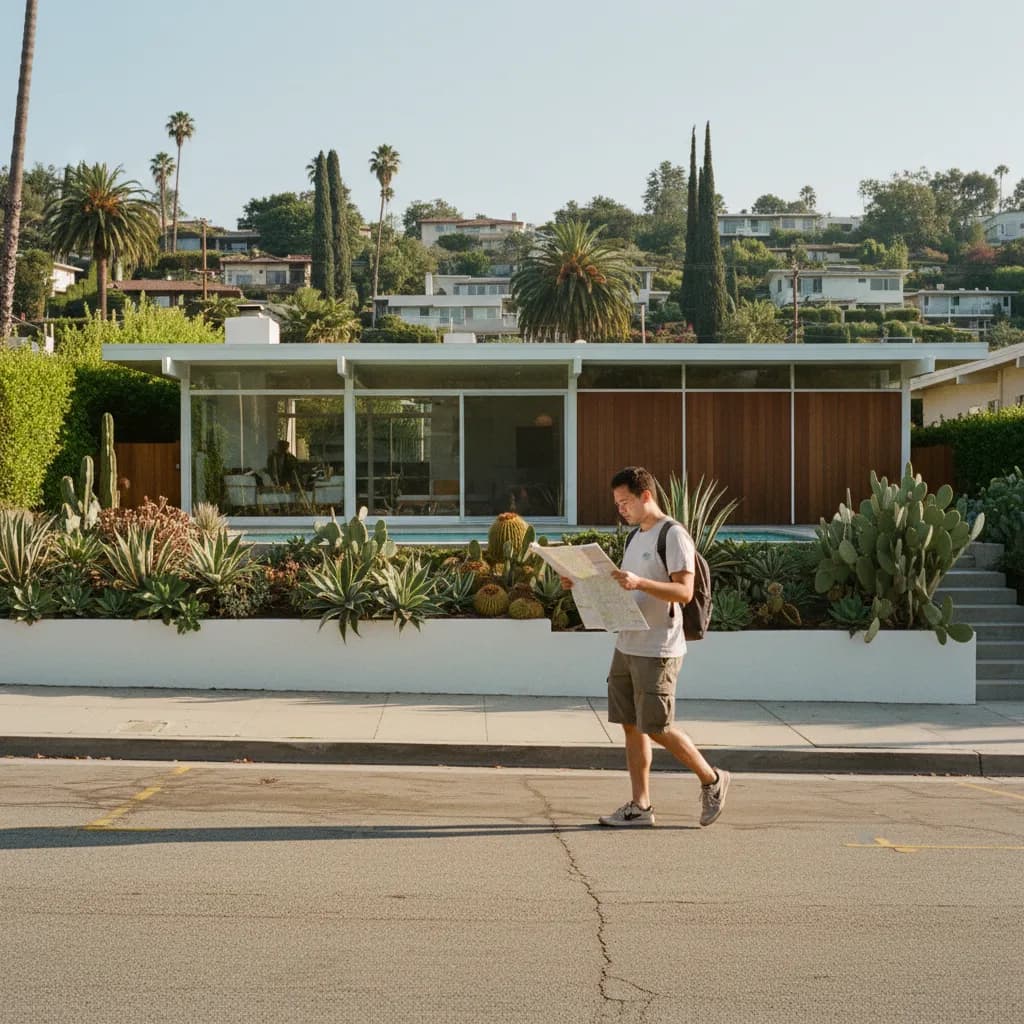
The VDL house opens for occasional guided tours that require a ticket, so check the university's listing in advance if you want to see inside. From the street, look for the flat roofs, horizontal bands of glass and aluminum fins that defined Neutra's style. A short side street nearby holds a cluster of smaller Neutra homes built for friends and clients, which architecture students often photograph on weekend mornings.
Sunset Junction and the 1967 Black Cat Protest
Finish by walking down to Sunset Junction, where Sunset and Santa Monica Boulevards meet. At the Black Cat Tavern on Sunset, police raided a New Year's party on January 1, 1967, beating and arresting patrons. Weeks later, on February 11, hundreds gathered outside in one of the earliest organized gay rights protests in the United States, more than two years before Stonewall. The building was named a city Historic-Cultural Monument in 2008.
Today the junction is a busy cluster of cafes, record shops and boutiques, and the sidewalks fill with dog walkers, freelancers on laptops and couples browsing on weekend mornings. If the stretch around the junction feels too crowded at brunch time, walk two blocks east along Sunset, where the pace drops quickly and you can still see the older storefronts with apartments above them.
Getting Around and a Short Version
Metro bus lines along Sunset Boulevard and Glendale Boulevard connect the start and finish, and the B Line's Vermont/Sunset station is about a mile west of Sunset Junction if you prefer the subway. Street parking on the hills is tight and many blocks are permit-only, so read every sign. Wear supportive shoes; the stairways and ridge streets add several hundred feet of climbing over the full route.
For a shorter version, do the Music Box Steps and then walk downhill to Sunset Junction, which covers the film and civil rights chapters in about ninety minutes. Ask Karpo APP to order the stops around a cool morning and add a coffee break near the junction, and it will suggest a sequence that fits your pace. Every stop on this route is a public street, stairway or sidewalk view that you can visit any day.
Ask Karpo for more information.
Keep reading
- Los Feliz Nail Salon Walk In Finder for Broken Nail Repair
 Highland Park Nail Salon Walk In Finder for Retro Manicures
 Koreatown Nail Salon Walk In Finder for K-Beauty Nail Looks