 Los Feliz Nail Salon Walk In Finder for Broken Nail Repair
Neighborhood Guides
Pasadena Neighborhood Historical Walking Tour: Civic Center
This free Pasadena history walk links the 1927 domed City Hall, the Jackie Robinson memorial, the Pasadena Playhouse and the Bungalow Heaven landmark district.
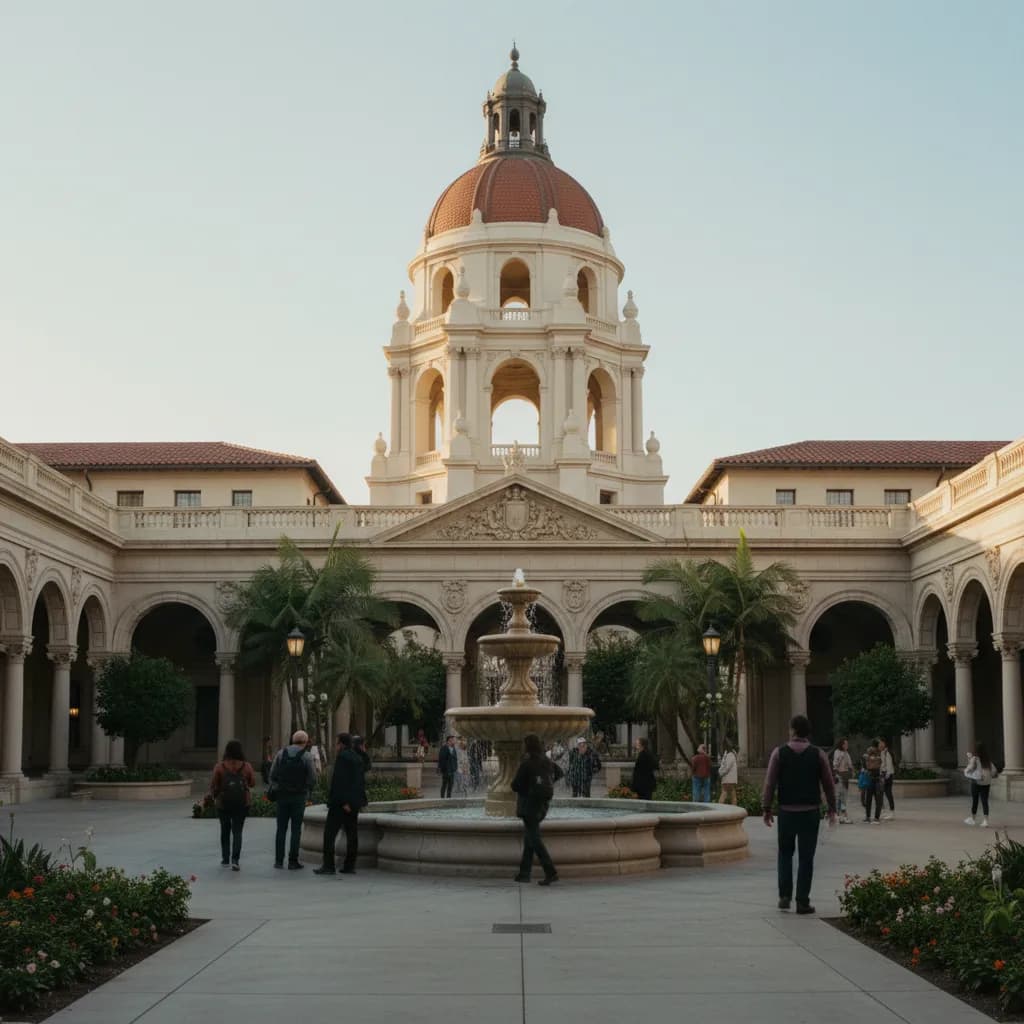
Pasadena City Hall, finished in 1927, was designed by John Bakewell Jr. and Arthur Brown Jr., the same partnership behind San Francisco's City Hall, and its open courtyard and fountain are free to walk into on business days. This neighborhood historical walking tour of Pasadena starts there, crosses the Playhouse District and ends among the craftsman bungalows north of the center. It is about three miles, flat, and avoids the busiest stretch of Old Pasadena entirely.

A City Beautiful Plan in Stucco and Tile
In the 1920s Pasadena voters approved a civic center plan inspired by the City Beautiful movement, with major buildings arranged along formal axes. City Hall, with its tiered dome and arcaded courtyard, sits at the center of that plan on Garfield Avenue. Step inside the courtyard to see the fountain, the tiled walkways and the clock-faced dome rising above the garden, which is how most residents first encounter the building.
The building closed for several years in the 2000s for a seismic retrofit and reopened with its original details intact. Office workers eat lunch on the courtyard benches, wedding parties often pose by the fountain on Saturdays, and film crews regularly use the building as a stand-in for government offices around the world. Keep to the public paths and do not enter offices; the courtyard is the part meant for visitors.
The Jackie and Mack Robinson Memorial
Directly across Garfield Avenue from City Hall stands a memorial to two brothers who grew up in Pasadena. Jackie Robinson broke Major League Baseball's color barrier with the Brooklyn Dodgers in 1947, and his older brother Mack Robinson won a silver medal in the 200 meters at the 1936 Berlin Olympics, finishing behind Jesse Owens. The large bronze heads were unveiled in 1997 and are a favorite stop for school groups.
Read the inscriptions slowly; they describe the segregation the brothers faced in their hometown, including restrictions on the public swimming pool. It is an honest civic monument that puts a hard chapter of local history right in front of City Hall. Families often pause here for photos, and baseball fans in Dodgers caps sometimes leave small tokens at the base, which is worth noticing and leaving undisturbed.
The Central Library and Civic Auditorium
Walk north on Garfield to the Central Library, designed by Myron Hunt and H. C. Chambers in a Spanish Colonial style and opened in 1927 as the northern anchor of the plan. The library closed in 2021 over seismic safety concerns, so check the city library website for its current status before planning to go inside. The arched entry and courtyard garden can still be appreciated from the street.
Then turn south along the axis to the Pasadena Civic Auditorium on Green Street, an Italian Renaissance hall that opened in 1932 and has hosted concerts, ballet and many televised awards shows. Its painted ceiling is visible only during events. Honest advice: skip any attempt to see the library or auditorium interiors on a casual weekday; the outdoor axis between the three buildings is the real point of this stop.
The Playhouse District
From the auditorium, walk east to El Molino Avenue and the Pasadena Playhouse, which opened in 1925 and was named the State Theater of California in 1937. Its Spanish Colonial courtyard with a fountain is visible from the sidewalk, and actors trained here before moving to Hollywood careers. Nearby on Los Robles Avenue, the USC Pacific Asia Museum occupies a 1924 building modeled on a Chinese imperial palace, with a ticketed courtyard garden.
The streets around the Playhouse hold small bookstores, cafes and theater-goers in the hours before evening shows, along with students from nearby colleges and older residents who have held season tickets for decades. If Colorado Boulevard is crowded on a weekend, this district is the calmer alternative, with shade trees, wide sidewalks and architecture from the same decade as Old Pasadena.
Between the Playhouse District and Bungalow Heaven, Lake Avenue changes character block by block. Near the center it is lined with banks and department stores from the mid-century shopping boom, and farther north the commercial strip thins into apartment courts and churches. Walking this stretch shows how Pasadena grew outward from its civic core along streetcar routes, with each decade leaving a slightly different storefront style behind.
Bungalow Heaven
Walk north about a mile on Lake Avenue to Bungalow Heaven, a neighborhood of roughly 800 small craftsman houses built mostly between 1900 and 1930. In 1989 it became Pasadena's first designated landmark district. Look for low-pitched roofs, deep porches, exposed rafter tails and river-rock chimneys and pillars, many made from stones gathered in the nearby Arroyo Seco. McDonald Park at the center makes a good resting point.
These are private homes, so stay on the sidewalk and keep photography to streetscapes rather than people's windows. Residents gardening in front yards will often talk about their houses if you show genuine interest. The neighborhood association hosts an annual home tour in the spring that opens some interiors with a ticket; outside that event, the porches and gardens seen from the street are the whole experience.
Getting Around and a Short Version
The Metro A Line stops at Memorial Park station, a short walk from City Hall, and Pasadena Transit buses run along Lake Avenue to Bungalow Heaven. Public parking structures in the civic center are close to the start. Sidewalks are flat, wide and shaded in many places, but summer afternoons in Pasadena are often hot, so start early and bring water for the walk north.
For a shorter version, stay in the civic center and Playhouse District, which covers City Hall, the Robinson memorial and the theater in about an hour. Ask Karpo APP to add Bungalow Heaven on a cooler morning or to pair the walk with lunch near the Playhouse, and it will suggest an order that fits your pace. Every stop on this route is a public sidewalk, courtyard or park.
Ask Karpo for more information.
Keep reading
- Los Feliz Nail Salon Walk In Finder for Broken Nail Repair
 Highland Park Nail Salon Walk In Finder for Retro Manicures
 Koreatown Nail Salon Walk In Finder for K-Beauty Nail Looks