 Los Feliz Nail Salon Walk In Finder for Broken Nail Repair
Neighborhood Guides
Hollywood: A Golden Era Neighborhood Historical Walking Tour
Follow Hollywood Boulevard golden era landmarks along free self-guided routes. Discover historic movie palaces, terrazzo sidewalk stars, and 1920s courtyards.
Hollywood Boulevard represents the legendary epicentre of the global motion picture industry and early twentieth-century American entertainment architecture. Officially listed on the National Register of Historic Places as the Hollywood Boulevard Commercial and Entertainment District, this world-famous thoroughfare stretches between La Brea Avenue and Gower Street. A neighborhood historical walking tour along the boulevard reveals an extraordinary concentration of opulent 1920s picture palaces, Spanish Colonial Revival hotels, and glamorous Art Deco retail buildings. Walking this storied sidewalk allows visitors to look beyond modern tourist souvenir stalls and uncover the genuine architectural ingenuity, theatrical showmanship, and civic history of Hollywood's golden era.
Origins of the Boulevard and the Motion Picture Boom
Before motion picture studios arrived in the 1910s, Hollywood was a quiet agricultural town celebrated for lemon groves and winter estates along Prospect Avenue. Renamed Hollywood Boulevard in 1910, the street rapidly transformed as pioneering movie moguls and theatrical impresarios constructed flagship theaters to premiere their latest cinematic releases. Visionary showman Sid Grauman recognized that moviegoing in Southern California should be an immersive theatrical spectacle, leading to the creation of exotic, themed picture palaces. Walking eastward from North Orange Drive toward Highland Avenue showcases how commercial banks, broadcasting studios, and luxury department stores formed a dense, vibrant urban canyon during the 1920s.
Grauman's Chinese Theatre and the Handprint Courtyard
At 6925 Hollywood Blvd rises the internationally renowned TCL Chinese Theatre, originally opened in May 1927 as Grauman's Chinese Theatre with the premiere of Cecil B. DeMille's The King of Kings. Designed by the architectural firm Meyer & Holler, the palace is an extravagant fantasy of Asian-inspired pagoda architecture, complete with copper-topped roofs, ten-foot-tall stone foo dogs, and hand-carved stone temple guardians. The theater's outdoor forecourt famously features the historic concrete handprints, footprints, and autographs of legendary cinema icons dating back to the late 1920s. Visitors can freely walk into the public forecourt to examine the authentic inscriptions of classic Hollywood pioneers, studying the tactile signatures preserved in stone.
The 1922 Egyptian Theatre: Birthplace of the Hollywood Premiere
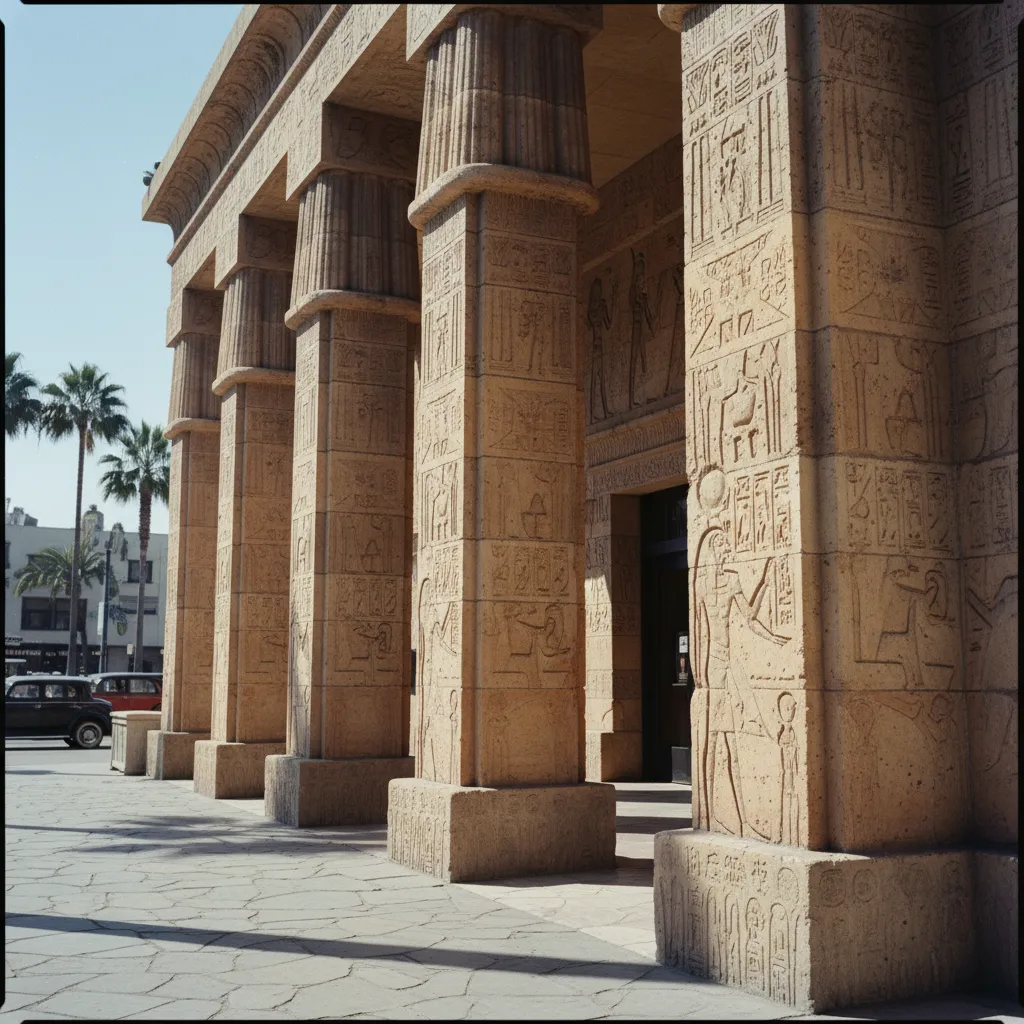
A few blocks east at 6712 Hollywood Blvd stands the landmark Egyptian Theatre, opened by Sid Grauman in October 1922 just months before the historic discovery of King Tutankhamun's tomb in Egypt. The Egyptian is celebrated in cinematic history as the birthplace of the modern red-carpet Hollywood premiere, first hosting Robin Hood starring Douglas Fairbanks. The theater features an expansive open-air pedestrian entry forecourt flanked by monumental sandstone columns, hieroglyphic bas-reliefs, and wrought-iron hanging lanterns. A thoughtful multi-million-dollar restoration recently returned the building to its authentic 1922 splendor, making its forecourt one of the most magnificent historical walking stops on the boulevard.
Gilded Hospitality at the Hollywood Roosevelt Hotel
Directly across from the Chinese Theatre at 7000 Hollywood Blvd stands the historic Hollywood Roosevelt Hotel, which first opened its doors in May 1927. Named after President Theodore Roosevelt and financed by cinematic titans including Mary Pickford, Douglas Fairbanks, and Louis B. Mayer, the hotel hosted the very first Academy Awards ceremony in 1929 in its Blossom Ballroom. The hotel's ground-floor public lobby remains a pristine showpiece of Spanish Colonial Revival design, featuring hand-painted timber ceiling beams, wrought-iron chandeliers, and a central tiled fountain courtyard. Walking through the public lounge corridors provides a tangible sense of the intimacy and elegance that defined golden-age celebrity gatherings in pre-war Hollywood.
Spanish Revival Palaces: El Capitan and Beyond
At 6838 Hollywood Blvd, the grand El Capitan Theatre stands as another shining architectural gem of the district, constructed in 1926 as Hollywood's first major live legitimate playhouse. Designed by architect G. Albert Lansburgh with an elaborate Spanish Colonial Revival exterior and lavish East Indian interior plasterwork, the theater bridged the transition between stage drama and Hollywood cinema. Along the surrounding sidewalks, walkers can admire the restored street-level terrazzo of the Hollywood Walk of Fame, created in 1960 to celebrate achievement across radio, recording, television, and film. Studying the bronze star plaques embedded along the terrazzo walkways provides a chronological walking timeline of twentieth-century American popular entertainment.
Pedestrian Awareness and Boulevard Etiquette
Because Hollywood Boulevard is an active metropolitan corridor that welcomes thousands of international visitors daily, mindful walking practices ensure a smooth and safe tour. Keep to the right along the wide terrazzo sidewalks, remain watchful of street performers and costumed characters in front of the major theaters, and step aside into plaza recesses when stopping to photograph architectural facades. Public restrooms, water refill stations, and transit connections are conveniently accessible within the open-air Ovation Hollywood shopping and entertainment complex adjacent to the Chinese Theatre. Using the Karpo APP on your smartphone allows you to easily track historic landmark registration numbers, locate specific celebrity star coordinates on the Walk of Fame, and follow curated self-guided walking loops.
Connecting to Hillside Heritage and Adjacent Historic Corridors
Extending your walking tour beyond the central boulevard corridor brings you within easy reach of several remarkable adjacent historical destinations. Walking north up North Highland Avenue leads toward the Hollywood Heritage Museum, housed inside the historic 1913 Lasky-DeMille Barn where the first feature-length motion picture in Hollywood was filmed. Further north along the hillside lies the legendary Hollywood Bowl amphitheater, nestled in a natural canyon since 1922 and featuring scenic pedestrian grounds open to the public during daytime hours. These nearby landmarks provide wonderful options for walkers looking to explore the roots of early studio production in Southern California.
Practical Guide and Walking Tour Itinerary
The ideal time to explore Hollywood Boulevard on foot is between 8:30 am and 11:00 am when morning sunlight illuminates the grand southern-facing facades and pedestrian congestion is at a minimum. The district is exceptionally well-served by public transit, with the Metro B Line subway providing direct access at both the Hollywood/Highland and Hollywood/Vine stations. Comfortable, flat walking footwear is highly recommended for navigating the hard terrazzo and concrete pavement across the two-mile walking route between La Brea and Vine Street. Equipped with sun protection, a water bottle, and the Karpo APP for self-guided architectural route planning, visitors will enjoy an illuminating journey through the genuine historic birthplace of cinema culture.
Ask Karpo for more information.
Keep reading
- Los Feliz Nail Salon Walk In Finder for Broken Nail Repair
 Highland Park Nail Salon Walk In Finder for Retro Manicures
 Koreatown Nail Salon Walk In Finder for K-Beauty Nail Looks