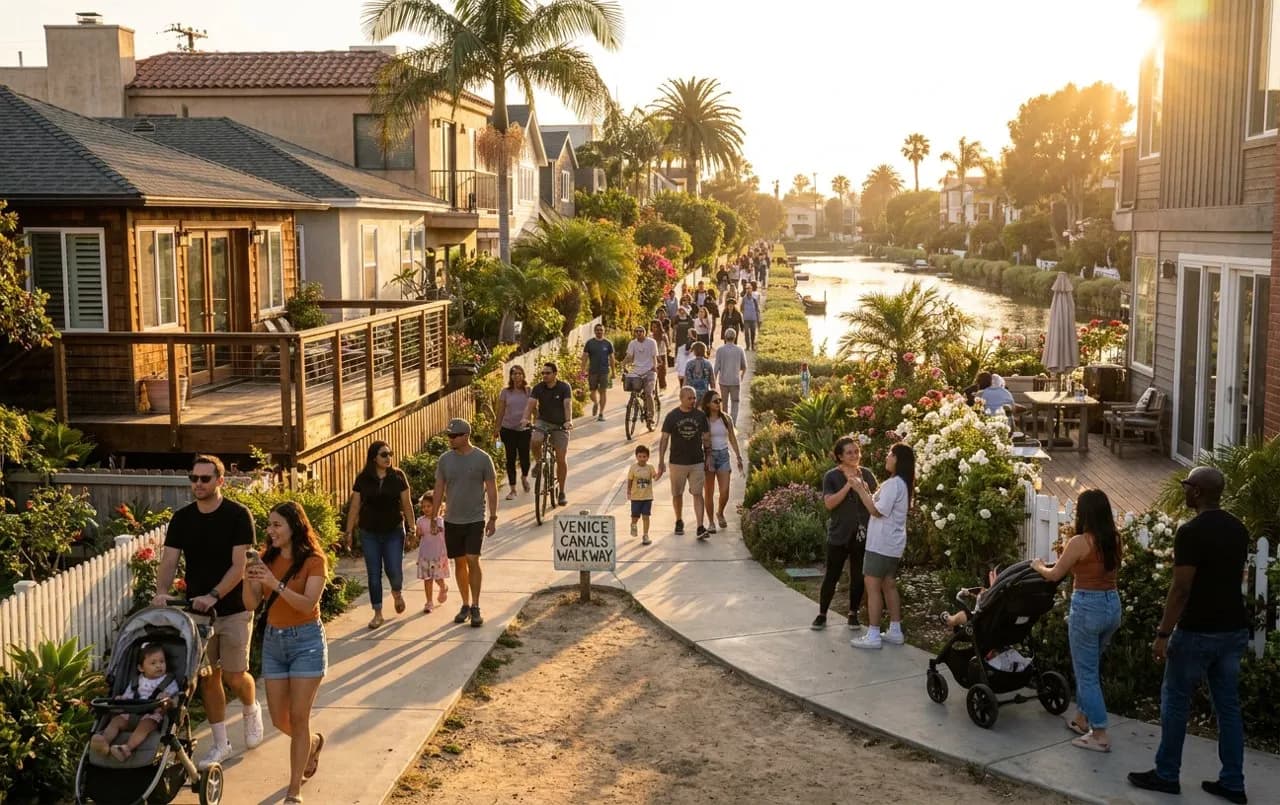
Why Late May, Why Golden Hour
Late May sits in that narrow window after the unpredictable spring weather and before the June Gloom fog reliably rolls in each morning. The marine layer typically clears by early afternoon, leaving the kind of crystalline light that photographers wait months to capture. Golden hour in late May—roughly 7:00 to 8:15 PM, check exact sunset times closer to your dates—stretches longer than winter's abrupt dusk, giving you a generous window to wander without rushing. The canals themselves, quieter on weekday evenings than weekend afternoons, take on an almost private quality as residents return home and day visitors disperse.
Finding the Canals (They Hide in Plain Sight)
The Venice Canal Historic District occupies a compact grid roughly bounded by Washington Boulevard to the north, Strong's Drive to the south, and stretching two blocks east of Pacific Avenue. Most visitors enter from either Dell Avenue or Eastern Canal Court, both accessible from Venice Boulevard. Street parking proves notoriously scarce; your best approach involves parking near Abbot Kinney Boulevard—try the public lot at 1600 Abbot Kinney Boulevard—then walking the fifteen minutes southwest. This walk itself serves as a useful transition, moving you from the boutique commerce of Abbot Kinney through residential blocks until suddenly, improbably, you're standing beside still water lined with eclectic homes. The contrast feels intentional, though it's merely geographic luck.
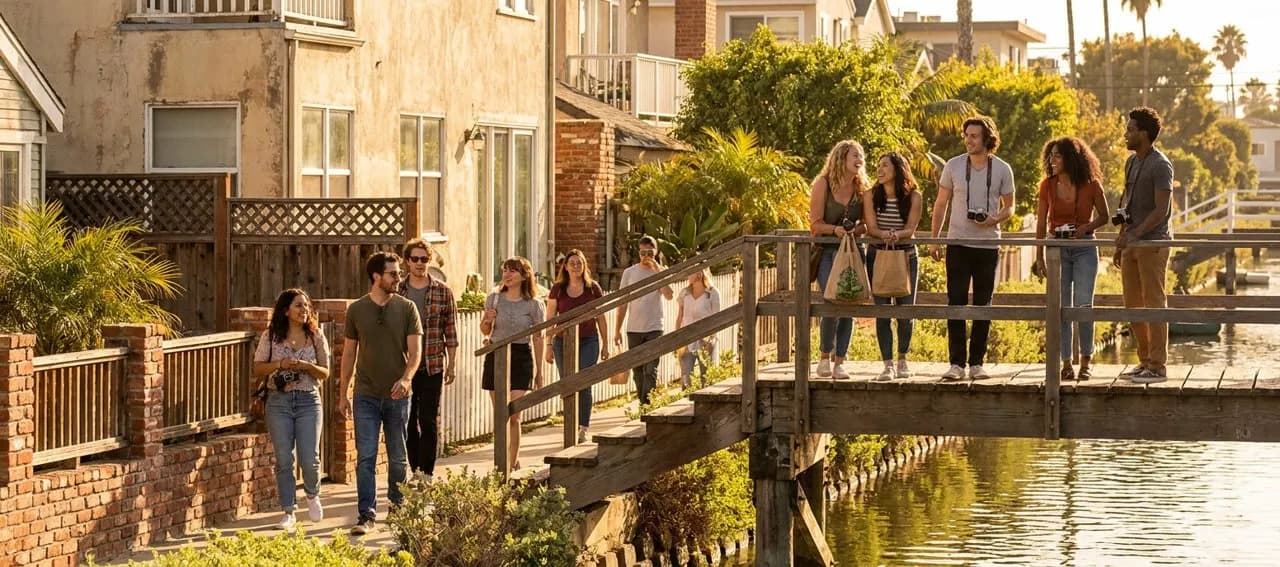
The Architecture of Accidental Charm
Abbot Kinney's 1905 vision of an American Venice survives in fragments—six remaining canals (Carroll, Linnie, Howland, Sherman, Eastern, and Grand) out of the original network. The architectural hodgepodge that lines them today reflects nearly 120 years of rebuilding, renovation, and wildly varying taste. You'll pass Spanish Colonial Revival bungalows sitting beside angular modernist boxes, weathered beach cottages dwarfed by three-story contemporary constructions with walls of glass. Some homes maintain meticulous gardens that spill toward the water; others present fortress-like privacy fences. This incoherence somehow works, perhaps because the canals themselves—authentic water, authentic reflections—provide visual continuity that architecture cannot disrupt. The arched footbridges, rebuilt during the 1990s restoration, offer the most consistent design element, their green-painted railings and concrete curves nodding to the district's original romanticism without pretending to be genuinely Venetian.
Walking the Loop: A Suggested Route
Enter at Dell Avenue and walk south along the eastern edge of the canal system, crossing bridges as they present themselves. The full perimeter covers roughly 1.5 miles if you trace every canal, more if you double back to catch views from different angles. The light shifts noticeably as you walk—what glows amber on west-facing facades may deepen to rose-gold on the water's surface ten minutes later. Sherman Canal, the longest, offers the most uninterrupted water views. Grand Canal, the widest, catches light differently, its broader surface creating more dramatic reflections when conditions align. There's no wrong route here, no optimal path. The district's compact size means you can't truly get lost; when you reach a residential street rather than another footbridge, you've simply found the edge. Turn around, try another canal. The ducks—mallards, coots, the occasional egret—pay no attention to your navigation.
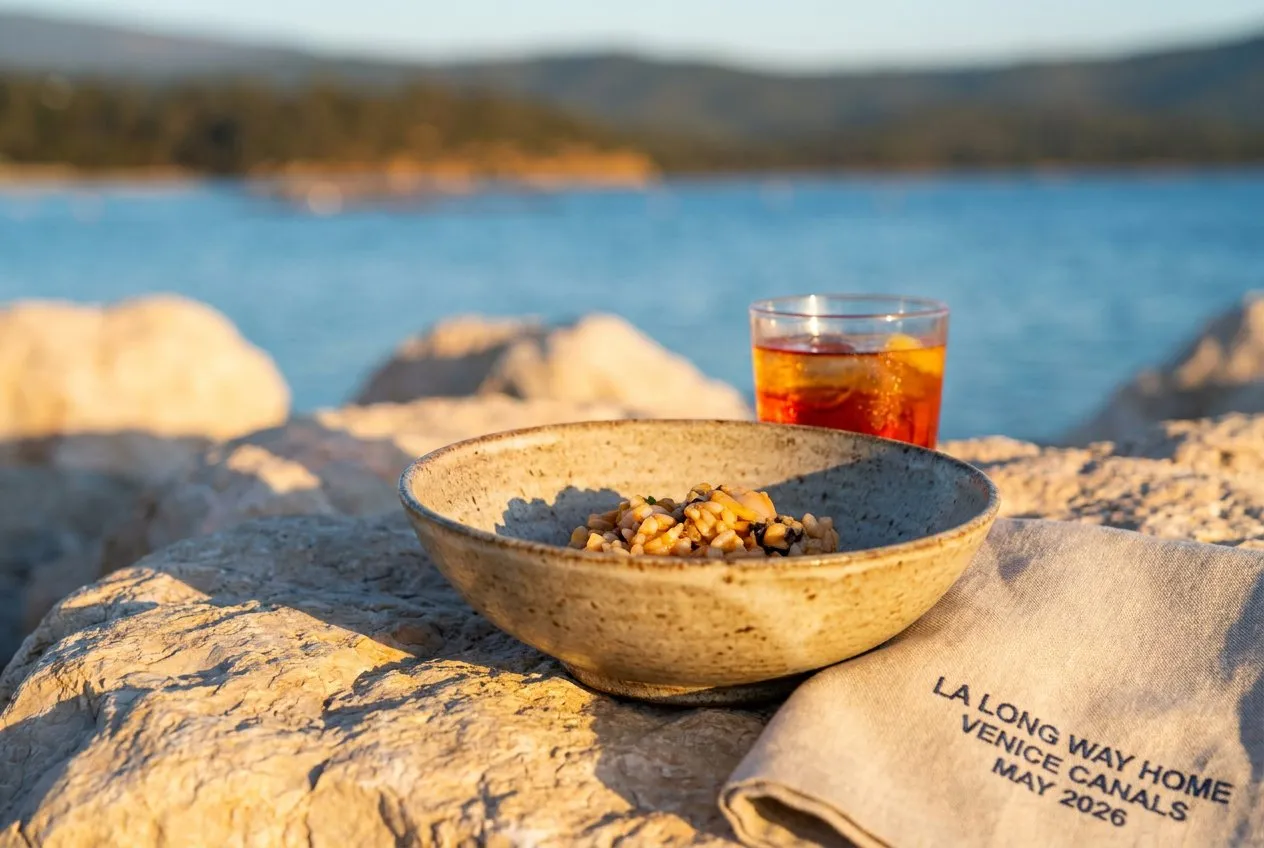
What Happens After the Light Fades
By 8:30 PM in late May, the golden hour has cooled to blue hour, and you'll need to decide whether to stay or return toward livelier blocks. The canals themselves have limited lighting—residents' porch lights, the occasional street lamp—creating pockets of shadow that feel atmospheric rather than unsafe but may not suit everyone's comfort level. If you're ready for the next transition, walk north toward Rose Avenue, where several long-standing establishments offer different versions of post-walk sustenance. Gjelina, at 1429 Abbot Kinney Boulevard, has anchored the neighborhood's dining scene since 2008; expect waits even on weekdays, or try for bar seating. Felix Trattoria at 1023 Abbot Kinney Boulevard offers a strong alternative, with handmade pastas and a serious wine list (note: The Tasting Kitchen at 1633 Abbot Kinney has been closed since a 2024 fire and currently operates only as a pop-up). For something simpler, head to Dudley Market at 9 Dudley Avenue (a narrow alley just off Speedway near the Cadillac Hotel), a neighborhood spot serving sandwiches and coffee without the Abbot Kinney markup. Verify current hours before walking over—pandemic-era schedule changes have persisted longer than anyone anticipated.
Why This Walk, Why Now
The Venice Canals don't offer dramatic reveals or Instagram-engineered moments, though plenty of people try to manufacture both. What they provide instead is a compressed dose of Los Angeles's fundamental strangeness—the city's habit of building improbable things, abandoning them, then rediscovering them decades later. Taking the long way home here means choosing slowness in a neighborhood that increasingly rewards speed, choosing water over concrete, choosing to notice how light behaves on a still surface while traffic hums two blocks away on Washington Boulevard. In late May 2026, as in late May of any year, the canals will remain precisely what they are: a small grid of human-made waterways lined with human-made homes, briefly beautiful when the angle of the sun cooperates. That modest promise, consistently delivered, feels like enough.
Practical Notes
**Access**: Venice Canal Historic District, bounded roughly by Washington Blvd (north), Strong's Drive (south), Pacific Ave (west). Enter via Dell Ave or Eastern Canal Court off Venice Blvd. No admission fee; public walkways open dawn to dusk, though not actively enforced. **Parking**: Extremely limited street parking; consider public lot at 1600 Abbot Kinney Blvd or metered spots along Venice Blvd, then walk 10-15 minutes. **Timing**: Sunset in late May typically 7:45-8:00 PM; golden hour begins 60-90 minutes before. Verify exact times closer to travel dates. **What to Bring**: Comfortable walking shoes (uneven pavement on some canal paths), water, phone or camera, light layer for post-sunset temperature drop. **Accessibility**: Most canal paths are ground-level with minimal elevation change, but not all bridges accommodate wheelchairs; some paths are narrow. **Restrooms**: No public facilities within canal district; plan accordingly or use venues on Abbot Kinney or Rose Ave. **Best Days**: Weekday evenings see fewer visitors than weekends; water surface reflects best light on low-wind days.
Tags: #TheLongWayHome #VeniceCanals #LosAngelesWalks #GoldenHourLA #VeniceBeach #LAHiddenGems #UrbanHiking #CaliforniaCoast #AbbotKinney #WalkingTour #SunsetWalk #LATravel #VeniceCA #SlowTravel #SpringInLA
Editorial note & disclosure
Sources consulted: Venice Canal Historic District — Wikipedia · Discover Los Angeles — Official Tourism Site · Venice, Los Angeles — Wikipedia · Time Out Los Angeles · LA Times Travel
All trademarks are the property of their respective owners.


