 Los Feliz Nail Salon Walk In Finder for Broken Nail Repair
Neighborhood Guides
LA Historic Walking Route: Read Little Tokyo in Layers
A Little Tokyo historic walking route pairs NPS history with street observations, separating documented claims from questions for later reading.
Little Tokyo's historic district represents the original commercial heart of a Japanese American community, according to the National Park Service. A historic walking route here should connect that documented history with the neighborhood you can see, while keeping the two kinds of evidence distinct. Begin with the NPS account, choose a question about continuity or displacement, and make a short walk around that question. This is a self-directed reading-and-walking method for Los Angeles. It does not promise entry into cultural institutions or turn contemporary businesses into exhibits of a vanished past.
Start the visit at your reading table
Read the National Park Service's Little Tokyo Historic District page before drawing a line on a map. Its account describes settlement by Japanese immigrants and the district's development as a commercial community. Take one question from that reading rather than copying a list of dates into an itinerary. You might ask how commercial frontages help a neighborhood function, or how a historic district relates to a larger cultural area. Those questions direct your attention toward relationships between places instead of reducing the visit to collecting photographs of names.
Make a simple page with space for a source, an observation, and an unanswered question. Put the NPS link in the source column. Leave the observation column empty until the walk. This small separation matters because it is easy to remember a sentence from an interpretive account as something a building itself told you. A facade can show you a shape or an entrance arrangement. It cannot, on its own, establish who used that space in a particular decade or explain why a community was displaced.
The historical district and the wider neighborhood should also remain separate in your notes. NPS describes the designated area as representing an original commercial heart, rather than treating every contemporary cultural destination as part of one unchanged historic footprint. Locate the district using the official material, then identify your preferred arrival and departure points on a map. A later meal, exhibition, or shopping visit may be worthwhile, but it can be a separate part of the day rather than evidence that you have followed the historical boundaries precisely.

Let the first pass establish ordinary use
On arrival, give yourself a first pass without taking detailed photographs. Notice how people move between pavement, entrances, and shared spaces. Keep these notes descriptive. You might see several people entering the same doorway or pausing at a corner, but you cannot infer their relationship to the neighborhood from appearance. Avoid turning strangers into illustrative characters for a history you have already decided to tell. The purpose of the first pass is to recognize a functioning urban neighborhood before applying the interpretive framework you brought with you.
Choose one short section for a second look. Record how the buildings meet the street and how the scale changes between adjacent frontages. If an interpretive marker is present and publicly readable, distinguish its wording from your own account. Note the organization responsible for it and which specific site it discusses. A marker has an author and a purpose. Reading it carefully includes noticing those things, rather than treating every sentence on a plaque as a complete explanation of the district around it.
If a marker cannot be approached without obstructing an entrance, defer it. There is no need to photograph around a person or lean into a business doorway to finish a research task. You can still document the question you hoped it would answer. Leave enough space in the itinerary for that kind of omission. A good historical walk is not measured by whether you obtained every planned piece of material. It is measured by how accurately you distinguish what you learned, what you saw, and what you still do not know.
Give difficult history room to remain difficult
The NPS account discusses the wartime removal of Japanese Americans and the disruption of Little Tokyo. Read that section as history concerning people, rights, and community life, rather than as a dramatic plot twist in a pleasant afternoon. Do not invent a family's experience to make the account more vivid. If a personal narrative is important to your question, follow a documented oral history or named primary account and preserve its context. Your walk can make space for that reading without claiming that you have witnessed the experience yourself.
Keep a separate note for absences. A missing use or altered building may prompt a question, but an empty space is not automatically evidence of a particular historical event. You need a record connecting the location and the claim. This is where the original source column becomes useful. Write down the exact question and the kind of source that could answer it. A city record, preservation account, or community archive may provide that connection later. Guessing at the answer while standing on the street adds confidence without adding knowledge.
A companion may want to talk immediately after reading difficult material, while another may prefer a quiet pause. Decide how to accommodate both before moving to the next stop. The pause can happen outside the main pedestrian flow without becoming an improvised public discussion circle. Avoid asking an employee or passerby to explain the community's history on demand. Staff may be working, and no individual owes visitors a personal account. An organized educational program is a different setting, with its own invitation and terms of participation.
Reconcile your notes before adding another destination
After the second pass, compare the source column with the observation column. Circle any sentence that has drifted from description into attribution. For example, noticing an entrance position is different from claiming that a particular kind of business originally used it. Keep the first statement and research the second. This short reconciliation produces a more reliable memory of the visit than adding another five stops. It also creates a useful conversation: which detail changed your question, and which part of the source became easier to understand in place?
Karpo APP can help you explore nearby city ideas when you want to extend the outing. Describe the next activity you actually want, such as a quiet break or a cultural visit, rather than asking an app to authenticate a historical claim. Keep your research notes and source links separately. A recommendation does not establish a building's designation, a program's admission conditions, or a community member's willingness to participate. When you choose an institution or event, use its own published arrangements for that distinct visit.
Practical Notes
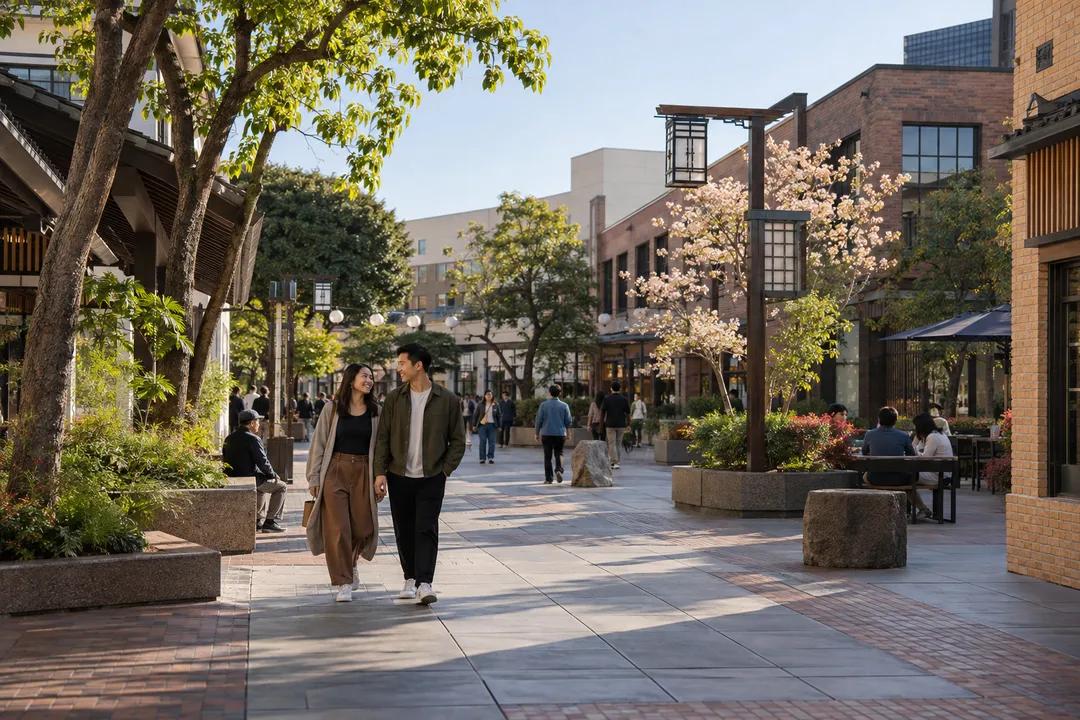
Limit the essential walk to a sequence you can explain without a screen: arrival, the selected public-street section, a pause, and departure. Use a map for directions and choose crossings suitable for the people with you. This article supplies neither a measured accessible itinerary nor a claim about live pedestrian conditions. Carry water and leave room for slower reading. The generated contextual images show an illustrative urban setting and a note-taking scene, not verified landmarks, historical documents, or evidence of current conditions in Little Tokyo.
Your final record should contain one sourced historical statement, one direct observation, and one unresolved research question. Link the first to the National Park Service page, nps.gov/places/little-tokyo-historic-district.htm, and date your own observation so you do not later mistake it for a permanent condition. End the route there if that is enough for one visit. A return walk with a better question can be more rewarding than extending the same afternoon until the historical thread has disappeared beneath a long shopping or dining itinerary.
Ask Karpo for more information.
Keep reading
- Los Feliz Nail Salon Walk In Finder for Broken Nail Repair
 Highland Park Nail Salon Walk In Finder for Retro Manicures
 Koreatown Nail Salon Walk In Finder for K-Beauty Nail Looks