 Los Feliz Nail Salon Walk In Finder for Broken Nail Repair
Neighborhood Guides

LA Historic Walking Route: Hear Leimert Park Beyond Events
A Leimert Park historic walking route starts with cultural context, then makes room for listening and observation without promising a scheduled performance.
Leimert Park can support a historic walking route even when your visit includes no performance, festival, or scheduled gathering. The neighborhood's cultural context is the reason to arrive with attention, rather than an expectation that someone will entertain you. Plan this Los Angeles outing around listening, reading, and noticing the relationship between a public gathering space and the surrounding streets. Keep any ticketed event separate. A quiet afternoon is not a failed version of a busy one, and a cultural district does not owe every visitor a spectacle.
Decide whether you want an event or a neighborhood
These are different outings. For an event, the organizer's invitation defines the place, participation, and arrangements. For a neighborhood walk, you are entering ordinary public space where people may be working, resting, talking, or passing through. Decide which experience you want before leaving home. If a live performance is essential, build the day around a real listing from its organizer. If your interest is the relationship between culture and place, let the walk stand on its own instead of attaching an unverified promise of music to it.
Read a preservation account before you arrive. The LA Conservancy identifies the Vision/Leimert Theatre as a community landmark associated with the village and neighborhood. That is a useful fixed reference for thinking about public cultural space, without assuming access to an auditorium. You can ask how a major cultural building relates to the streets around it while remaining outside. Do not interpret the existence of a historic theatre as evidence that a show will be running, that an entrance is available, or that a rehearsal welcomes visitors.
Choose one research question that extends beyond the building. How does a cultural destination connect to the smaller spaces where people meet? What can public space tell you about the scale of a neighborhood? The question should be something you can investigate through a combination of reading and careful observation. It should not require a stranger to share a personal story. Bring the background you need yourself, and remain ready to change an assumption when what you observe is more ordinary or more complicated than the image you expected.
Make the first pause a listening exercise
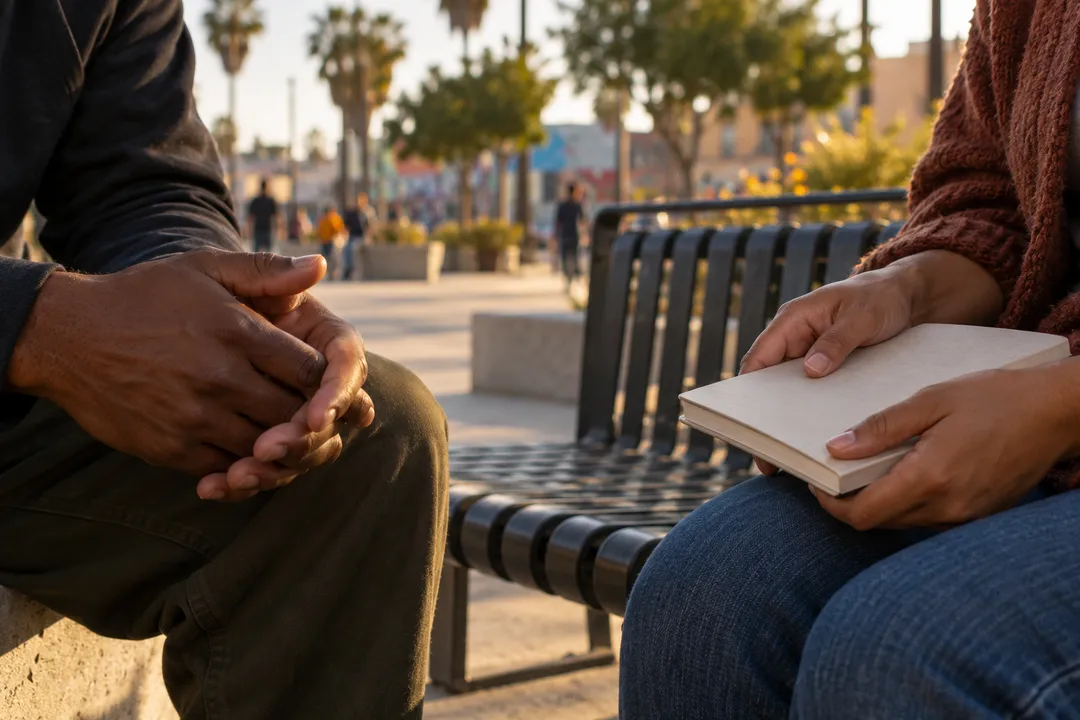
Find a place where standing briefly does not interfere with movement, then give the scene your full attention without recording it. Notice the difference between sounds generated by traffic, ordinary conversation, and any organized activity actually taking place. You are describing what you hear on that visit, not establishing a permanent soundtrack for the neighborhood. A quiet moment is still information. Resist filling the silence with an imagined drum circle or a story about a performance you did not witness. Let the present moment keep its own character.
For companions, silence can be an agreed part of the outing rather than an awkward interruption. Tell each other beforehand that you want a short period of listening, then discuss what each person noticed afterward. One may hear the movement of a bus while another notices how conversation carries across an open space. Neither observation needs to be elevated into a statement about the whole community. Keeping the scale of the claim small makes the discussion more precise and leaves room for people whose everyday experience of the neighborhood is different.
If music or another public activity is present, observe the actual setting before approaching. A public location does not automatically make every gathering an invitation to join, photograph, or record. Look for an organizer's instructions when an organized event is clearly identified. Ask permission before making an individual the subject of a photograph, and accept a refusal without negotiation. Participation can be generous and joyful when invited. It becomes intrusive when a visitor assumes that cultural significance removes the need for ordinary consent.
Walk the relationship between a landmark and its surroundings
Move from your first pause toward the theatre's public-facing surroundings using an ordinary map and appropriate crossings. The goal is to understand spatial relationships, not to secure interior access. Notice the changes between an open gathering area, a frontage, and a narrower pedestrian section. A cultural building can be a point of orientation without becoming the only subject of the route. Give the connecting spaces the same attention you would give the facade, since those spaces organize how people approach, wait, meet, and continue elsewhere.
Avoid using architectural appearance as a shortcut to a complete social history. A building's form and a neighborhood's cultural importance require different kinds of evidence. The Conservancy's account can support a statement about the theatre as a landmark. It cannot establish what a stranger sitting nearby thinks about it, or explain every change in the surrounding community. If you want a deeper account of local cultural life, seek a named community history or a documented program rather than assigning that role to whoever happens to be within reach.
This is also a good point to separate a visitor's route from a resident's routine. A doorway that looks like a useful shelter may be somebody's working entrance. An informal-looking chair may belong to a business. Make your rest decisions from the actual spaces available to you, without treating the neighborhood as one continuous visitor facility. If there is nowhere suitable to stop, keep moving and shorten the walk. Protecting room for ordinary activity is more valuable than completing every pause on your original plan.
Let conversation produce the next question
After the walk, discuss what changed between the image you brought and the place you encountered. Perhaps the most memorable feature was a relationship between buildings, or the way a quiet space felt connected to surrounding movement. Describe that finding without claiming it represents every day in Leimert Park. The most useful result may be a better question for a return visit: a particular artist's history, the role of a cultural organization, or the story of a building's changing use. A second visit can have a different purpose.
For a later organized activity, use the organizer's actual event page. Karpo APP can serve as a starting point for discovering nearby city ideas, but keep the distinction between a suggestion and an invitation. Write your interests plainly: a cultural visit, an independent neighborhood walk, or a separate event. Keep meeting arrangements with companions in your own messages and notes. There is no need to claim automatic group tracking or live performance detection to make the outing useful. A clear shared intention is the practical tool that matters here.
Practical Notes
Set a modest walking area, an arrival point, and a recognizable place to finish. Carry water and allow enough flexibility to pause only where it is appropriate. This is not a measured access audit or a promise about seating, shade, or pedestrian conditions. If a performance is your reason for traveling, its separate booking arrangements should lead the plan. Otherwise, leave the route independent of a schedule. The generated contextual photographs illustrate a listening-focused urban visit and do not document a particular event or the current appearance of a named property.
Use the LA Conservancy's Vision/Leimert Theatre page at laconservancy.org as one starting source, then follow your questions toward community-authored material. Record the author of any account you use so different perspectives do not merge into an anonymous visitor narrative. End with something specific enough to remember accurately: one spatial connection, one observed moment, and one source you want to read more closely. That is a substantial result for a quiet walk, even if no stage lights came on and no performance became part of the afternoon.
Ask Karpo for more information.
Keep reading
- Los Feliz Nail Salon Walk In Finder for Broken Nail Repair
 Highland Park Nail Salon Walk In Finder for Retro Manicures
 Koreatown Nail Salon Walk In Finder for K-Beauty Nail Looks