 Los Feliz Nail Salon Walk In Finder for Broken Nail Repair
Neighborhood Guides

LA Historic Walking Route: 3 Broadway Facade Clues
A Broadway historic walking route uses rooflines, windows and storefronts to compare LA facades from public sidewalks, without relying on interior access.
A Broadway historic walking route works better as a study of three facade clues than a race through a theatre checklist: the building's outline, the treatment of its windows, and the relationship between its upper floors and the pavement. Those clues remain useful when a theatre door is closed. This self-directed Los Angeles outing concentrates on looking from public sidewalks. It does not include interior admission, guided access, or a performance. Start with the street outside, then decide whether an independently booked interior visit deserves a separate occasion.
Read the outline before the ornament
The LA Conservancy's Broadway tour identifies a cluster of theatres and commercial buildings, including the Orpheum, Palace, and Eastern Columbia. Its tour material is a useful starting bibliography rather than permission to enter those properties. Select a compact part of Broadway from that list and give it one question: how does each building announce itself above the storefronts? Resist beginning with a camera close-up. A small decorative panel makes more sense after you have noticed the width and height of the whole facade.
From a comfortable public standing position, follow the outer silhouette with your eyes. Does the roofline continue the rhythm of neighboring buildings or interrupt it? Does the central bay rise above the sides? Describe the visible form in ordinary language before assigning an architectural style. A stepped outline and a projecting cornice are observations. A construction date or an architect's intention requires documentation. Keeping those categories apart makes the walk more interesting because it gives you a real question to pursue afterward rather than a confident guess to repeat.
Choose two facades for this first comparison. More buildings will add names faster than they add understanding. Give each building enough attention to make a rough outline in a notebook, without trying to produce a polished drawing. Then put the sketches next to each other. Differences in height, emphasis, and symmetry become easier to discuss when decorative detail is temporarily absent. If you are walking with someone who dislikes architectural terminology, this exercise gives both of you something concrete to compare without turning the outing into a lecture.
Let windows reveal a different rhythm
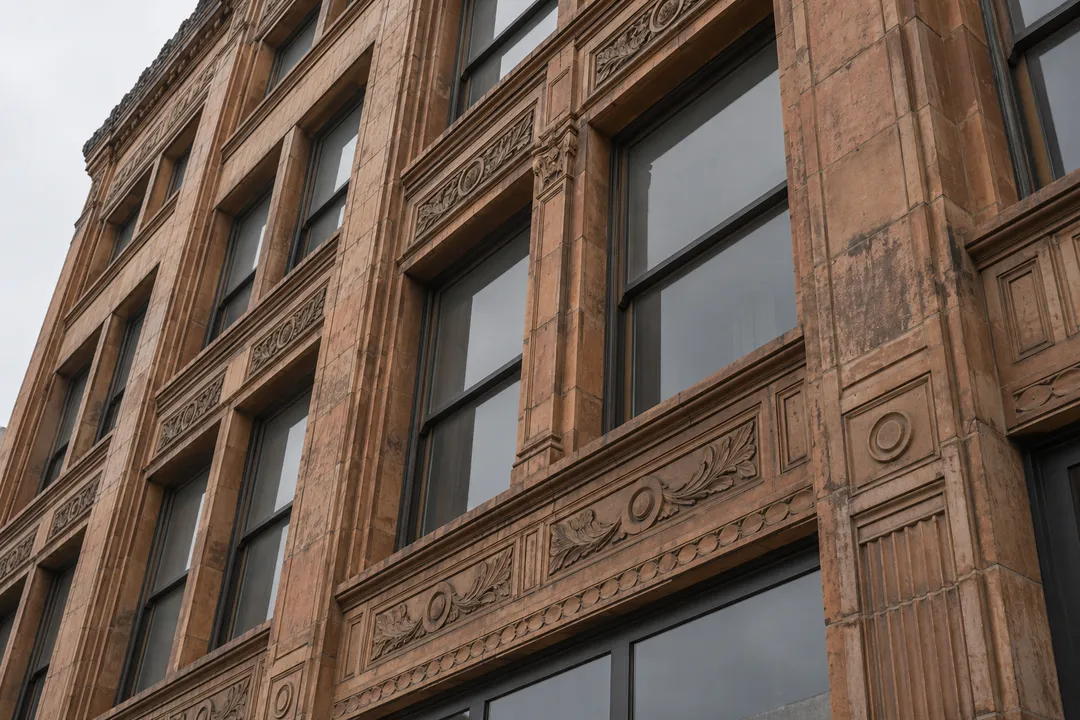
The second pass should follow the windows rather than the roofline. Count a small section, notice where openings align, and look for changes between the lower and upper floors. You are comparing what is visible today, not reconstructing an original elevation from imagination. A replaced window or altered shopfront can be part of the observation. Avoid treating every mismatch as damage or every regular pattern as proof of an untouched building. The street has multiple periods of use, and appearance alone cannot establish when an alteration happened.
Try describing the same facade from two distances. At the closer position, you may notice material joints and the depth of a window surround. Farther back, the repeated openings may read as a grid or a vertical sequence. Use existing crossings to change sides, and continue looking only after you have reached a suitable place to stand. Do not step into the roadway for a symmetrical photograph. An imperfect viewpoint is a reasonable trade for staying out of moving traffic and leaving pedestrian movement unobstructed.
A photography-focused pair can divide the task. One person records the wider composition while the other takes a single detail from public space. Compare the pictures before continuing. Ask whether the close view explains anything about the larger one. If it does not, you may have found an attractive texture rather than an architectural clue. That is still a valid photograph. It simply serves a different purpose. This distinction prevents a history walk from becoming a collection of disconnected details with historical captions added later.
Follow the seam at street level
The third clue is the seam between an upper facade and the storefront below it. Look at where the materials change, where a canopy begins, and how an entrance relates to the bays above. These are prompts for observation rather than statements about the businesses inside. You do not need to buy anything or enter a lobby to complete the exercise. A working doorway also belongs to people going about their day, so leave the approach clear and avoid using a threshold as a gathering point.
Broadway's theatre identity can pull attention toward marquees and away from ordinary commercial architecture. Counter that tendency by pairing one theatre exterior with a less theatrical frontage nearby. Compare the ways each addresses a person walking past. One may direct attention toward a central entrance, while another repeats smaller openings along the pavement. Record the difference without ranking one as more authentic. The Conservancy's historic-place entries can help you investigate a particular building later, once you have a precise feature to search for rather than a vague impression.
Skip an interior detour if its access conditions are not part of your plan. An open outer door does not establish that a stair, auditorium, or elevator is available to visitors. The Conservancy offers guided Broadway visits with their own registration arrangements and explicitly notes that theatre availability affects the experience. That is a different product from this public-sidewalk walk. Keep the two separate. If interiors are your main interest, organize the outing around the operator's actual offering instead of promising yourself that the street will provide access spontaneously.
Turn three observations into a compact route
Draw a sequence with one outline comparison, one window comparison, and one storefront comparison. The sequence can use some of the same buildings. Repetition of a place is useful when the question changes. You do not need to add another district to make the route feel substantial. A small area studied carefully can produce a fuller conversation than an ambitious downtown loop. Mark an endpoint that is easy for your companions to recognize and give everyone the same written description before starting.
Karpo APP can be an entry point for discovering nearby city ideas. Put the historical question and the kind of outing you want into your request, such as an exterior architecture walk with a refreshment break afterward. Keep your chosen sequence in your own notes, and use an ordinary map for street directions. Historical attribution belongs with the preservation source, and entry arrangements belong with the venue or tour operator. A useful discovery suggestion does not establish permission to enter a building or prove that a facade has retained its original materials.
Practical Notes
Wear shoes suited to pavement and carry water. Choose your walking budget before adding optional stops, leaving room for crossings and conversation. If glare makes upper-floor details hard to study, reverse the order of your comparisons or concentrate on a different visible feature. Do not promise that every facade can be photographed from a particular spot. Street activity determines where it is reasonable to pause. The generated contextual photographs accompanying this article illustrate architectural observation and are not records of specific buildings, conditions, or historical appearances.
Finish with three short notes: an outline you can recognize again, a window pattern you can describe, and a street-level change you want to investigate. Add a source link beside any historical claim you subsequently attach to those notes. The result is a repeatable method for reading Broadway, not a claim that you have seen every important building. For background and optional guided experiences, use the LA Conservancy's Broadway Historic Theatre and Commercial District material at laconservancy.org. Keep the walk small enough that the final comparison still gets your full attention.
Ask Karpo for more information.
Keep reading
- Los Feliz Nail Salon Walk In Finder for Broken Nail Repair
 Highland Park Nail Salon Walk In Finder for Retro Manicures
 Koreatown Nail Salon Walk In Finder for K-Beauty Nail Looks