 Los Feliz Nail Salon Walk In Finder for Broken Nail Repair
Neighborhood Guides
West Hollywood Historic Architecture Walking Route: 5 Stops
Follow a West Hollywood historic architecture walking route from R. M. Schindler's 1922 Kings Road studio to Harper Avenue courts and the 1931 Sunset Tower.
During the 1920s, the unincorporated strip of Los Angeles County tucked between Beverly Hills and Hollywood operated outside municipal building codes, attracting both radical European modernists and theatrical courtyard apartment designers serving the booming motion-picture studios. Within a compact square mile between Melrose Avenue and the Sunset Strip, an experimental concrete tilt-slab dwelling built in 1922 stands just blocks below fairy-tale French Normandy turrets, Andalusian tiled courtyards, and a soaring Art Deco skyscraper. Walking a West Hollywood historic architecture walking route from North Kings Road through the Harper Avenue Historic District up to Sunset Boulevard lets you trace how indoor-outdoor California living was invented.
The 1922 Birthplace of California Modernism on North Kings Road
Begin your walk on North Kings Road between Melrose Avenue and Santa Monica Boulevard at the Schindler House, completed in 1922 by Viennese-born architect Rudolph M. Schindler after he arrived in Los Angeles to supervise Frank Lloyd Wright's Hollyhock House. Conceived after a camping trip to Yosemite Valley as a cooperative live-work compound for two couples—Schindler and his wife Pauline along with engineer Clyde Chace and his wife Marian—the house erased the traditional barrier between interior rooms and the garden.
Screened from the street by a tall hedge of bamboo, the pinwheel-plan structure pairs heavy rear walls of tilt-slab concrete poured directly on the ground and hoisted into place with narrow vertical slits of tempered glass. Facing the sunken garden lawns, movable redwood-and-canvas sliding panels replaced solid walls, while open-air rooftop frames known as sleeping baskets allowed residents to sleep outdoors year-round under the Southern California sky. Just across the street and along neighboring blocks of Kings Road and Orlando Avenue, compare Schindler's low-slung 1922 pavilion with contemporary infill residences by architects Lorcan O'Herlihy and Thom Mayne that pay direct tribute to Schindler's spatial layering.
Spanish and Normandy Courtyard Palaces on North Harper Avenue
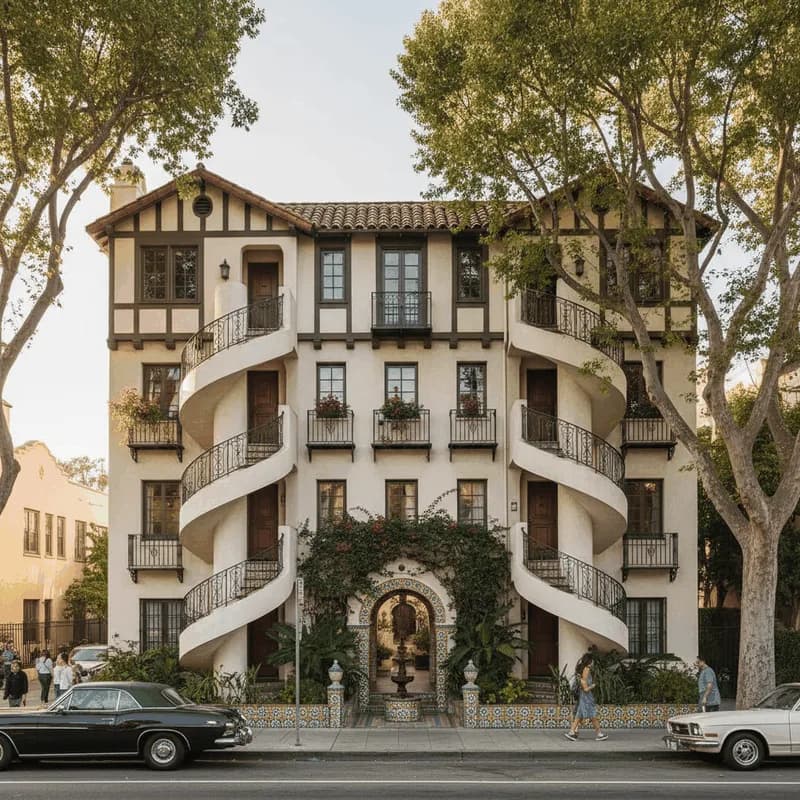
Walk north across Santa Monica Boulevard and turn up North Harper Avenue between Fountain Avenue and Sunset Boulevard, designated on the National Register of Historic Places as the Harper Avenue Historic District. On this single tree-shaded hillside block, more than a dozen intact Period Revival apartment houses built between 1923 and 1931 demonstrate how Southern California architects adapted the single-family bungalow court into multi-story romantic enclaves for screenwriters, stage actors, and directors.
Halfway up the east side of North Harper Avenue stands Patio del Moro, designed in 1925 by husband-and-wife architectural team Arthur and Nina Zwebell, masters of the 1920s Andalusian courtyard apartment. Peer from the public sidewalk into the lushly planted entry court to spot hand-glazed Malibu tile fountains, deeply recessed Moorish arches, exterior wood-balustraded galleries, and dramatic outdoor chimneys. Directly beside and across from Zwebell's Spanish courts rise architect Leland A. Bryant's French Normandy and Romanesque Revival apartment houses—including La Fontaine and Theura—distinguished by steep conical slate-shingled turrets, half-timbered gables, and cast-stone heraldic shields. Just one block east on North Havenhurst Drive, Bryant also completed the seven-story Colonial House in 1930 alongside Arthur and Nina Zwebell's 1928 Andalusia courtyard apartments, extending the pedestrian-friendly enclave across two parallel streets.
Leland Bryant's 1931 Art Deco Sunset Tower and Chateau Marmont
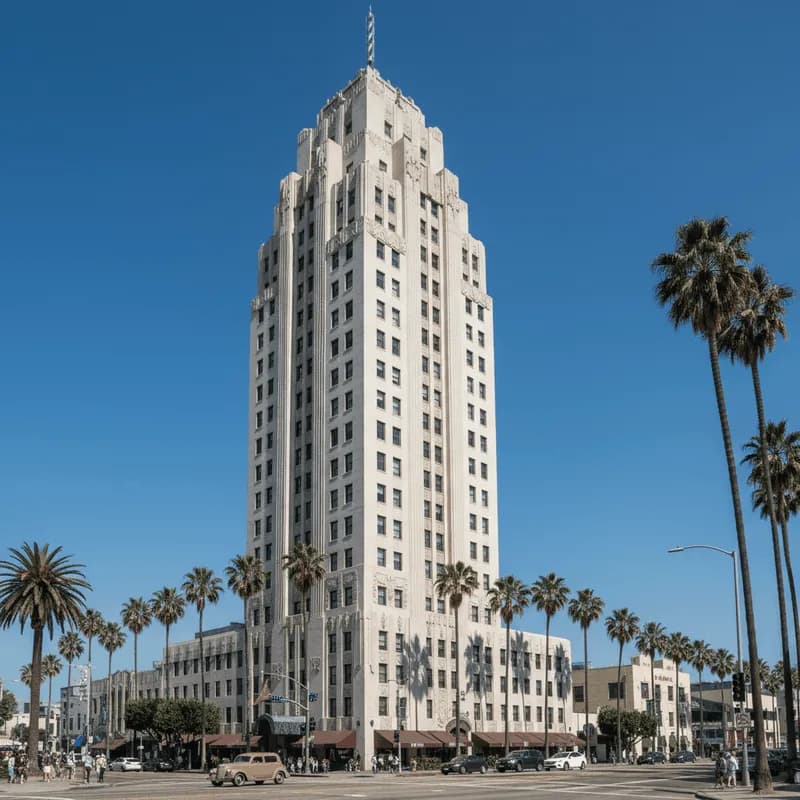
At the top of Harper Avenue and Kings Road, step onto Sunset Boulevard to stand before the Sunset Tower Hotel, completed between 1929 and 1931 by architect Leland A. Bryant. Rising fifteen stories above the hillside slope, this Zigzag Moderne and Streamline Art Deco landmark was engineered as the first all-electric, steel-reinforced poured-concrete high-rise apartment hotel in West Hollywood. Look up at the stepped vertical piers and the cast-concrete bas-relief friezes above the windows and porte-cochere, where sculptors cast stylized flora, clouds, ocean waves, and transatlantic zeppelins directly into the concrete.
Walk four blocks east along the south sidewalk of Sunset Boulevard toward Marmont Lane to contrast Bryant's sleek Art Deco tower with the 1929 Chateau Marmont, designed by architects Arnold A. Weitzman and William Douglas Lee for developer Fred Horowitz. Modeled after the royal Chateau d'Amboise in France's Loire Valley and engineered with earthquake-resistant concrete framing, its Gothic arched loggias, steeply pitched gables, and castle turret perched above Sunset Boulevard show how 1920s West Hollywood embraced both historicist romance and modernist geometry simultaneously.
Bungalow Courts, Sunset Strip Traffic to Skip, and Your Design District Plan B
To complete your architectural survey, loop back south down Sweetzer Avenue or Crescent Heights Boulevard toward Santa Monica Boulevard and Rosewood Avenue. Along these quieter residential cross streets, early 1920s Spanish Colonial Revival and Craftsman bungalow courts still cluster six to ten one-story cottages around central citrus walkways. If you extend your walk east to Vista Street at Plummer Park, you can also view Fiesta Hall, a whitewashed Spanish Colonial Revival community building completed in 1938 under the Works Progress Administration with deep shaded arcades and hand-forged ironwork. Walkers who detour to the western edge of the city along North Doheny Drive north of Beverly Boulevard can also admire the 1927 Studio and Residence of architect Lloyd Wright, where precast interlocking concrete blocks patterned after desert Joshua tree fronds frame a dramatic two-story studio window.
Morning hours between nine in the morning and eleven-thirty provide the best walking conditions in West Hollywood, when soft eastern light illuminates the courtyards along North Harper Avenue and before afternoon heat builds on the south-facing slope of the Sunset Strip. Because the Harper Avenue courtyard buildings are private residences, stay on the public sidewalk and admire the tiled fountains and spiral staircases through the open street archways rather than stepping past entry gates. Skip walking the western stretch of Sunset Boulevard past Doheny Drive during weekday afternoon rush hours, when commuter traffic fills all four lanes and narrow hillside curbs leave little room to pause. If midday sun heats up the incline of Sweetzer Avenue or Harper Avenue, switch to your Plan B by dropping south of Santa Monica Boulevard to the level, tree-lined residential blocks of Rosewood Avenue and Norwich Drive beside the 1975 blue-glass Pacific Design Center plaza at San Vicente Boulevard. Open the Karpo APP before setting out to sequence your five West Hollywood architectural stops and pair the loop with a shaded patio coffee on Melrose Avenue.
Ask Karpo for more information.
Keep reading
- Los Feliz Nail Salon Walk In Finder for Broken Nail Repair
 Highland Park Nail Salon Walk In Finder for Retro Manicures
 Koreatown Nail Salon Walk In Finder for K-Beauty Nail Looks