 Los Feliz Nail Salon Walk In Finder for Broken Nail Repair
Neighborhood Guides
LA Historic Architecture Stroll: Free Wilshire Corridor
Explore historic Westlake on this free self-guided architecture stroll past the legendary MacArthur hotel, Bullocks Wilshire, and Neo-Gothic facades.
During the Roaring Twenties, the urban expanse between MacArthur Park and Western Avenue along Wilshire Boulevard served as Los Angeles' premier luxury residential and retail corridor. Wealthy Angelenos escaped the congestion of the historic downtown core to build palatial private clubs, luxury residential hotels, and monumental houses of worship amid the palm trees of the Westlake district. When department store pioneers recognized that the private automobile was revolutionizing American mobility, they chose Wilshire Boulevard to erect the world's first cathedral of commerce designed specifically around the motorcar. This self-guided historic architecture stroll guides you past monumental Neo-Gothic fraternal palaces, Byzantine domes, and soaring Art Deco monuments, revealing how this vibrant corridor pioneered the architectural vocabulary of modern twentieth-century Los Angeles.

Chivalric Grandeur at The MacArthur
Begin your exploration at 607 S Park View St across from MacArthur Park before the monumental facade of The MacArthur, originally erected in 1925 as the Park Plaza Hotel and Elks Lodge No. 99. Designed by the master architectural firm of Curlett & Beelman, this colossal twelve-story steel-and-concrete edifice served as a multi-million-dollar fraternal headquarters and residential club. Clad in pale brick and heavily carved Bedford limestone, the building is universally recognized as one of the finest examples of Neo-Gothic revival architecture on the Pacific Coast.
Look upward to inspect the dramatic entrance portal, framed by towering pointed arches, carved heraldic shields, and heroic stone sculptures of majestic eagles perched atop the buttresses. Above the entrance, a magnificent carved frieze depicts medieval knights and allegorical figures celebrating charity, justice, and brotherly love. The grand interior houses a soaring four-story lobby featuring hand-painted wooden ceiling trusses, monumental stone fireplaces, and stained-glass heraldic crests that evoke the chivalric grandeur of an ancient European fortress overlooking the park's tranquil lake.
Cathedral of Commerce at Bullocks Wilshire
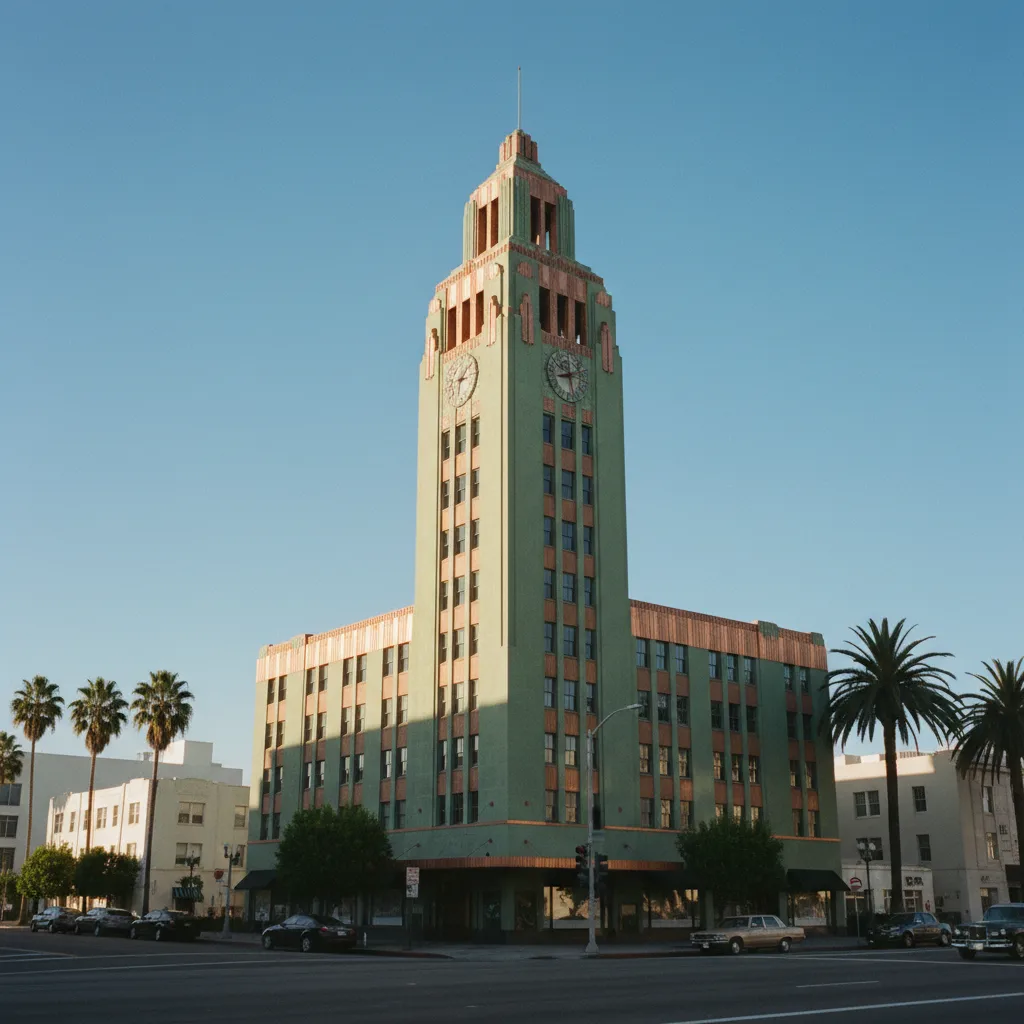
Stroll westward toward 3050 Wilshire Blvd to marvel at the peerless Art Deco masterpiece of Southern California: the Bullocks Wilshire Building, dedicated in September 1929. Conceived by John and Donald Parkinson, this landmark department store fundamentally transformed American retail architecture by turning its primary entrance away from the pedestrian sidewalk and toward a luxurious rear automobile courtyard and porte-cochère. Clad in warm buff-colored terra cotta accented with deeply oxidized, weathered verdigris copper panels, the building rises dramatically to a central stepped tower soaring 241 feet into the sky.
Walk beneath the rear porte-cochère ceiling to gaze upward at the breathtaking fresco mural titled 'The Spirit of Transportation', painted by artist Herman Sachs in 1929. Executed in brilliant mineral pigments, the fresco celebrates modern travel through dynamic abstract depictions of steamships, racing locomotives, aeroplanes, and early Graf Zeppelin airships. The building operated as a high-fashion shopping cathedral where Hollywood stars like Greta Garbo, Clark Gable, and Marlene Dietrich shopped in custom designer salons, preserved today as an architectural campus for Southwestern Law School.
Byzantine Magnificence at Wilshire Boulevard Temple
Continue west along Wilshire Boulevard to 3663 Wilshire Blvd to admire the monumental dome of the Wilshire Boulevard Temple, dedicated in 1929. Designed by architects Allison & Allison, this palatial sanctuary houses the oldest Jewish congregation in Los Angeles, founded in 1862. The exterior architecture represents a magnificent fusion of Byzantine and Romanesque revival styles, constructed with rough-textured California limestone and crowned by an awe-inspiring one-hundred-foot-wide ribbed dome covered in black-and-gold geometric tiles modeled directly after the Roman Pantheon.
Examine the triple-arched stone entry portico, flanked by massive carved columns adorned with Byzantine capitals and delicate Star of David tracery. Above the central portal, an intricate rose window filters natural light into the sanctuary, where renowned artist Hugo Ballin painted a continuous three-hundred-and-twenty-foot narrative fresco mural around the interior perimeter, chronicling biblical Jewish history from Abraham to the immigrant arrival in America. Hollywood studio founders including the Warner brothers, Louis B. Mayer, and Carl Laemmle personally contributed to the building's lavish construction, creating an enduring spiritual landmark.
Spanish Churrigueresque Fantasy at Chapman Market
Turn north onto Alexandria Avenue and walk two blocks to 3465 W 6th St to inspect Chapman Market, opened in 1929. Designed by the celebrated architectural firm of Morgan, Walls & Clements, this extraordinary commercial complex is historic as the world's very first drive-in shopping center. Anticipating the car-centric lifestyle of mid-twentieth-century Los Angeles, the architects designed an enclosed commercial market around a central open-air parking courtyard, allowing suburban motorists to drive through grand arched gateways and park directly in front of specialty grocery and meat stalls.
The building's exterior is an exuberant explosion of Spanish Colonial and Churrigueresque Baroque ornament. Cast-stone pilasters dissolve into luxuriant acanthus leaves, decorative gargoyles, sculpted Spanish crests, and soaring corner watchtowers that evoke a fortified colonial fortress in Old Madrid. Notice the ornate wrought-iron entrance gates and hand-painted Spanish ceramic tiles that frame the central motor courtyard, demonstrating how historic revival architecture was brilliantly adapted to solve practical automobile traffic challenges during the late 1920s.
Historic Residential Splendor Along West 6th Street
Stroll eastward along West 6th Street back toward Westlake to observe an exquisite collection of 1920s luxury apartment hotels, anchored by the Asbury Apartments at 2505 W 6th St. Completed in 1925, this thirteen-story Classical Revival residential tower features an imposing arched entrance loggia, classical stone urns, and a deep modillioned cornice. During the 1920s, Westlake was celebrated as a fashionable residential district filled with affluent winter visitors who stayed in furnished luxury apartments surrounded by subtropical palm gardens.
Look across neighboring street corners to inspect the detailed terracotta friezes, copper bay windows, and brick diaper-pattern masonry that define the streetscape. The cohesive scale and material continuity along 6th Street create an authentic pre-Depression urban ambiance, reflecting an era when Los Angeles architects prioritized craftsmanship, pedestrian elegance, and classical proportions even on mid-rise residential commissions.
Transit Logistics and Practical Architecture Stroll Notes
This self-guided historic architecture stroll covers approximately one point five miles along West 6th Street and Wilshire Boulevard, taking about seventy-five to ninety minutes to complete at an appreciative walking pace. For optimal architectural photography, schedule your walk during the mid-afternoon hours between one and four o'clock, when bright sunlight strikes the copper-clad facade of Bullocks Wilshire and illuminates the intricate stone carvings of Chapman Market without casting deep shadow chasms.
Public transit connections are exceptionally convenient: ride the Metro B Line or D Line to Westlake / MacArthur Park Station to begin directly beside The MacArthur, or utilize the Wilshire / Vermont Station to access the western half of the route near Bullocks Wilshire and the Temple. Frequent Metro Rapid and local bus lines including route 20 and route 720 operate along Wilshire Boulevard. Karpo APP delivers turn-by-turn walking waypoints, historical context, and architectural diagrams, making your journey through historic Westlake effortless, informative, and inspiring.
Ask Karpo for more information.
Keep reading
- Los Feliz Nail Salon Walk In Finder for Broken Nail Repair
 Highland Park Nail Salon Walk In Finder for Retro Manicures
 Koreatown Nail Salon Walk In Finder for K-Beauty Nail Looks