 Los Feliz Nail Salon Walk In Finder for Broken Nail Repair
Neighborhood Guides

LA Historic Architecture Stroll: Free Spring St Route
Explore the historic core of Los Angeles on this free architecture stroll past the Title Guarantee Building, Biltmore Hotel, and Spring Street towers.
Long before skyscrapers crowned Bunker Hill, South Spring Street earned widespread renown as the 'Wall Street of the West'. Spanning the core of Downtown Los Angeles from 4th Street southward to 7th Street, this stately banking corridor emerged in the opening decades of the twentieth century as the primary financial center of the Pacific Coast. Here, visionary financiers, oil barons, and rail magnates erected imposing neoclassical banking temples and soaring Art Deco commercial headquarters clad in granite, glazed terra cotta, and hand-carved limestone. This self-guided historic architecture stroll guides you through the historic core and neighboring Grand Avenue, highlighting the technical engineering milestones, opulent decorative banking halls, and civic design philosophy that established Los Angeles as a modern commercial powerhouse.
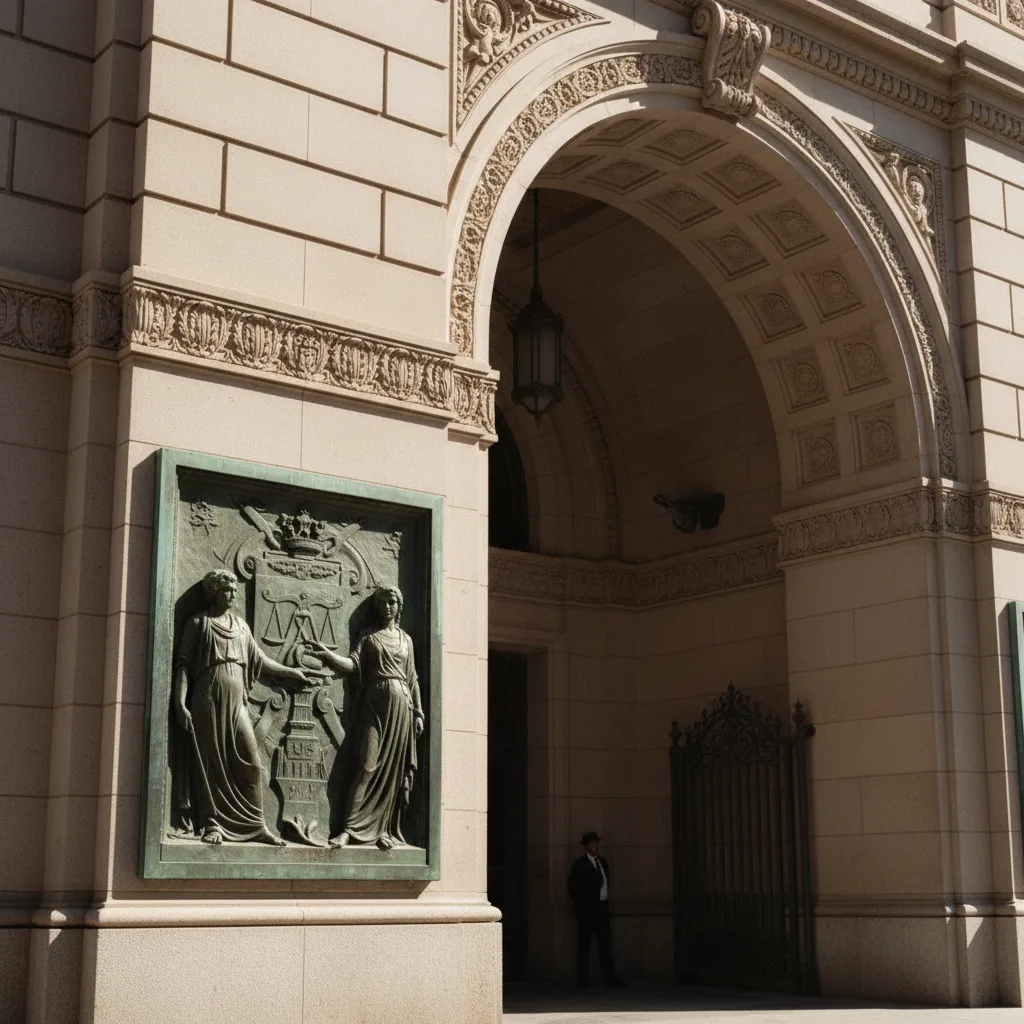
The Continental Building and Early Skyscraper Engineering
Begin your exploration at 408 S Spring St before the landmark Continental Building, celebrated as Los Angeles' very first skyscraper. Designed in 1904 by prolific civic architect John Parkinson, this twelve-story commercial tower rose to a height of one hundred and seventy-five feet, prompting the city government to establish a strict one-hundred-and-fifty-foot municipal height limit in 1905 that shaped the downtown skyline for the subsequent half-century. Parkinson structured the facade following the classic Beaux-Arts tripartite vertical division modeled on a classical column, featuring a two-story rusticated granite base, a tailored seven-story brick shaft, and an ornate terra-cotta capital.
Look upward to inspect the monumental stone lion heads and carved modillion brackets supporting the projecting copper cornice beneath the roofline. Constructed with a cutting-edge fireproof steel skeleton wrapped in masonry, the Continental Building proved to skeptical local business leaders that tall, slender commercial structures could safely withstand earthquake tremors in Southern California. The building's successful completion inaugurated an unprecedented building boom along Spring Street, transforming what had been a modest residential roadway into a bustling canyon of finance and corporate enterprise.
Los Angeles Stock Exchange Building and Moderne Power
Proceed south down Spring Street to 618 S Spring St to admire the monumental granite facade of the Los Angeles Stock Exchange Building, dedicated in 1931. Designed by architect Samuel E. Lunden in collaboration with Parkinson and Parkinson, this five-story Moderne financial stronghold was erected to replace older exchange facilities that could no longer accommodate the region's explosive boom in oil and aerospace securities. The facade is executed in monumental gray Yosemite granite, rising five stories without conventional window openings to present an impregnable, secure symbol of institutional stability following the 1929 stock market crash.
Above the massive bronze entrance doors, examine the heroic bas-relief granite sculptures chiseled by Italian-American master sculptor Salvatore Cartaino Scarpitta. Three monumental allegorical panels depict 'Finance', flanked by 'Research and Discovery' and 'Production', with stylized classical figures holding drafting compasses, industrial gears, and chemical flasks. The interior trading floor once featured a forty-foot-tall acoustic ceiling covered in hand-painted gold leaf and polished cedar panels, representing the pinnacle of Southern California classical modernism during the transition into the machine age.
Art Deco Ascendance at the Title Guarantee Building
Turn westward onto 5th Street toward Pershing Square to reach 411 W 5th St, home to the striking Title Guarantee and Trust Building, completed in 1930. Designed by the father-and-son architectural practice of John and Donald Parkinson, this twelve-story Art Deco masterpiece features a dramatic stepped ziggurat tower capped by stylized Gothic cresting. Clad in warm buff-colored architectural terra cotta manufactured by Gladding, McBean & Company, the building demonstrates how Parkinson seamlessly blended classical Gothic verticality with streamlined Art Deco geometric setbacks.
Step inside the public entrance vestibule to admire the monumental six-panel historic mural cycle painted directly onto the lobby walls by celebrated artist Hugo Ballin. Ballin's rich oil murals depict the founding epochs of California history, starting with indigenous Tongva settlements, progressing through the arrival of Spanish missionaries and Mexican rancheros, and culminating in the construction of modern transcontinental railroads and the Los Angeles Aqueduct. Look above to inspect the monumental wrought-iron chandeliers and polished travertine wainscoting that make this lobby one of downtown's most pristine historic interiors.
Mediterranean Splendor at the Millennium Biltmore
Cross Grand Avenue to 506 S Grand Ave to stand before the grand brick facade of the Millennium Biltmore Hotel, opened with international fanfare in October 1923. Designed by the prestigious New York architectural firm Schultze & Weaver—who later created the Waldorf Astoria—the Biltmore was hailed upon completion as the largest and most luxurious hotel west of Chicago. Clad in variegated red brick with extensive limestone and terra-cotta ornamentation, the hotel combines Spanish Renaissance, Italian Baroque, and Mediterranean revival elements to honor California's Mediterranean climate and historical roots.
Enter the majestic central Galleria to witness one of the grandest interior promenades in the western United States. The soaring barrel-vaulted plaster ceilings were painted by Italian master artist Giovanni Smeraldi, who previously decorated the Vatican Palace and the White House. Look closely at the hand-painted ceiling beams, intricate heraldic shields, gilded rosettes, and hand-carved travertine columns that line the marble hallways. The Biltmore holds an indelible place in cultural history as the birthplace of the Academy of Motion Picture Arts and Sciences, where the concept of the Oscar statuette was first sketched on a banquet napkin in 1927.
Civic Symbolism at the Los Angeles Central Library
Conclude your architectural walking loop at 630 W 5th St before the iconic Los Angeles Central Library, dedicated in 1926. Conceived by visionary architect Bertram Grosvenor Goodhue, this National Historic Landmark represents a daring break from conventional Beaux-Arts civic design, blending ancient Egyptian, Mediterranean, and Art Deco influences into an original civic monument. The building is anchored by a monumental central limestone tower crowned by a mosaic-tiled pyramid topped with the gilded bronze 'Torch of Learning', symbolizing the illumination of knowledge across the city.
Walk around the exterior perimeter to admire the heroic stone sculptures chiseled directly into the limestone walls by master sculptor Lee Lawrie. Lawrie created monumental statues of ancient philosophers, poets, and statesmen, alongside winged sphinxes guarding the library's southern garden terrace. Inside the Goodhue rotunda, breathtaking four-panel murals painted by Dean Cornwell chronicle the historical development of California from prehistoric flora to modern industrial engineering, framed by a massive bronze zodiac chandelier suspended sixty feet overhead.
Walking Route Logistics and Transit Guidance
This self-guided historic architecture stroll covers approximately one point one miles through the historic core and financial district, requiring sixty to seventy-five minutes at an observant walking pace. The route features a gentle uphill grade as you walk westward from Spring Street toward Grand Avenue. For optimum architectural photography, schedule your walk in the late morning, when sunrays illuminate the north-facing limestone facades of 5th Street and cast deep sculptural shadows across the relief panels of the Central Library.
Public transit connections are exceptionally straightforward: ride the Metro B Line or D Line directly to Pershing Square Station, utilizing the 5th Street portal to emerge directly between the Title Guarantee Building and the Biltmore Hotel. Alternatively, the 7th St / Metro Center station connects the A Line and E Line within three blocks of the walk. Karpo APP provides turn-by-turn waypoint routing, historical timeline comparisons, and archival architectural photographs, enabling you to explore the legacy of Spring Street with ease and historical depth.
Ask Karpo for more information.
Keep reading
- Los Feliz Nail Salon Walk In Finder for Broken Nail Repair
 Highland Park Nail Salon Walk In Finder for Retro Manicures
 Koreatown Nail Salon Walk In Finder for K-Beauty Nail Looks