 Burbank Film Memorabilia Collector Shop Walk: Studio Stash
Hidden Gems & Odd Finds
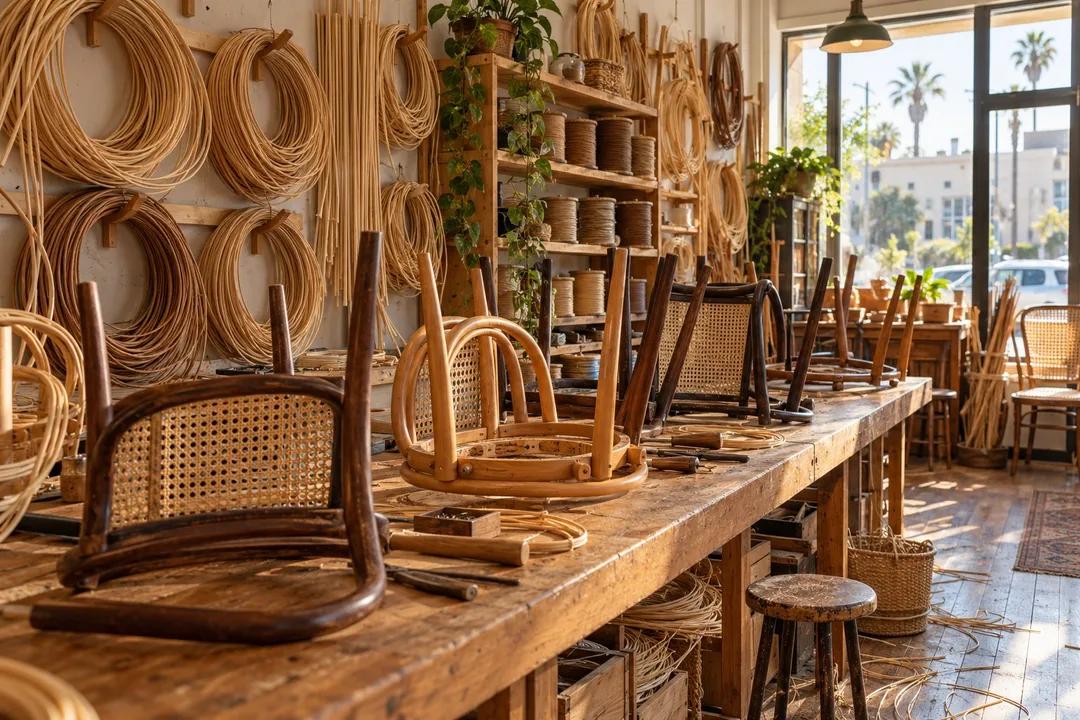
Chair Caning Furniture Restoration Shop in LA: Cane & Basket
Cane & Basket Supply Co. on South Cochran Avenue has rewoven LA chair seats since 1934, with walk-in free estimates for cane, rush, Danish cord and wicker.
Cane & Basket Supply Co. has been weaving Los Angeles chair seats back together since 1934, and its workshop and supply store sits at 1283 South Cochran Avenue in Mid-City, a few blocks below Olympic Boulevard. If the furniture restoration shop you need is one that can reweave a hand-caned dining chair, replace a rush seat or redo a Danish cord stool, this is the specialist much of the city sends people to, and the free estimate needs no appointment.
A Classified Ad, a Family and Ninety Years of Cane
The company's About page tells the story in a few lines. The business was established in 1934, and it has been a small family-run company since 1962, when William Fimpler II bought it after seeing it for sale in the Los Angeles Times. His son Bill Jr., now retired, and his daughter Susan both worked for him, and his granddaughter Sara now works alongside her mother, Susan, which carries the family's know-how into a third generation.
The repair department describes itself as having over a hundred years of combined experience. The About page also notes that most of the same employees have been with the company for over 40 years. That depth is the reason designers, antique dealers and homeowners bring in chairs that other workshops turn away.
The Weaves They Repair
The repair page lists hand caning, blind caning, double panels, press cane, rush, Danish cord, splint and wicker repairs, as well as installing cane panels on cabinet and closet doors. Each is a different craft. Hand caning is the traditional seven-step pattern woven strand by strand through holes drilled around the seat frame. Press cane, also called sheet or machine cane, is a prewoven mesh pressed into a groove and held with a reed spline, common on mid-century and Breuer-style chairs. Blind caning hides the holes on the underside of the rail, a sign of finer antique seating.
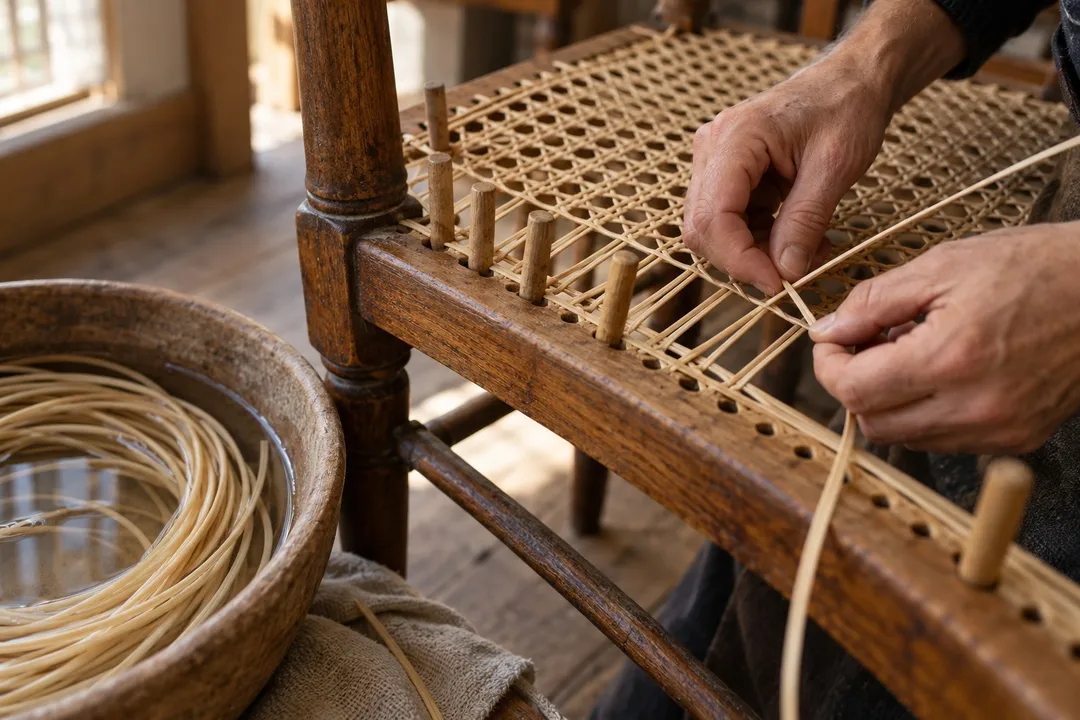
Rush seats, twisted from fiber cord into four triangular sections, appear on ladder-back and country chairs, while Danish cord is the paper cord woven across Scandinavian modern stools and Wegner-style chairs. Splint uses flat strips of ash or reed, and wicker repair covers rattan and willow chairs and baskets. Bring any piece that uses one of these materials and the team can tell you which method was used originally and which will hold up.
Walk In for a Free Estimate
The shop's policy is refreshingly simple: come by any time it is open for a free estimate, and no appointment is necessary. That makes it easy to test whether an old chair is worth saving before you commit. Carry the chair in rather than sending photos if you can, because a caner can look at the frame, count the holes and check whether the seat rail is cracked in one visit. For distant customers, the homepage also accepts photo quotes by email or text, and a clear picture of the whole seat plus a close-up of the holes or groove helps a lot.
The frame matters as much as the weave. A chair with loose joints should be reglued before a new seat goes in, because tightening fresh cane over a wobbly frame strains both. Ask whether the frame work can be done in-house or whether you should take it to a wood restorer first.
Buying Supplies for a Do-It-Yourself Seat
Half of the business is a supply store, and its prices are listed online. Fine open half-inch press-cane mesh, item 102M, costs $0.80 per lineal inch. A ten-pound spool of Original Danish Seat Cord costs $145.00, and a coil of jumbo laced round reed is $18.95. Those prices are for materials, not repair labor; repair quotes are given at the estimate.
If you plan to replace a press-cane seat yourself, bring the old spline and a measurement of the groove width so staff can match the mesh and the spline size. For hand caning, buy cane by strand width, since the hole spacing on your chair determines which size works. Soak natural cane and reed in warm water before weaving so they bend without cracking.
Once a new seat is in, a little care keeps it tight for years. Natural cane relaxes when it dries out, which is why old seats sag in the middle. Wiping the underside lightly with a damp cloth now and then lets the strands shrink back a little, while standing on a cane seat, or kneeling on it to reach a high shelf, is the quickest way to break it. Danish cord and rush prefer to stay dry, so keep sweating glasses and wet bathing suits off them.
When to Go and What to Expect
The shop is open from 9:00 to 5:00, Monday through Friday, and closed on weekends. Weekday mornings are the easiest time to talk to a caner before benches fill up with the day's work. Street parking on Cochran is residential, so plan a few minutes to find a space and bring a moving blanket if you are carrying several dining chairs. Turnaround depends on the weave and the queue, and the estimate is the time to ask how long your chairs will be away.
Around South Cochran Avenue
The workshop sits in a quiet residential stretch of Mid-City between Olympic and Pico. Sonoratown's Mid-City location on San Vicente Boulevard is a short drive away and serves the Sonoran-style flour tortilla tacos and chivichangas the original downtown shop became known for, a good lunch after dropping off chairs. Further north, the museums of Miracle Mile, including LACMA and the Academy Museum of Motion Pictures, line Wilshire Boulevard around Fairfax Avenue.
If your chair also needs serious woodwork, the neighborhood has a French-trained antique furniture restorer working nearby on South Orange Drive, about a kilometer south, so a cane seat and a frame repair can be planned on the same afternoon.
Practical Notes
Address: 1283 South Cochran Avenue, Los Angeles, CA 90019, in Mid-City between Olympic and Pico Boulevards. Hours: 9:00 to 5:00 Monday through Friday. Free estimates for walk-ins, with no appointment needed, and photo quotes by email or text.
Repairs: hand caning, blind caning, double panels, press cane, rush, Danish cord, splint and wicker, plus cane panels for cabinet doors. Supply prices online include press cane at $0.80 per lineal inch, Danish cord at $145.00 per ten-pound spool and jumbo round reed at $18.95 per coil. Ask the Karpo APP for a taco spot in Mid-City or a coffee bar on Pico before you head over.
Ask Karpo for more information.
Keep reading
- Burbank Film Memorabilia Collector Shop Walk: Studio Stash
 Pasadena Film Memorabilia Collector Shop Walk: Classic Route
 Silver Lake Film Memorabilia Collector Shop Walk: Indie Lore