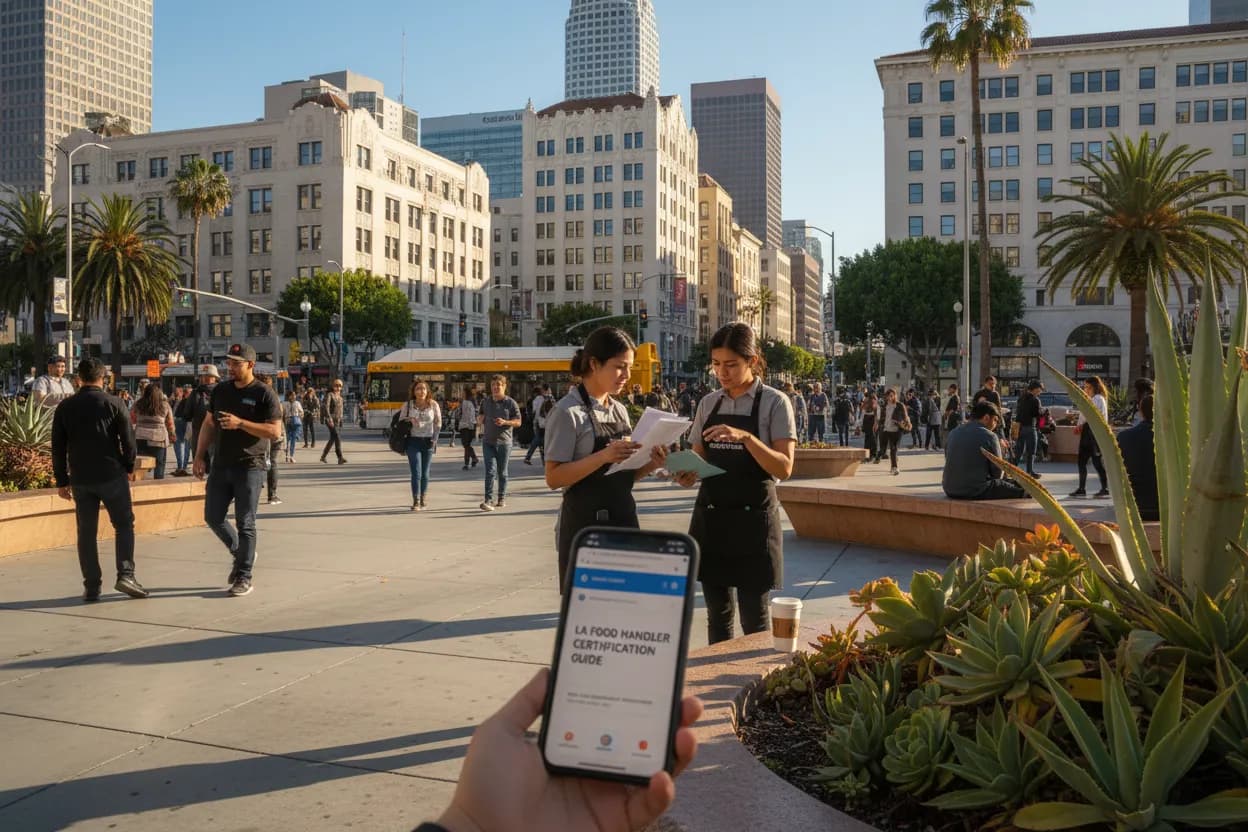
If you work around food in Los Angeles, the phrase LA food handler certification can sound simple until you start comparing course pages, employer instructions, and credential names. The safest move is not to buy the first certificate you see. Start by confirming what your workplace, role, and local authority actually require, then choose a course or exam path that matches that requirement. Official examples show why precision matters: New York City’s public Food Protection Certificate page is aimed at restaurant managers, operators, and other staff, and its rules include a supervisor requirement for food places there. That does not automatically describe Los Angeles, so treat every credential name, fee, exam rule, and language option as something to verify before you commit.
Want a second set of eyes before you pay for a course? Text Karpo with the credential page, your job role, and your deadline, and ask what needs verifying first.

Decide Whether You Want Making Or Browsing
For restaurant workers, “making” means you are choosing a credential path because you need to handle food at work, onboard quickly, or satisfy a manager’s request. “Browsing” means you are researching options before applying to kitchens, food trucks, catering teams, coffee shops, or grocery prepared-food departments. Those are different decisions. If you are already employed, ask your manager for the exact credential name they expect and whether they need proof of completion, a wallet card, a certificate, or an exam result.
Do not assume every food-safety class is the same. The official New York City Food Protection Certificate page, for example, describes a course that anyone can take, while also stating that NYC food places must have a supervisor with that certificate on duty during all hours of operation. That is a manager-style supervision rule in that city. For Los Angeles, verify the official local or state requirement that applies to your job before using an out-of-area page as a guide.
Check Materials Before You Commit
Before you enter a card number, inspect the course materials like you would inspect a prep station. Confirm the credential title, issuing organization, lesson structure, exam requirement, language options, and whether completion produces the document your employer will accept. If the page mentions a final exam, check whether it is online, in person, proctored, scheduled separately, or paid for separately. If anything is unclear, pause and ask the provider or your employer in writing.
Official course pages can contain details that change the real cost and timeline. NYC’s official page, for instance, says its online course is free, has 15 self-paced lessons, requires each lesson and quiz before moving forward, and still requires an in-person final exam with a separate exam fee. It also says final exams and study guides are available in 37 languages. Use that as a reminder to verify Los Angeles-specific materials, exam format, language access, and payment steps on the official page you plan to use.

Match The Class To Your Attention Span
A useful certification plan is one you can actually finish. If you learn best in a fixed classroom, look for an official page that clearly states the in-person format, total class length, daily schedule, location, registration process, and what happens after you pass. If you prefer to work in short bursts before or after a shift, a self-paced course may fit better, but only if the official page explains how lessons unlock, how quizzes work, and when the exam becomes available.
The NYC example shows two very different formats: an in-person Food Protection Course listed as 15 hours over five days, and an online course described as self-paced with 15 lessons. Los Angeles workers should not copy those numbers unless they appear on the official Los Angeles-relevant page they are using. Instead, use the comparison to ask better questions: How long will this take, what must be completed in order, and when do I receive temporary or final proof?
Pair The Workshop With An Easy Reset
Food safety training is not a creative workshop, but it still competes with the same LA realities: commute time, late shifts, childcare, parking stress, and screen fatigue. Build a low-friction reset around it. If you are taking a class or exam away from home, plan the route before you book. If you are studying online, pick a quiet block of time and avoid stacking it after your hardest service shift.
LA Metro’s official site points riders to its Trip Planner, Alerts, Maps & Schedules, and the official LA Metro app for real-time arrivals, step-by-step directions, and service alerts. It also says riders can pay fare by tapping a credit or debit card in plastic or digital form on buses or at train stations. Before you go anywhere for an exam or appointment, verify current route, alert, fare, and station details directly with Metro.
Leave Room For Pickup Or Shipping
Certification tasks often fail at the handoff: you passed, but your manager needs a specific document; you finished lessons, but the exam must be scheduled; you received a temporary certificate, but you do not know whether a permanent version follows later. Before you book, look for the official “after you apply” or completion instructions. If the page does not explain pickup, download, mail, replacement, or verification steps, ask before paying.
The NYC page states that people who pass the final exam receive a temporary Food Protection Certificate. That detail matters because temporary proof may not be the only document someone eventually needs. For LA food handler certification planning, verify exactly what proof is issued, how it is delivered, how long it takes, whether your employer can verify it, and what to do if your name, email, or workplace changes.

Confirm Policies Before Booking
The last check is policy, not promotion. Confirm registration rules, cancellation or rescheduling terms, accepted identification, exam language availability, retake rules, accessibility support, and whether fees are refundable. If the official page lists a cost, make sure it is for the complete path you need, not only a course, a study guide, or a separate final exam. If a third-party page promises instant approval, treat that as a reason to slow down.
Los Angeles is full of restaurants, food trucks, pop-ups, markets, and hospitality jobs, and Discover Los Angeles describes the city as one of the world’s great food cities with global cuisines across the region. That makes the credential worth getting right. Before booking, verify the requirement with your employer and the official credential page, then save screenshots or confirmation emails so you are not reconstructing details during onboarding.
Tags: #AskKarpo #BeforeYouGo #LosAngeles #LAFoodHandler #FoodHandlerCertification #RestaurantWorkers #FoodSafety #LARestaurants #HospitalityJobs #CredentialCheck #VerifyFirst #MetroLA #creative_workshops #LocalGuide
Sources consulted: food handler certification · Discover Los Angeles · LA Metro
All trademarks are the property of their respective owners.
Ask Karpo first
Ask Karpo first if a course page looks official but the credential name, exam step, or proof format feels fuzzy. Send the link, your Los Angeles job role, and your deadline, and Karpo can help you build a verify-first checklist before you book.