 Los Feliz Nail Salon Walk In Finder for Broken Nail Repair
Neighborhood Guides
Hollywood Boulevard: Free Architectural Landmark Walk in LA
Explore Hollywood Boulevard on a free architectural landmark walk past 1920s movie palaces, grand Spanish Colonial facades, and gleaming Art Deco marquees.
Hollywood Boulevard stands as the worldwide epicenter of cinema history, yet beneath the commercial tourist storefronts and celebrated Walk of Fame stars lies an extraordinary open-air museum of 1920s and 1930s commercial architecture. During the golden age of silent and early sound film, visionary exhibitors collaborated with leading West Coast architects to build opulent movie palaces inspired by distant lands and exotic ancient civilizations. Walking this historic corridor on a self-guided architectural landmark walk provides an incomparable look into how theatrical showmanship shaped the civic streetscape of modern Los Angeles.

Exotic Pagoda Grandeur at Grauman's Chinese Theatre
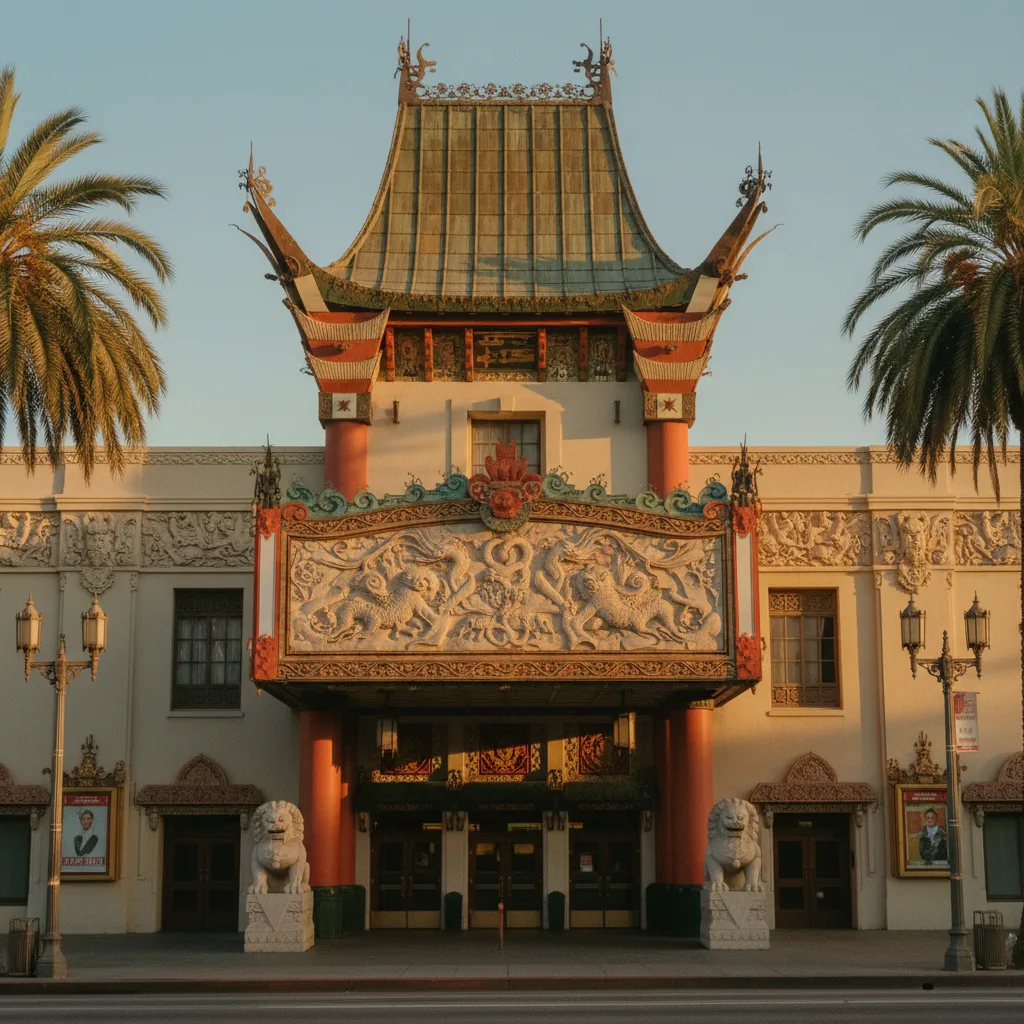
Begin your walking survey at 6925 Hollywood Boulevard with TCL Chinese Theatre, historically known as Grauman's Chinese Theatre. Conceived by showman Sid Grauman and designed by the architectural firm Meyer & Holler, this world-famous cinema palace opened in May 1927. The exterior represents a monumental expression of Exotic Revival architecture, combining authentic Chinese decorative arts with Hollywood theatrical exaggeration.
Stand within the forecourt to study the building's exterior centerpiece: a soaring ninety-foot bronze-colored pagoda roof supported by two massive coral-red octagonal concrete columns topped by wrought-iron masks. Guarding the ceremonial entrance are two authentic stone Heaven Dogs sculpted in China during the Ming Dynasty, imported specifically by Grauman. Walk across the famous concrete forecourt to observe how the custom terrazzo pavers and historic star handprints are framed by deeply incised plaster dragon reliefs and copper roof cornices.
Pharaonic Splendor at the Historic Egyptian Theatre
Stroll two blocks eastward to 6712 Hollywood Boulevard to visit the Egyptian Theatre, opened in October 1922 as Sid Grauman's very first Hollywood showplace and the site of the world's first formal Hollywood movie premiere. Also designed by Meyer & Holler, the theater was originally planned as a Hispanic courtyard until the sensational 1922 discovery of King Tutankhamun's tomb inspired Grauman to adopt an exotic Egyptian Revival theme.
The theater's exterior is distinguished by an expansive open-air pedestrian entry court framed by monumental stone pylon gates that step back from the sidewalk. The stucco walls are adorned with colorful incised Egyptian hieroglyphs, lotus-bud column capitals, and carved scarab beetles that evoke the ancient temple complexes of Luxor and Karnak. Following an exemplary multi-year restoration, the forecourt's original palm trees, decorative plaster ceilings, and sandstone pavement look exactly as they did a century ago, demonstrating how outdoor courtyards welcomed evening cinema crowds.
Churrigueresque Richness at the El Capitan Theatre
Cross the boulevard to 6838 Hollywood Boulevard to examine the El Capitan Theatre, constructed in 1926 as a legitimate live playhouse by developer Charles E. Toberman and architect Stiles O. Clements of Morgan, Walls & Clements. The facade represents an exquisite example of Spanish Colonial Revival architecture, distinguished by intricate Churrigueresque cast-stone relief work framing the upper window arcades.
Unlike the exotic fantasies of the Egyptian and Chinese theaters, the El Capitan's facade connects directly to California's Spanish colonial heritage through dense Baroque scrollwork, carved cherubs, and stylized foliage surrounding the arched fenestrations. Contrast the delicate, pale cast-stone detailing of the upper office floors against the glowing neon marquee and polished brass ticket booth installed at street level during the theater's mid-century cinema conversions, illustrating the layering of theatrical eras along a single facade.
Spanish Colonial Majesty at the Hollywood Roosevelt Hotel
Proceed westward to 7000 Hollywood Boulevard, where the Hollywood Roosevelt Hotel has anchored the western end of the entertainment district since May 1927. Designed by architects Fisher, Curlett & Hoch and financed by a consortium including Douglas Fairbanks, Mary Pickford, and Louis B. Mayer, this twelve-story luxury hotel hosted the very first Academy Awards ceremony in its Blossom Ballroom in May 1929. The grand celebration gathered two hundred and seventy industry guests for an untelevised banquet dinner, forever establishing the Roosevelt as the physical cradle of modern cinema award history.
The building's exterior showcases refined Spanish Colonial Revival styling, characterized by smooth stucco walls, arched street-level colonnades, decorative wrought-iron window grilles, and a low-pitched red clay tile roof. The skyline is crowned by an iconic multi-story red neon sign that has served as a beacon for arriving motorists since the late 1920s. Step through the entrance archway to glimpse the grand two-story Spanish lobby, complete with hand-painted wood ceiling beams, decorative ceramic tiles, and wrought-iron chandeliers.
Art Deco Zigzag Triumph at the Pantages Theatre
To complete your architectural survey, take a short stroll or transit hop eastward along the boulevard to 6233 Hollywood Boulevard, home of the Hollywood Pantages Theatre. Completed in June 1930 and designed by architect B. Marcus Priteca, the Pantages stands as the absolute pinnacle of Art Deco movie palace design in the United States and the last grand theater constructed by vaudeville magnate Alexander Pantages. The palatial entertainment venue was engineered to accommodate both lavish stage spectacles and premier motion picture presentations, equipped with cutting-edge electrical switchboards and sophisticated acoustic plaster contours.
The exterior facade is a masterclass in Zigzag Moderne styling, featuring clean stepped vertical pylons, fluted stone panels, and geometric sunburst bas-reliefs that celebrate modern machine-age aesthetics. At dusk, the vast marquee illuminates the sidewalk with cascading patterns of neon and incandescent bulbs. The dramatic vertical composition demonstrated how architects shifted away from historical European revivals toward energetic, forward-looking contemporary design as the 1930s commenced, capping the boulevard's architectural golden age.
Practical Notes for Exploring Hollywood Boulevard
This Hollywood Boulevard walking route spans approximately one mile between the Roosevelt Hotel and the Pantages Theatre, following wide and completely flat public sidewalks. The most rewarding photographic light occurs in the mid-morning between 9:00 am and 11:30 am, when the sun strikes the south-facing facades of the Chinese and Roosevelt theaters, or in late twilight when the historic neon signs begin to glow. Pedestrian foot traffic is lively, so keep a relaxed pace.
The route is directly served by the Metro B Line, with stations conveniently positioned at Hollywood/Highland and Hollywood/Vine at either end of the walking tour. Crosswalks are clearly marked with pedestrian signals at every block. To discover interactive architectural maps, transit directions, and curated self-guided walking tours across historic Los Angeles districts, consult the Karpo APP.
Ask Karpo for more information.
Keep reading
- Los Feliz Nail Salon Walk In Finder for Broken Nail Repair
 Highland Park Nail Salon Walk In Finder for Retro Manicures
 Koreatown Nail Salon Walk In Finder for K-Beauty Nail Looks